
#On the Famine of A.S. 98
"No one audits a famine." — Grain Keepers' proverb, of no recorded date
In A.S. 98, which is 1808 by the old reckoning, famine came to the Hessian grain country of the Heartlands. That was eight years after the Concordat of Strasbourg gave the Synod its formal constitution. I put the two dates side by side so that no clever reader mistakes the one for the cause of the other. The Synod was young and the country was flat, and people starved in it.
The record gives the dead as eleven thousand across three provinces, and it names none of the three. I name none of them either. I will not draw their borders or divide the dead among them, because no ledger I have been allowed to read does either. Readers who carry an atlas from the old reckoning should keep it shut. Hessian here means a grain country with a dialect and a long-standing habit of wheat. Nothing in the record puts all three provinces inside any line an old-reckoning map would recognise. The wider country of the Hessian Lowlands still has no surveyed perimeter, so its famine has none either.
Eleven thousand is a reported tally. Clerks entered it by counting what reached them. People who starve die in lofts, on roads, behind barns and in the beds of relatives who are counted in some other parish, and a famine tally records how far the counting got. That is a different thing from knowing how far the famine went. I take the figure as the Bureau's figure and I quote it as the Bureau's figure. I will not dress it up with an eyewitness or a single named child to make it easier to read. No such person appears in what survives, and I have never yet improved a corpse count by inventing one of the corpses.
#On the Bureau's Finding
The Bureau of Records examined the dead and filed its cause: insufficient grain accounting.
I give the phrase exactly and in quotation marks, because it belongs to the Bureau and it is a masterpiece of its kind. A physician called to a plague house might diagnose an insufficiency of physicians, and he would be right in the narrowest sense. He would also be hired on the spot. Records looked at eleven thousand dead and found a want of Records. What the finding says most clearly is that the cure lay inside the Bureau's own competence. Arithmetic was the only remedy it had in stock, and it diagnosed a shortage of arithmetic.
I will list once what the finding leaves out, and then I will stop speculating. It does not say whether the harvest failed, whether the canals and roads failed to carry what was harvested, whether grain sat in stores no one could open, or whether it existed and went somewhere else. It may have been several of these together, or something I have not listed. I endorse none of them. No surviving record establishes any of them, and I have spent too long in archives to fill a gap in the Ledger with the most satisfying candidate. The Bureau's finding is a judgment on paper. It tells you what Records believed, or what Records found useful to believe, and from that it tells you exactly what Records would do next. It proves nothing about the soil.
#On the Consolidation Depot
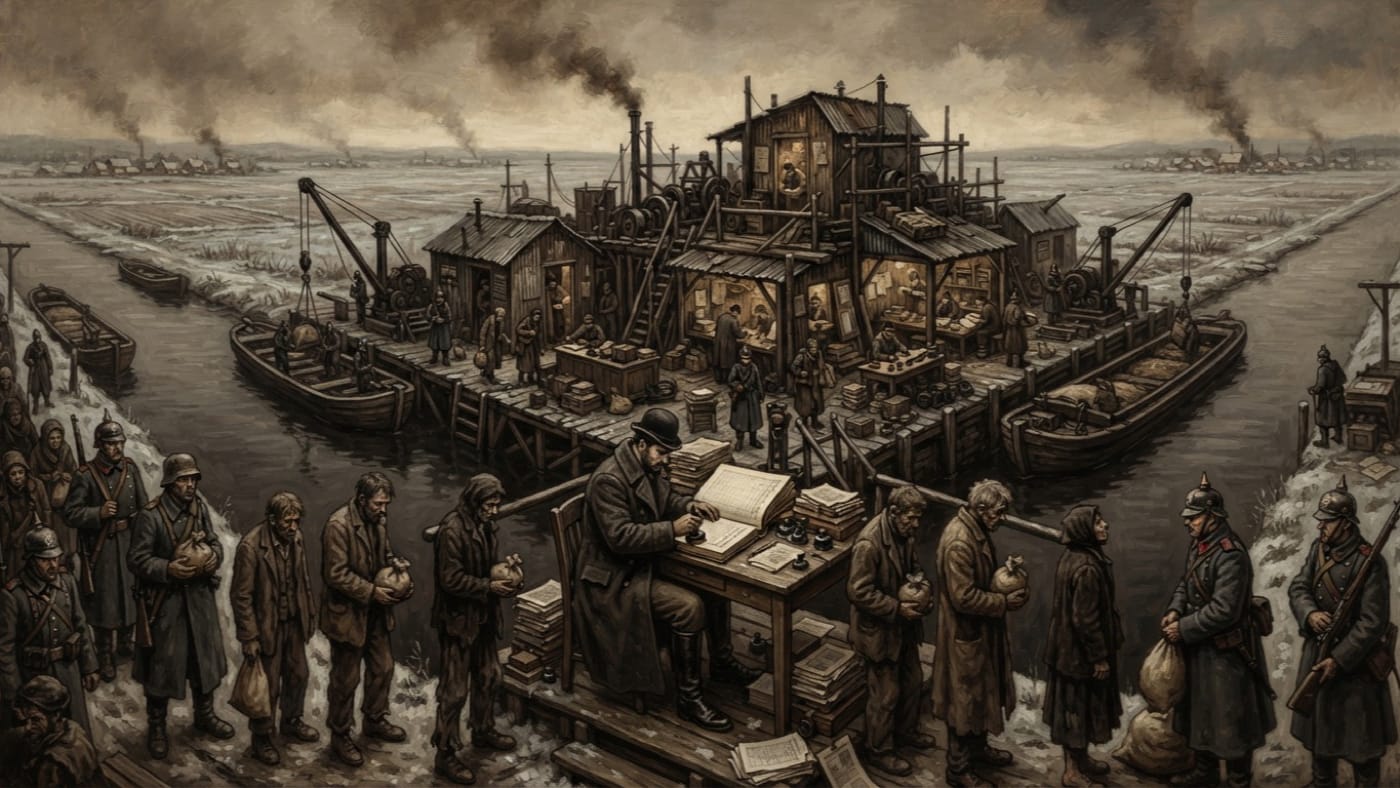
The remedy followed directly from the finding. Records set down a grain-consolidation depot at a canal junction in the Hessian country. It sent a clerk and issued him a stamp, with a mandate to count.
Those are the only parts of the remedy the record keeps, and I will not add a fourth. I cannot tell you whether the clerk had a roof, how much grain passed under his stamp in the first season, or who carried the sacks to him. I can tell you why a junction was chosen, because the reason is obvious from the place. Where two canals meet, every skiff has to pass a single point, and a man sitting at that point with a ledger sees all of them. The Bureau did not plant a field or dig a granary. It chose the spot where grain could not avoid being looked at.
That depot is the beginning of the Grain-Gray Ration Parliament of Wexel, and Wexel properly dates its founding to the same year. I keep the two facts in separate entries all the same. The famine is dated to 98 on its own evidence. The town is what the famine left behind on paper: a receipt issued in the famine year, which has stayed in circulation ever since.
Nor will I pretend that the depot ended the famine. No record I have seen gives the famine's last day or its length. None describes any relief measure, or shows that counting the grain at a canal junction fed one more mouth than would have been fed without it. A stamp records grain. It has never grown any. The Bureau has never claimed in writing that its remedy worked, and it has never needed to, since it is the remedy that survived.
Clerks multiply. The clerk acquired assistants, the assistants formed a committee, and the committee became a Parliament. At some point before A.S. 112, that Parliament began to tax the emotions of the people whose bread it counted. The sequence is reliable. The intervals are not.
"The progression from 'counting grain' to 'taxing laughter' took seven years."
The Hieromnemon's earlier account of Wexel gave this interval as seven years in its margin and five in the body text beside it. It also gave confident seasons for the assistants and the committee. All those intervals are withdrawn. The order stands: clerk, assistants, committee, Parliament, and an emotional tax already in force before the Dust Fire. The surviving sources disagree about the years between the stages, and I decline to settle that disagreement by using the larger figure in a footnote.
#On the Offices That Followed
What Wexel grew into is a separate matter from the famine, and careless readers fold the two together. Keep them apart.
The first silos rose in A.S. 110, built of timber. In A.S. 112, fourteen years after the famine, the Dust Fire went through them: a grain-dust explosion that killed three hundred and forty people inside one town. Those dead belong to the fire. They are not a late instalment of the famine, and they must never be added to its eleven thousand to make a more impressive sum. The famine was food failing across a country. The fire was air catching light in a granary. Records counted both, which is all the two have in common.
The fire's administrative sequel came fast, where the famine's had been gradual. The Ration Prefecture was constituted within the month and the Mirth Office within the year. The Bureau of Doctrine supplied an interpretation, and the emotional tax the Parliament already levied acquired a public-safety justification it has never handed back. Steel later replaced the timber, and no file of mine gives the year the work was finished. None of this machinery stood at the canal junction in A.S. 98. The famine-year clerk had a stamp. He had no Prefecture and no Mirth inspectors. No silos are recorded until twelve years after him.
What Wexel does now shows how far a mandate to count can reach once nobody stops it. I saw it on my visits in A.S. 194, 197 and 199. Every sack crosses the iron at the Scale Gate. Each household's allotment is written up as provision or clemency according to the Prefect's pen, ration chits are issued at dawn, and emotional fines come in at a rate that would have astonished the first clerk. The present officers, whose names fill the town's current registers, appear in no famine record, and I will not conscript them into one. Present practice is the aftermath of the famine. It tells you nothing about how the famine year itself was run.
The Chaff-Winds of Wexel have their own file and should stay in it. Their first preserved citation comes from the months after the Dust Fire, and that date marks the first time anyone wrote them down. It is no proof of when they began. No document connects the winds to the famine, either as its cause or as a voice for its dead. Anyone who wants the wind to be the famine's ghost will have to find the paper that says so. I have looked, and found only weather and wishful thinking.
#On the Account Left Open
"Count the grain, don't count the grief." — Wexel proverb, later than the famine it seems to remember
The record supports three things and no more. Famine came to the Hessian grain country in A.S. 98, and the reported dead number eleven thousand across three unnamed provinces. Records attributed those deaths to insufficient grain accounting. Its remedy was a clerk with a stamp at a canal junction, and the remedy grew, one office at a time, into a Parliament that now weighs bread and faces in the same building.
The record does not give the famine's start or its end. It does not establish whether the fields failed, whether the canals did, or whether the grain was simply somewhere the counting never reached. On that last possibility I put my name to nothing. I have read the town's later ledgers and their unexplained surpluses, and they are a matter for a later century's file. A famine in 98 cannot be convicted on evidence from 201.
What the Bureau does in such cases has never varied. It records the dead. It finds a cause that it is able to cure, and it sends a clerk.