
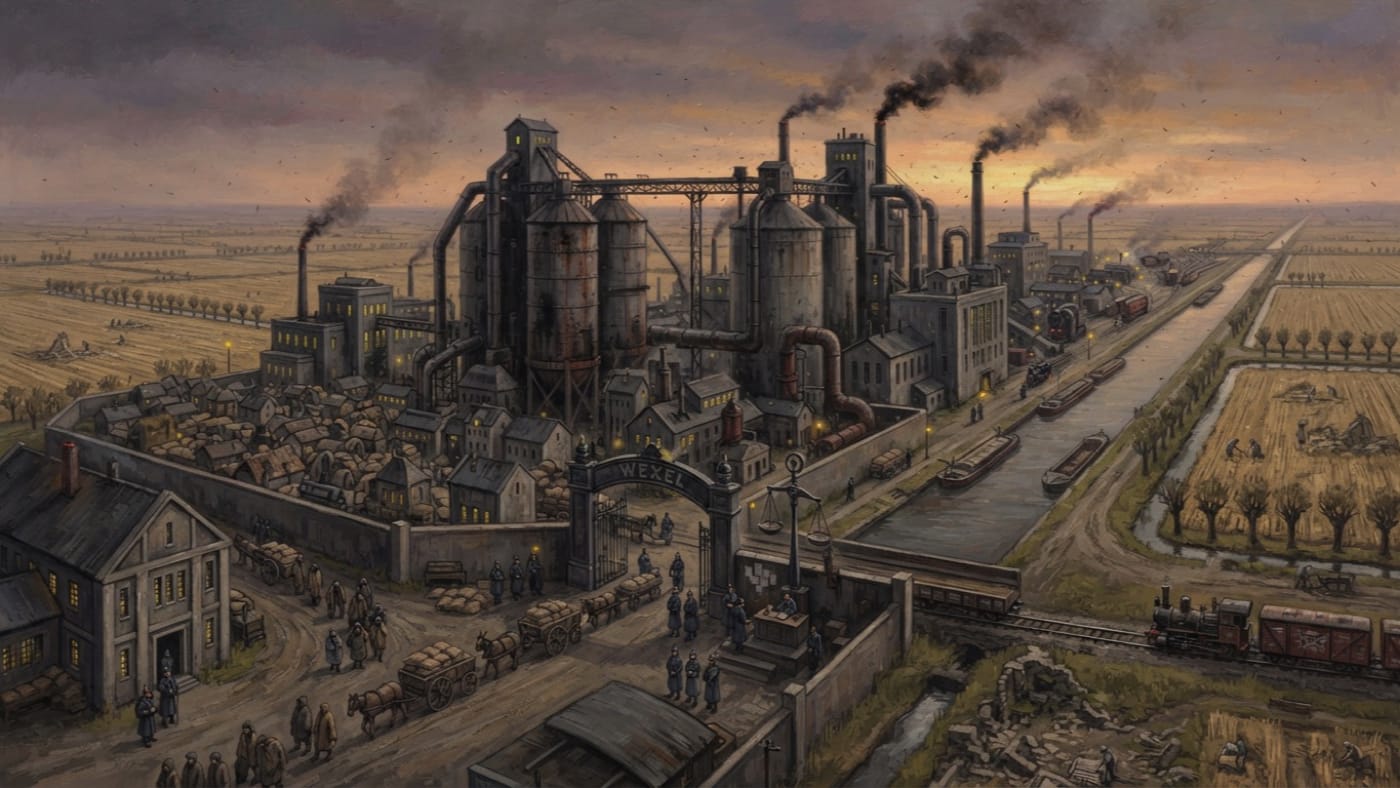
#On the Grain Country
"Bread with paperwork baked into it." — Line-soldiers' description of Wexel's issue
The Hessian Lowlands are flat. I put this first because every other fact about them follows from it. Flat country cannot hide a silo, a wagon, a column of smoke or a hungry man walking toward a gate, and the Bureau of Records has always loved country that offers no cover. The lowlands lie in the Heartlands, within Zone 2, west of the Sagittal Line and far enough behind it that the war arrives here as a requisition order, never as a sound.
Their edges have never been surveyed. I have looked. There is no filed perimeter, no measured area, no regional seat and no census of the province. The Bureau's registry places Wexel, the one lowland town it troubles to describe at length, somewhere near fifty and a half degrees north and nine and a half east. It then adds the word possibly, which the Bureau of Records uses about as often as it uses the word sorry. I take the coordinate for what it is: a pin marking one town. It does not fence a province.
The ground itself can be described. Grain plains run toward every horizon the wind comes from, which is all of them. Irrigation canals rule the fields into columns. Silo berms rise out of the level like the raised seal on a writ, and windbreak groves stand in planted lines, because somebody once understood that wind takes the topsoil before it takes anything else. Between them lie the old threshing ruins, floors of beaten stone and stumps of broken posts from before the Synod counted anything. Sheep use them now, and so do people who would rather not be seen meeting.
The wind does not stop. After harvest the fog lies low over the stubble with chaff suspended in it, fine as censer ash. A man who works the threshing season breathes in enough of the field to keep coughing it up until the frosts.
#On the Famine and Its Accounting
"No one audits a famine." — Grain Keepers' proverb
In A.S. 98, which is 1808 by the old reckoning and eight years after the Concordat of Strasbourg gave the Synod its formal constitution, famine came to the Hessian country. It is reported to have killed eleven thousand people across three provinces. The record does not name the three, so I will not name them either.
The Bureau of Records examined the dead and gave its finding: "insufficient grain accounting." I quote the phrase exactly because it is the Bureau's explanation, written in the Bureau's own hand, and it has the great merit of placing the cure inside the Bureau's own competence. The finding says nothing about whether the harvest failed, whether the roads failed, or whether the grain existed and simply went somewhere else. Its subject is arithmetic, so arithmetic is what the lowlands were given.
A grain consolidation depot was set down at a canal junction. A clerk arrived with a stamp. The depot became the Ration Parliament of Wexel, and Wexel became the place where the lowland harvest is gathered, weighed, entered and released, in that order and no other.
Careless readers fold the famine and the Dust Fire into one disaster. Keep them apart. The fire came fourteen years later, in A.S. 112 (1822): a grain-dust explosion among Wexel's silos that killed three hundred and forty. The famine was food failing across a whole country. The fire was air failing inside one town. Both were answered with offices. The Ration Prefecture was constituted within the month of the fire and the Mirth Office within the year, and both answer to Wexel's jurisdiction. Neither has ever been given a province.
#On the Movement of Bread
"Count the grain, don't count the grief." — Wexel proverb
Food in the lowlands is grown by one set of people and permitted by another.
The first set is large, filthy and indispensable. Farmers plough and reap by the bell, in the Heartlands manner, starting when the bells cry and stopping when they sigh. Mill hands feed the stones and come out white to the eyebrows. Sack carriers shoulder the burlap that the weavers make. Canal workers dredge the silt out of the cuts so the skiffs can float, standing thigh-deep in water that gives them fever in return. Handcarts, ration wagons, canal skiffs and runner children with sealed slips carry the harvest inward to Wexel. Every sack that goes in or out crosses the iron scales at the Scale Gate and is written down.
The second set is small, clean and also indispensable, as it will tell you. Records counts the grain, the households and the permissions. The Bureau of Doctrine interprets the conduct of the people being counted. The Bureau of Purity enforces against what Doctrine forbids. The Bureau of Tithes takes its share of the harvest and its share of the money. Not one of these four has ever lifted a sack, and every one of them decides where the sack goes.
What leaves through Wexel is grain, flour, ration chits issued to the nearby towns, and quota manuals offered to the wider Heartlands as a model of government. What comes in is salt, lamp oil, mill parts, medicine, ink and paper. The Queue Road reaches Wexel from the west. A rail spur runs to the Palatine Switchyard of Lorn, which the town reckons at a day by rail and two by wagon. I give these as the town's figures. I make no promise about the lowlands' weather, its axles or its audits. Grain goes to Lorn and tools come back. Beyond the switchyard, the flour joins the Heartlands bread trains and passes out of what any lowland ledger I have read can follow.
So a farmer who cut the wheat with his own arms can walk home past a full silo carrying an empty chit-book. The grain belongs to the lowlands. The permission to eat it belongs to Wexel.
#On the Town's Reach
"Hunger hears everything." — Wexel proverb
Every official of consequence in this country is an official of one town. Speaker Huld Bex presides over the Ration Parliament. Prefect Marwen Kile commands the Ration Prefecture. Sister-Lector Neme Varr directs the Mirth Office. The Scale Gate Authority keeps the iron. The register gives Wexel thirty-three thousand souls, plus a flux it does not count, which swells at the harvest audits when labour lines walk in from the fields. That is a town's census. Anyone who quotes it as the population of the lowlands deserves to be made to count the lowlands himself.
The town's reach is still long. It runs as far as the chit-book of every household whose bread passes through Wexel's issue. Kile decides how much grain a family receives and when it receives it, and also whether the entry reads provision or clemency. Provision is owed to you. Clemency is a debt you owe. Over years of patient reclassification he has moved most of Wexel from the first column into the second. A family that looks too comfortable at the Scale Gate may have its allotment cut for "suspect abundance." Counting Week follows the harvest, and it is Wexel's own season of audit and riot. Whether the farms outside its silo ring keep any comparable festival, the record does not say. I have not invented one for them.
"In Wexel no one is punished for emotion — only for fraud."
This sentence, long repeated about the town, is withdrawn. The Mirth Office fines emotion as a matter of course, and by Wexel's own municipal accounting its mirth-compliance fees make up eleven percent of the town's revenue. The figure is municipal. The lowland farms are not assessed for their faces. The Bureau regrets that this is the most generous thing it can say about them.
Below the issue there is another economy, as there is below every issue. Wexel's cellar networks deal in hidden grain, forged chits and lamp oil, along with the town's peculiar contraband in jokes. The wider profession of the Grain Keeper does this work in other places, and its methods are a matter of record: skim a little and often, hide in several caches and never in one hoard, falsify the spoilage, launder grain into bread and bread into alms, and burn the old chits. Whether the lowland farms have Keepers of their own, no ledger I have seen will say. That is exactly what a well-kept cache would arrange.
#On the Wind and the Unclosed Account
"If the wind laughs first, don't answer with yours." — Wexel superstition
The lowlands have plenty of ordinary dangers. Grain dust explodes, as Wexel learned in 112. Mould blights the stores. Rats swarm the berms. The canals flood and the sick die of canal fever. Threshers and mill hands get the dust lung. Winter hunger comes every year, whatever the silos hold. None of these needs a demon to explain it, and the Bureau of Doctrine has the decency, for once, not to supply one.
Wexel itself reports something more. Its chaff-winds are said to repeat laughter after the laugher has stopped, to rearrange read-out quotas into something like questions, and to leave the ink in citation ledgers drying in loops shaped like smiles. The Bureau files this as a Category One Localized Atmospheric-Acoustic Disturbance. Localized is the word that matters here. Nobody has proved what causes it or shown that it thinks. No surveyor has followed the wind out over the stubble to see whether it says anything once it has left the silo ring. I have stood in a lowland field at dusk with the chaff coming at me sideways and heard only weather. I recorded it as weather.
There remains the account. Wexel takes in more grain than Wexel eats. The surplus is real and it is counted, and no published ledger says where it goes. Officials in the town hint, and insinuation travels well through flat country. I put my seal to grain I can weigh. I will not put it to a mouth I have not seen.