
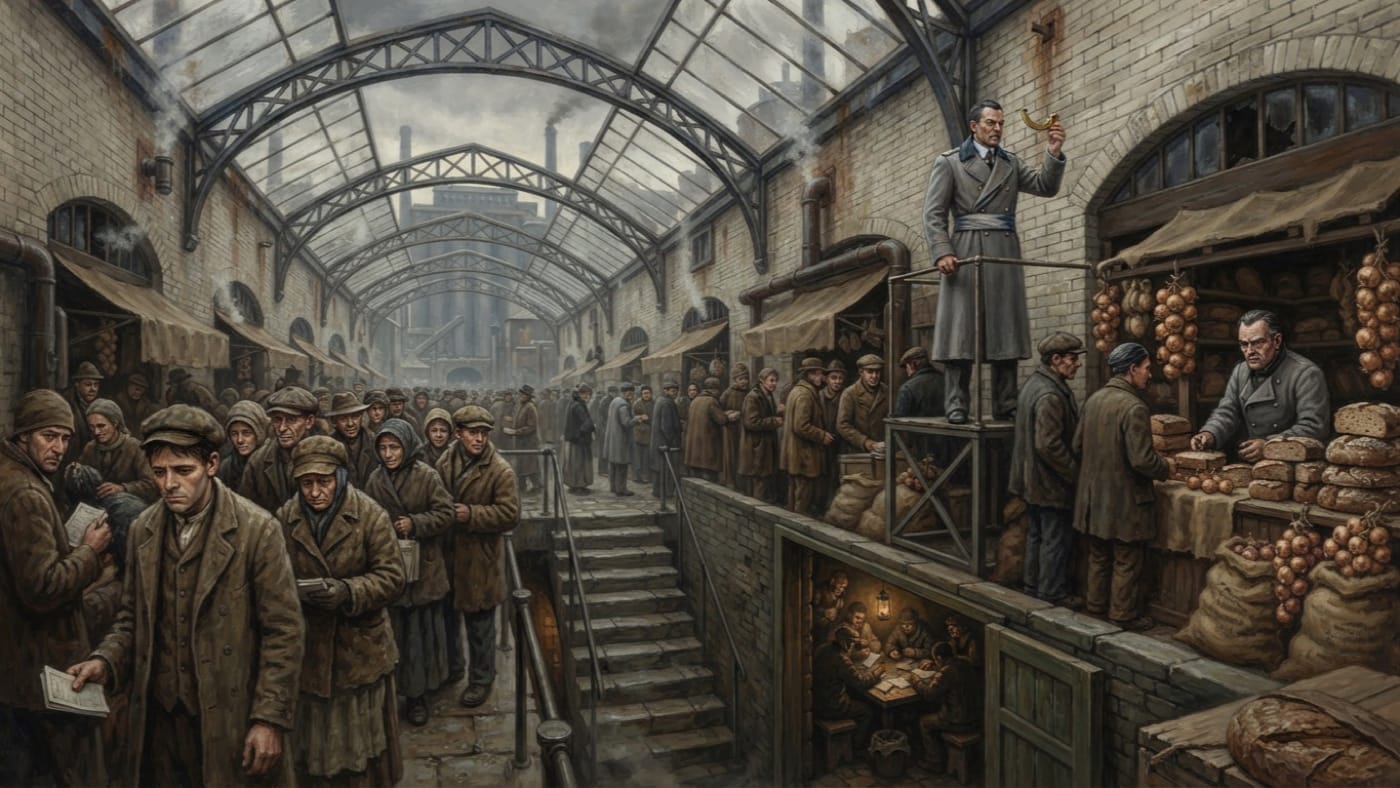
#On the Exchange
"A smile is a receipt." — Wexel proverb
Chit Market is the district of Wexel where food meets paper, and a third party in a grey sash supervises the introduction. Its exchange is the Chit Market Arcade, a covered run of pale brick and salvaged glass along one of the town's market spines, within sight of the silo ring and well within its hearing. The district smells of onions and burlap. The surveyors of the Ration Parliament put a third note in the register, and the Ration Prefecture has never managed to have it struck out: fear.
Burlap sacks slump against the stall posts like penitents who have stopped expecting absolution. Onions hang in braids. Coarse bread waits under cloth, and the cloth comes up only for a buyer whose book is already open. Grain dust settles on everything, the customers included. They stand with chins lowered and mouths arranged, as the law requires.
Wexel was founded in A.S. 98, after a Hessian famine killed eleven thousand, and it has kept that lesson with a convert's diligence. Records holds the town's date and will not lend it to the market. Nobody recorded when the arcade first traded. A market without a birthday seems to have always been there, and that is the impression the Prefecture prefers.
#On Paper Fit to Eat
Wexel pays in five currencies and trusts none of them: ration chits, stamped paper, oath-notes (promises under seal), labour-hours (promises with a body attached), and coin. Coin is secondary and slightly embarrassed, like a layman who has wandered into a synod.
Wealth here is plainer. It means calories, clean chits, storage that no inspector has measured, and above all a household ledger without a mark in it. A family can own a sack of flour and still have no lawful way to eat it if the book does not say so. The grain that exists and the grain a household may obtain are governed by separate doctrines and kept by separate clerks, and only one of the two has ever filled a stomach.
A child receives a first ration book at twelve. At the Chit Anointing its pages are sealed with tallow-wax, a solemn rite that smells like a snuffed candle. The book comes to the arcade held in both hands. Two-handed presentation is the courtesy of the place: chit flat, book open, fingers clear of the stamp so the clerk can see that nothing is covered. One hand implies haste. Haste implies appetite. In Wexel, appetite is an opinion, and opinions are cited.
The people across the counter are the Chit Traders, the third of the town's six social layers. Above them sit the Ledger Clean, meaning the clerks and inspectors, and the Grain Holders who own the farms and mills. Below them are the Canalback Poor, the Ash-Fined, and the Erased-but-Used, who do the night work that no ledger admits to. A Chit Trader has a stall, a stamp-pad, and exactly enough height to see the Parliament's chalkboards over the canal rot. The trade is respectable. The traders are watched anyway.
I could obtain no tariff for the arcade, and I am a man to whom tariffs are usually surrendered. Whether a chit buys a loaf, a braid of onions, or a reprimand is decided at the counter, in front of the gauge.
#On Measured Faces
The Ration Parliament sits every day to vote quotas. At midday, while it sits, the Mirth Office walks the markets. Its inspectors wear grey sashes and carry curved smile gauges, small brass rulers bent to the shape of an acceptable mouth. They stop where the arcade's queues are longest. They do not have to measure everyone. Once a gauge leaves a pocket, forty faces correct themselves at once.
The approved expression is the measured smile, and citizens practise it in mirrors with the devotion other towns give to their responses at Vespers. Ask a local "How's your mouth today?" and the answer is a number, and the right number is two. At three, a face in front of a bread stall reads as greed. At one, it reads as ingratitude for the portion. At zero it reads as grief, and on a market day grief reads as accusation.
Three officers own different parts of the consequence. Sister-Lector Neme Varr directs the Mirth Office, and her inspectors write the mark. Prefect Marwen Kile controls household allotments, so a mark in Varr's book becomes a reduction in Kile's. Speaker Huld Bex keeps the audit name lists, and a household that collects enough marks finds its name rising on one of them. None of the three keeps an office in the arcade. They do not need one. The arcade is where their ledgers come to do the shopping.
Debt brings ration reductions, labour obligations, foreclosure, and the device Wexel calls name substitution. A trader with a mark against the stall may offer another name "for review," and sometimes the mark lifts. Silence can be bought for particular accounts and particular offences. A clean audit clearance cannot be bought at any price, which is the only honest line in the Parliament's catalogue. Everyone who has paid in a name eventually learns what it means.
"No one is punished for emotion—only for fraud." — the town's standing answer to outside enquiry.
Incorrect. The Mirth Office cites unlicensed mirth and unearned joy at the stall, and those citations cut household allotments with no finding of fraud. The Prefecture has been advised to amend the answer to "No one is punished for emotion without proper documentation." The Bureau of Records welcomes the gain in accuracy.
#On the Bread Stall and the Cellars
Pickpockets work the arcade, as they work any crowd that the law keeps looking at the ground. A child in the queue who has learned the measured smile has also learned that nobody studies a measured smile closely, and a chit lifted from a coat is someone's supper. The Prefecture records these thefts as ration fraud. The victims record them as the end of the week.
A counterfeit ring operates beneath one of the arcade's bread stalls. I state it plainly because Wexel will not. Counterfeit ration chits are one of the town's red lines, along with publicly inciting unlawful laughter and burning a silo ledger vault, and the penalty is ruin. The ring continues anyway. The record does not say who keeps the stall, who runs the ring, how the paper is made, or how long it has been made, and I will not improvise answers. The Bureau already has enough fiction in its fee schedules. The street describes the forger's ambition in one line: paper that smells like honest bread.
The forger's ink is ordinary ink. No counterfeit chit has been reported smiling, rewriting itself, or eating its neighbours. The smiling ledgers of Wexel belong to the Mirth Office and the Chaff-Winds. The appetite of Hungry Ink belongs to another docket entirely.
At curfew the arcade goes dark in stages. Lanterns are fixed to the ration posts. Patrols begin their smile loops, routes that bring an inspector past every lit door twice before the hour bell. Trade stops above ground and moves below it. Wexel's markets go down into the cellars, and the stock changes with the altitude: hidden grain, forged chits, mirth scripts, arson insurance. One item is missing downstairs, and it is the same item missing upstairs. Audit immunity has no cellar.
The cellars also hold the Cellar Circles, called the Quiet Mirth, who keep jokes, coded proverbs, and mutual aid alive under the houses and out through Canalback. Their knock on a door is a laugh-tap. Nothing in the record connects them to the counterfeit ring. The inspectors find that distinction tiresome, since every cellar looks like every other and a joke sheet and a forged chit are both paper. Doctrine prefers the confusion, because a heresy network that is also a criminal enterprise needs only one warrant.
#On Laughter Leaving the Market
The published account of the Chaff-Winds of Wexel records one incident from this district. A child at Chit Market suppressed a snort, and the snort did not stay suppressed. It came out somewhere else, from the Scale Gate chain, as a bright metallic titter. The child is unnamed and the day is unrecorded. The inspectors at the Scale Gate heard a chain laugh and had no one to cite.
The Bureau of Rites classifies the winds as a Category One atmospheric-acoustic disturbance. That account holds that they carry genuine amusement farther than physics should allow, and that nothing licensed or rehearsed travels with them. The Mirth Office has not commented on why its own approved smiles never leave the room.
For the arcade, this is a disaster of method. Its whole economy rests on the claim that a face can be audited: chin lowered, mouth at two, both hands out, gauge in view. The child did everything right, and the face held. The amusement simply left by another road, went farther than any throat could send it, and arrived where no ledger could trace it. Doctrine has not ruled on whether the wind intends anything, and I will not rule ahead of Doctrine. I record only this: the Mirth Office can discipline a mouth, and it has no instrument for whatever the mouth was holding back.
#On the Present Exchange
In A.S. 201 the arcade trades as it always has. The weighline opens at dawn and the chits are issued. By midday the queues stretch under the glass and the sashes come down the spine. After harvest the Counting Week audit swells the town, every book is read twice, and the pressure reaches the counter before the clerks do. The bread stall sells bread, and some of it may even be bread. The onions hang. The traders keep their stamps dry and their mouths at two.
The Parliament describes its town as a place of equitable distribution and spiritual discipline, and the arcade is where that description is redeemed against a chit. I have inspected the arcade. I certify that distribution takes place, that discipline is applied, and that the seam between them is sealed in tallow-wax.