
#On the Office
"The procession is a prayer that requires a route."
Somebody has to decide where the float turns.
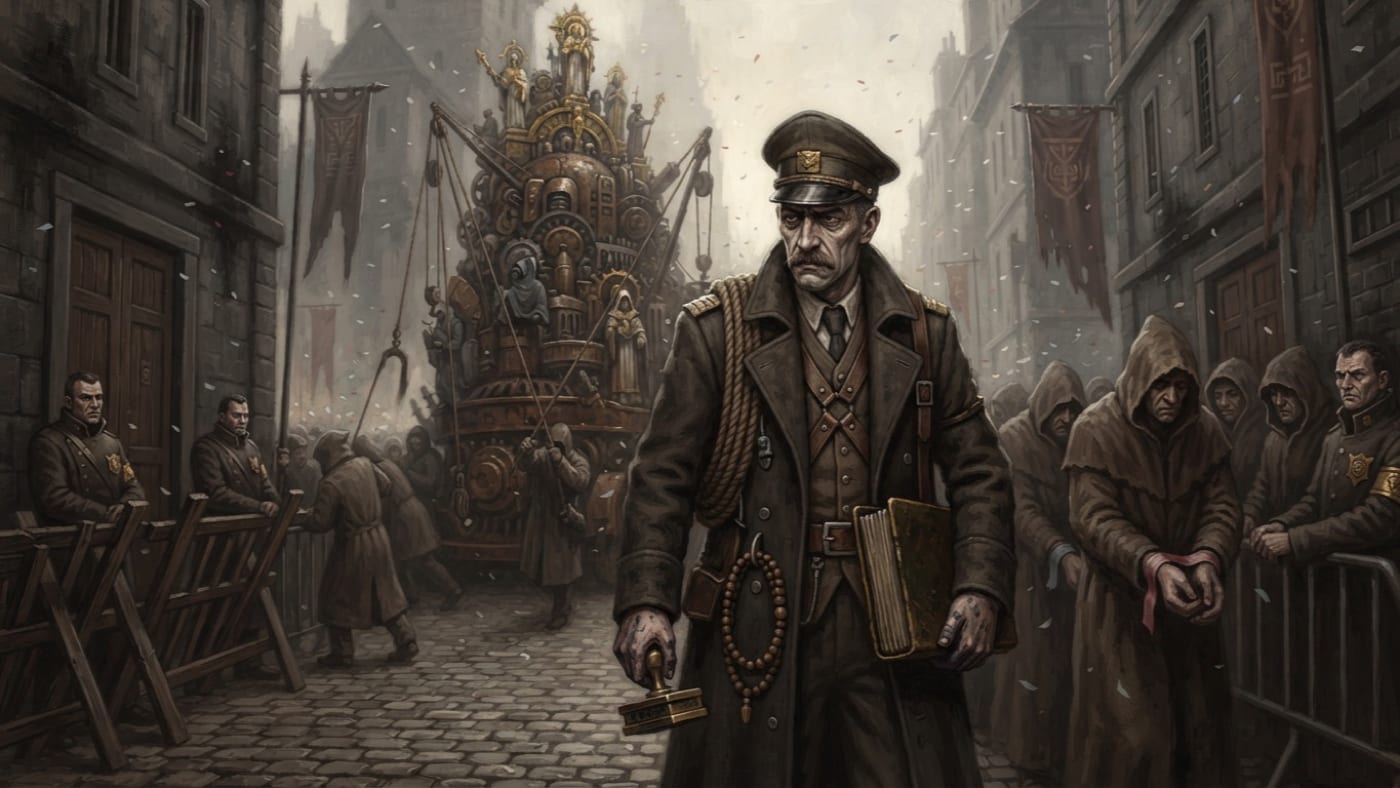
The Bureau of Festivals keeps three principal kinds of officer in the field, and the faithful confuse them constantly. The Chorus-Master decides what the crowd sings, when it weeps and the exact second at which it must stop. The Attendance Auditor decides what the crowd's face was worth. The Pageant Captain decides where the crowd stands while both of these things are done to it. The Bureau's own description calls the Captain half-director and half-auditor. That officer handles the physical execution of processions, floats and outdoor ceremonies, which in practice means crowd flow, barricade placement, float routing and the distribution of confetti.
The Chorus-Master has the Conservatory, the hymnals and the reputation. The Captain has rope.
No surviving paper records the appointment of the first Pageant Captain. Festival governance entered Augustinus's Charter of Prescribed Observance in A.S. 58 (1768 CE), and the Bureau received its seal in A.S. 72 (1782 CE). After that, the office appears in the Bureau's correspondence as though it had always existed. Offices that carry rope usually turn up that way.
Earlier editions of this Codex stated that organised festival administration began in the years following the Concordat of Strasbourg.
Festival governance was written into the Charter of Prescribed Observance in A.S. 58, and the Bureau's seal dates from A.S. 72. Both belong to the Church's developing administration. The Concordat of A.S. 90 is the later constitutional settlement of the formal Synod, and it found the Bureau already working, already underfunded and already quarrelling with the Bells.
The overlaps need to be stated plainly, because every one of them has generated a jurisdictional complaint. Captains keep manifests and make counting possible, but the Joy Compliance Index belongs to the Auditors, who do not take orders from a man holding a coil of barricade rope. Procession Marshals are a neighbouring trade that deals with cadence, columns, queues, crossings and dispersal. The Codex knows of no universal precedence between Marshal and Captain. Each city settles it locally, and usually loudly.
#On the Route
"Keep the route breathing."
A sanctioned celebration begins a week before anyone celebrates. The Captain walks the route with chalk and marks the curbs where floats will halt, where barricades will stand and where the street narrows enough to kill someone. Float wheels are greased. Axles are inspected, because a relic-float that loses a wheel on a gradient will take a saint and a dozen spectators downhill together. Rehearsal follows. The Chorus-Master's cues are laid against the route so that the float stops where the refrain swells and moves on before the refrain ends, and the crowd never has a reason to stand still once the music has stopped.
Escorts are briefed on the choke points. The faithful see none of this, and they are meant to see none of it.
I will not pretend the work is trivial because its purpose is coercive. A plaza holding three thousand people with one usable exit is an artillery problem. In the pilgrim quarter of Bastion-Przemyśl, a crowd demanded an unsanctioned encore and was refused, and the crush that followed killed dozens. The Chorus-Masters remember the Riot of the Third Encore as a lesson about desire. The Captains remember it as a lesson about gates: which way they opened, who stood behind them and how long it took the pressure from the back of the crowd to reach the bodies at the front.
At its largest the office becomes military logistics in a festival hat. The Procession of the Triune Hearth runs for forty days through eleven cities, from Strasbourg to the Pilgrim's Gate of Bastion-Constantinople, with four thousand participants and ninety-seven floats. Each city's Captains receive the column at their gate, move it across their streets and hand it to the next city's officers. When the column arrives, the next city expects to count the same number of floats that left the last one.
#On the Instruments
"Joy leaves a trace."
A Captain's issued kit has four items. The manifest ledger lists every float, troupe, barricade and licensed participant, with columns for arrival and departure. The crowd-counting beads are strung on cord and thumbed in sets, and the faithful mistake them for a rosary often enough that the Captains have stopped correcting anyone. The stamping iron is for permit violations: a stall set up outside its licence, a banner without its seal, a troupe performing a verse that was not in the script. The fourth item is the whistle.
The whistle is tuned to the Bureau of Bells' curfew signal. The Bureau of Festivals claims that it can clear a plaza in eleven seconds. I have heard it demonstrated in the Cathedral square at Strasbourg, and the plaza did clear. I cannot certify the eleven seconds, because I was one of the people leaving.
The confetti is where the office earns its notoriety. It is licensed by weight and issued by weight. The faithful throw it, the sweepers gather it, and the Captain weighs it again. A shortfall means paper has been diverted to unofficial celebrations: a wedding in a back court, a child's name-day, a tavern that heard the music and drew its own conclusions. The Captain enters the difference in the manifest. Wind, rain, pigeons and children's pockets are all recognised causes of loss under the Bureau's tables, and each one requires its own form.
#On the Receipt Procession
"All gifts require witness."
The specialty that has earned the office its fear is the Receipt-Procession Pageant Captain. The formal title is Processional Comptroller. On the street the same officer is Parade-Master or Receipt King to anyone being polite, and Joy-Taxer or Glitter Rat to everyone else. The public doctrine is that processions teach gratitude and receipts honour provision. Attendance at mandated observances is not voluntary, so the gratitude on display has been arranged in advance.
The work follows a fixed order. First comes route design, and in the receipt houses route design means deciding who will be forced to be seen. An alley mouth can be watched, closed or left open, and a skilled Captain knows what each choice will drive into the light. Ribbon Runners then issue the wrist-ribbons. Each is stamped and punched to mark a body as present, accounted for and fed. At the curb tally, faces are matched to the parish roll and wrists are checked against ration marks. This happens during the floats, the music and the gratitude pauses, when the crowd leans forward to look at a painted saint and holds out its wrists without thinking.
Exceptions come next. These are names missing from the roll, wrong stamps, forged ribbons, and a man who is clapping on a ribbon issued to his dead brother. The lost-child tent at the edge of the route deals with some of these exceptions, and lost children are not what it deals with. Reconciliation comes on the same night. The tallies are totalled, set against the rolls, and the anomaly list is sealed in red wax for the Bureau of Records. Through the Records office the list reaches the Great Ledger, and from there whichever Bureau wants it.
Nowhere is it written that a receipt procession is a census. The officers who conduct one are protected by the fact that no document says so.
Below the Captain in the receipt houses stand Confetti Cutters, Ribbon Runners, Route Marshals, Drum-Coders and Float Wardens. That is the local ladder of a specialist trade, and it is not a constitution for the whole office. The specialty's patron is Saint Caldrin the Jubilant Scribe, painted smiling, with hands black to the wrist in ink. His image hangs above ribbon stations. He is the patron of these receipt-keepers and of nothing larger.
#On Liability
"Don't wake the Judge."
The Captain answers to too many people at once. The crowd needs to move. The Auditors need clean totals. The Bureau of Purity wants anomalies, and the more of them the better. The Bureau of Tithes wants the cost per float reduced. These demands contradict each other at the curb. A tally station placed in a narrow street slows the crowd, and a slowed crowd presses forward. The officer who counts most thoroughly creates the conditions for the next Przemyśl.
Every crowd can turn into the precedent its Captain fears most. Seville in A.S. 153 / 1863 CE is the Bureau's nightmare. Lyon in A.S. 170 / 1880 CE is its permanent reorganisation. After the Tumults of Lyon, carnival masks were outlawed in three provinces, and in those three the curb tally runs faster because every face along the route has to be shown.
Money moves along the route as well. Shopkeepers pay for front-row placement. Ribbon forgers set up shop wherever paper allotments run short. Inspectors are paid to admire the floats and move on. The Lantern Brotherhood escorts at the choke points are tolerated and can be dismissed by any district, and their help is paid for in favours that come back to be collected later. A Captain under pressure from above adjusts the quota and sacrifices a Ribbon Runner, or a troupe, or a stranger who can be called a foreign agitator.
The worst corruption sits inside the office's most ridiculous procedure. A confetti weighing records how much paper came back. It cannot show what that paper used to be. A form recording a miscount, an unrecorded detention or a bribe can be shredded and thrown over a feast-day crowd, and it will return to the scales as properly reconciled confetti. Captains call this confetti laundering. The Bureau calls it destruction of evidence, when it can prove it, and it rarely can.
The route can be used in the other direction too. Captains have left an alley open on purpose so that a family could walk out under the drums, and floats have carried cargo that no manifest listed. A minority of compromised officers do this. The corps as a body serves the Bureau. That is the strongest statement I will certify on the matter.
#On the Present Employment
"Receipt is remembrance."
In A.S. 201 the office does what nobody else in the Holy Bureaus can do. It takes ninety-seven floats across eleven cities, empties a plaza without loss of life on most occasions, and returns a manifest that balances. The Bureau of Doctrine supplies the meaning, the Chorus-Masters supply the music and the Auditors supply the score. The Captains supply the street, and the Captains' signatures are on every anomaly list that leaves it.
The profession has its own illness, and its officers call it joy rot. The veteran stands in a cheering crowd, counts the claps without meaning to, and finds that celebration no longer registers unless it can be counted. No Bureau has issued a remedy for it. Most of the Bureaus would like to know how the Captains acquired it so quickly.
I asked a senior Captain at Strasbourg, after the Feast of Saint Rupert, whether the day had been a good one. The answer was a weight in kilograms, and the paper had balanced to the gram.