
#On the Procession
"Let the dead keep their station."
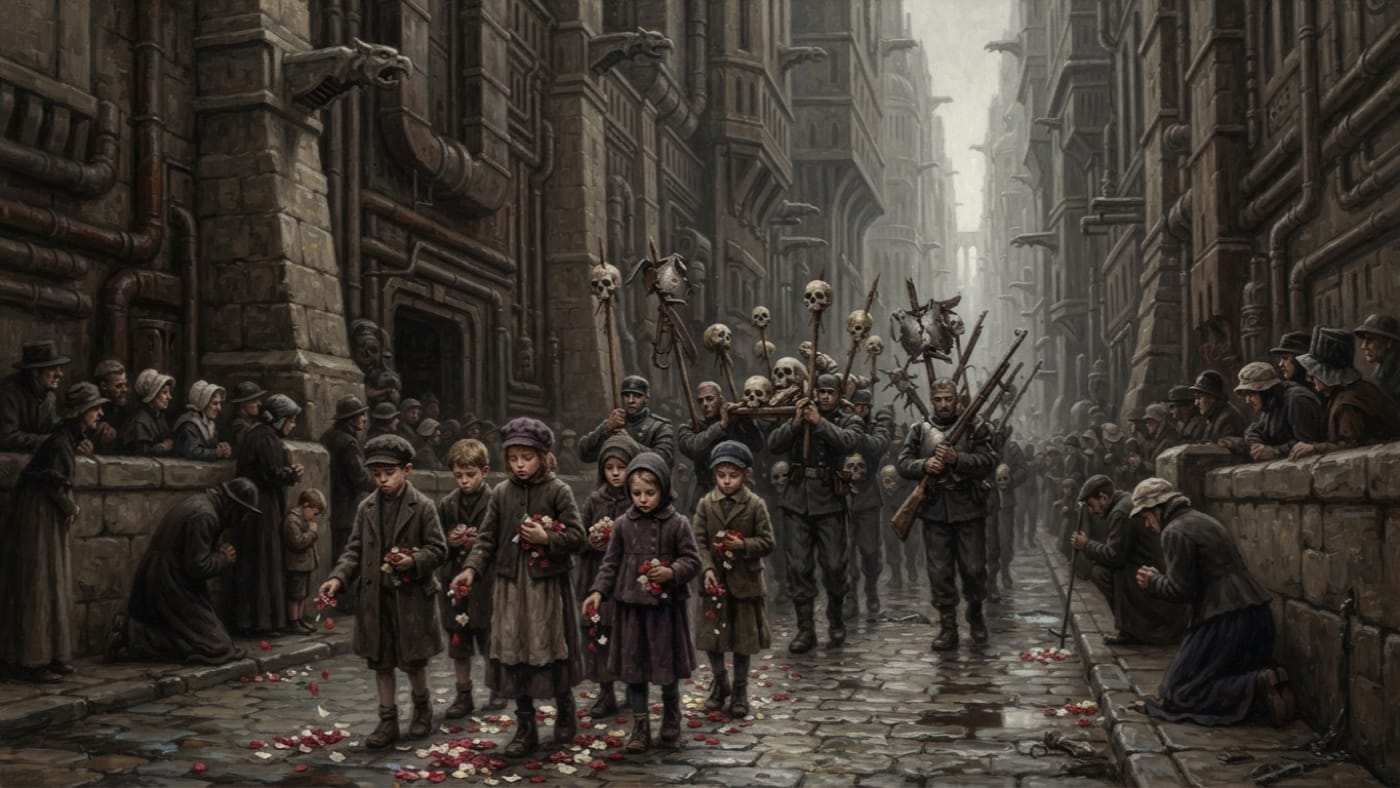
The children come first. They walk a short way ahead of the column, each holding a fistful of petals, and they drop them onto the bastion stones in front of what follows. Behind them come the remains, all carried by hand. There are skulls. There are breastplates opened by shot and blade. There are the iron remnants of consecrated weaponry: a blessed edge snapped at the tang, a barrel split along its seam, a pike-head whose prayer-engraving has worn down to a scratch. All of it moves at the pace of a funeral that no longer remembers whose funeral it was.
This is the Parade of the Bones, a municipal observance of the bastion cities that hold the Sagittal Line from Königsberg in the north to Constantinople in the south. The Bureau of Festivals administers it under that Bureau's mandate over sanctioned celebration, mourning and public remembrance. Its material is military and its petals are civilian. The column works because neither half can be taken away. Without the petals it would be an armoury inventory carried through the street. Without the bones it would be a flower show.
I have found no record of the first Parade, of its founder, or of the day on which it is meant to fall. The Bureau has never thought the question worth answering. A procession that has always existed needs no anniversary, and an observance with no anniversary can never be accused of having lapsed.
#On the Service of the Fallen
"Death is the final oath of loyalty."
The doctrine is no secret. In the Church's teaching, death closes the contract of a life spent in the Creator's service, and the service continues afterward. The faithful are carried to the Pyres of Benediction. Their ash goes into mortar and onto the fields, and a rare portion goes into reliquary icons, so the dead keep working after the living have stopped weeping. Every departure is written into the Book of Departures. To fall in battle, the catechism says, is to wear a crown.
The Parade takes that crown and puts it on the street.
I set the general rite of ash beside this procession of bone on purpose, and I leave the two unreconciled. The doctrine of departures says nothing on certain questions. How does a soldier's skull come to be carried rather than burned? By whose leave, under which register, and to what shelf does it return afterward? The Bureau of Festivals has published nothing on them that I have been able to obtain. I decline to invent the paperwork. Someone in this Synod will invent it soon enough, and will be promoted for it.
What the Bureau does publish is its verdict on the result. By its own accounting, which I share, the Parade costs less per mile of street than any other morale operation it runs. The reasons are easy to find. The dead draw no wage and need no ration, billet or script. They do not object to being displayed, and they file no grievances. At almost no cost, a garrison that watches its fallen pass under petals is shown that the Bureau of War keeps faith with the men it spends.
The demonstration may even be true. It is certainly cheap.
#On the Ordering of the Living
"One chorus, one creed."
The dead are the easy part, since they keep formation without drill. The trouble is everyone else. Bearers may stumble. Onlookers may weep too long, or not at all. Children may forget what the petals are for.
For the living the Bureau has its ordinary apparatus, and the Parade borrows from it as any sanctioned observance does. A licensed Chorus-Master is responsible for the approved performance: the vetted line, the sanctioned harmony, and the cue bell that tells a crowd when to kneel and when to fall silent. A Pageant Captain is responsible for the column itself: its route, the barricades, and the movement of bodies through streets built for gun-carriages rather than grief. An Attendance Auditor is responsible for what the crowd does, and records it on a slate. In the Bureau's view, a feeling that has not been written down has not, technically, been felt.
Hymns and head-counts differ from city to city, and I seal neither. The method is the same in every bastion. The living are given a script so that the dead may appear to speak.
Then there are the children.
They are the one part of the Parade that cannot be audited into meaning, though the Bureau tries. A child holding petals in a closed fist has been told what to do and very little about why. They walk ahead of skulls, and some of them look back. Those who look back see the empty eye sockets coming on behind them at the bearers' pace. Without a single line of catechism, they learn what the street thinks is worth carrying. Those who never look back watch the petals land. That is also instruction, and a gentler kind.
This reading of the spectacle is mine, and I mark it as mine. The Bureau has issued no ordinance calling the Parade a lesson in service, because it has never needed one. A city that sends its children ahead of its dead has already said everything such an ordinance would say, and has said it with flowers.
#On the Authentication of Bones
"Provenance is purity."
The Bureau of Relics objects. According to the account of the Bureau of Festivals entered in this Codex, it objects every year that the Parade displays un-notarised skeletal material without proper authentication writs. Every year Festivals replies that the dead do not care. The same account says the dispute is entering its ninth decade. I reproduce the attribution and leave its arithmetic alone.
Two different acts are in question, and both Bureaus prefer to blur them. Carrying a soldier's skull through a street is an act of remembrance, warranted by grief, custom and the calendar. Declaring an object sacred is an act of notarisation, and it follows a set sequence. A Relic Authenticator places the object in quarantine and reconstructs its chain of custody. The Authenticator examines it under lamp and tincture and tests whether it fits doctrine and how it responds to the ward. Then the Authenticator drafts a verdict, presses the seal and enters the object in the registry. Remembrance produces a mourners' procession. Notarisation produces a Sanctity Writ, and the Writ gives the object value: in pilgrimage, in indulgence and in the defence of walls.
Relics understands why the difference matters, even when it is being insufferable about it. Once an unstamped object is displayed with honour in public, the crowd treats it as a relic whatever any Bureau intended. Under the Church's law, counterfeiting a relic is the blackest of crimes and is punished by fire, because a false miracle poisons faith. A contaminated object may be worse than a false one. Authenticators exist partly to sell sanctity and partly to stop a sealed box from opening a wall to the Great Deceiver. Both halves of the profession are real.
Festivals answers with an efficiency I am bound to admire. It never calls the remains relics. It calls them the fallen, and the fallen need no Writ to be grieved. The petals, the cue bell and the bearers' pace do the rest, and the crowd kneels to something the paperwork carefully declines to name. The Bureau gets a relic's reverence for the price of a funeral. Relics gets its annual letter.
The remains carried in the Parade of the Bones are authenticated relics of the soldier-saints of the Line.
Withdrawn as drafted. The documented account describes relics of fallen soldiers, namely skulls, shattered armour and the iron remnants of consecrated weaponry. It also records the Bureau of Relics' standing objection that the skeletal material lacks authentication writs. It establishes no canonisation of the soldiers and no writ for the bones. Whether any particular object in any column has passed notarisation is a matter for that object and its ledger. This office declines to certify by adjective what the Bureau of Relics has not certified by seal.
#On the Present Observance
"Gold rusts, but relics endure."
In the A.S. 201 survey of the Bureau's calendar, the Parade of the Bones stands among the Named Observances. It has not been revoked, renamed or authenticated, and the bastion cities still carry it in the form described above. It has no floats, no saints' bones and none of the grandeur of the Procession of the Triune Hearth, and it needs none of them. The Bureau of Relics keeps its objection on file, and the Bureau of Festivals keeps its reply filed next to it. Neither has asked the Bureau of Doctrine to settle the matter, which is the surest sign that both prefer it left open. Relics keeps its grievance, Festivals keeps its procession, and the dead keep no opinion at all.
The skulls are still carried and the armour is still broken. The children still walk ahead with full fists, opening them a little at a time so the petals last the length of the street.
I commend the accountancy. About the children I have nothing to add.