
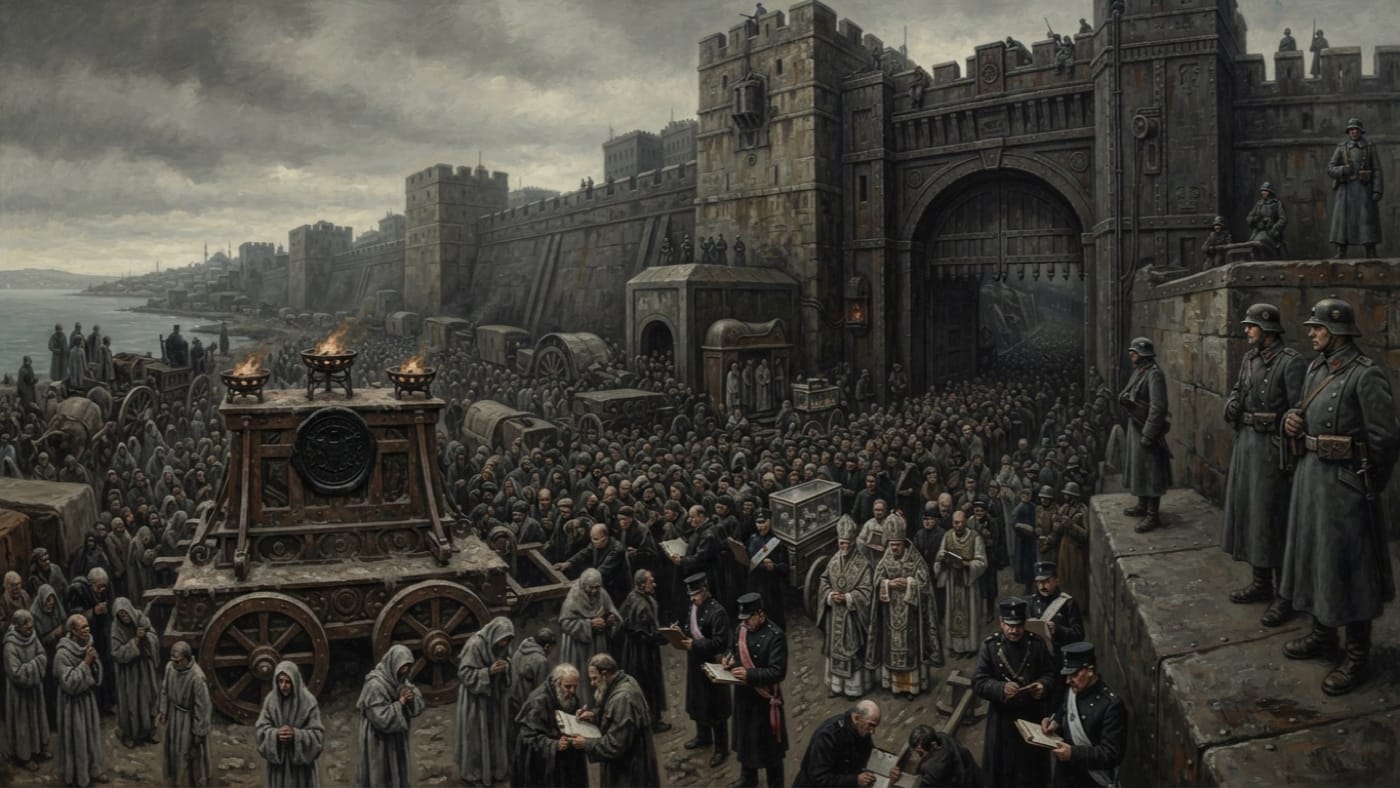
#On the Procession's Limit
The Procession of the Triune Hearth has one beginning and one end, and the Synod has never let either of them move. It begins at Strasbourg. It ends at Pilgrim's Gate, which the Bureau of Festivals calls the Pilgrim's Gate of Constantinople in its longer and more anxious documents, so that no clerk confuses it with some lesser arch in some lesser city that has pilgrims of its own. The gate belongs to Bastion-Constantinople, the southern lock of the Sagittal Line, where the Line comes down to the Bosphorus and the sea closes both flanks.
After forty days on the road, four thousand participants and ninety-seven floats arrive at this threshold. They go no further. On the near side of the gate, Festivals governs scripts, choirs, banners, cadence and the regulated joy of the faithful. On the far side, the Bureau of War governs, and joy does not appear on its list of supplies. At the gate one jurisdiction runs out of road, and the other declines to lend it any.
The Codex does not record who raised the gate, in which year, or at whose expense. The bastion's ratification belongs to A.S. 68, and that date belongs to the bastion. I will not glue it to an arch because the arch would look better with a birthday.
#On Forty Days Brought to a Halt
The Procession was first staged in A.S. 175, five years after the Tumults of Lyon, and it returns every tenth year. It commemorates the Concordat of Strasbourg and the Triune Hearth that the Concordat sealed: France, Iberia and the Rhineland, three territories persuaded at great length to become one. The cities between Strasbourg and the gate change with each revision, with rail capacity, with the state of the bridges and with the moods of bishops. There are always eleven. The forty days do not change, and neither does the end.
Everything reaches the gate. At the head comes the Hearth float, with three iron braziers around the black seal of Strasbourg. Its flames are lit from Basilica coals and tended by flame-keepers who swore at Strasbourg not to blink and have failed since the first city. Behind it walk the relic-bearers, carrying saints' bones under glass now grey with road-dust. Then come bishops in armour so heavy that lifting crews follow them like a second congregation, and chained penitents whose misery stopped needing rehearsal somewhere around the fortieth day. Then oxen, then food carts, then choirs whose voices the road has worn down to a rasp. Last come the clerks, who have counted everything and stand ready to count it again.
A column that long cannot simply stop. Its head halts while its tail keeps arriving. Wheels that have turned for forty days seize on a final gradient. Oxen that were promised rest smell the end of the road and turn theologically uncooperative. Somewhere in the middle, a float of great doctrinal importance reveals the cracked axle it has been hiding since the ninth city.
The Codex already knows the trades that do the halting. A Pageant Captain moves floats, sets barricades and holds the manifest. A Procession Marshal handles cadence, queues, crossings and dispersal. No statute gives either one precedence over the other, and that silence costs the most in the last mile before the gate. The column has a head, a tail, four thousand bodies in between and one direction it is forbidden to go.
#On the Reply of War
The Bureau of Festivals once asked permission to process beyond the gate.
The request survives in summary. Its date does not, and its author has sensibly declined immortality. Its argument is easy to rebuild without inventing a word, because Festivals has only one argument. The Hearth is the unity of the faithful. That unity has no frontier. The Hearth float should therefore roll on into the bastion and show the garrison what it defends. It is a splendid case. I have made worse ones before Synodal committees and been applauded.
War replied with a map, a casualty table and five words: "No floats beyond this line."
Admire the economy. The map showed where the line was. The table showed what the ground beyond it cost. The sentence told Festivals what to do with the information. War offered no theology and needed none. Festivals can bring forty days of incense to bear on any question, and it learned that a column of figures does not respond to incense. Let no clerk claim that the table recorded deaths caused by the request. Its figures belonged to the ground the map described. Festivals had added none of them and had no wish to start.
I resent it, naturally. A splendid argument deserves a reply of comparable length, and War answered it with a document a child could read. The Synod honours prestige everywhere except where the shells land. A float can command a city, bring a mayor to his knees and empty a parish onto its balconies. It cannot make a garrison open its road for oxen. The bastion is a working fortress, fed by rail, harbour and supply, and on its ground a delay is measured by what it costs on the walls. Wax does not appear in that accounting.
Festivals tested the boundary once. It has not tested it again.
#On Those Who Have Already Been Counted
By the time the column reaches the gate, its truest work is finished. The theological purpose of the Procession is unity. Its practical purpose is counting, and the counting happened in the eleven cities, at balconies, church steps and viewing ropes, long before anyone saw the bastion.
The arrival therefore tests the counters as much as the counted. The Captain's manifest has to answer one question: did the floats that left Strasbourg reach the gate? The Attendance Auditor keeps a separate ledger. It scores enthusiasm, times cheers and notes every cap left on a head as the Hearth float passed. The Auditor takes no orders from a man holding barricade rope, and the man holding the rope likes it that way. The Marshal cares for neither ledger and wants only a column that stands still without falling over.
What the counting yields goes out under separate seals. Records receives counts. Tithes receives addresses. Purity receives enthusiasm and its absence. Festivals receives the applause and files it under its own name. None of these ledgers was opened at the gate. All of them close there, because the road does.
Older maps and descriptions of the Sagittal Line place Bastion-Constantinople at the Line's western anchor.
Corrected. The Sagittal Line runs north to south, from Königsberg on the Baltic to the Bosphorus. Bastion-Constantinople is its southern anchor, and Pilgrim's Gate lies at the southern end of the Line. The older maps survive in drawers. They are not to be used for directions.
#On Pilgrims and Permission
The name misleads the hopeful. A pilgrim who reads "Pilgrim's Gate" on a festival broadsheet may assume the gate admits pilgrims. Bastion-Constantinople admits civilian pilgrims on three days a year, each fixed to a doctrinal anniversary, and only as far as the Ravelin of Sorrow. The application goes to the Bureau of Pilgrimage, passes through Purity and is stamped by Records. In almost every case it is approved. Almost.
Those three days belong to the bastion. The Procession belongs to the ten-year calendar of Festivals. The Codex has no record of how the two calendars are reconciled, and I decline to supply one. Arriving with the Hearth float grants no admission. A penitent who has marched forty days in chains reaches the gate with exactly the rights of one who stayed home. Neither may pass the line, and the marcher's file now sits closer at hand than they might like.
The faithful sometimes mistake a procession for a pass. War never has.
#On the Boundary Remaining
The Procession has come every tenth year since A.S. 175, and it will come again. Festivals is already planning, War is already objecting and Tithes is already weeping. Each time, the braziers will come down the last mile, the oxen will balk, the Captains will count, the Auditors will score, and the Hearth float will halt with its three flames toward the bastion and its seal toward nobody in particular.
Beyond the gate, the garrison will go on with its business. The Procession was never invited to watch.