
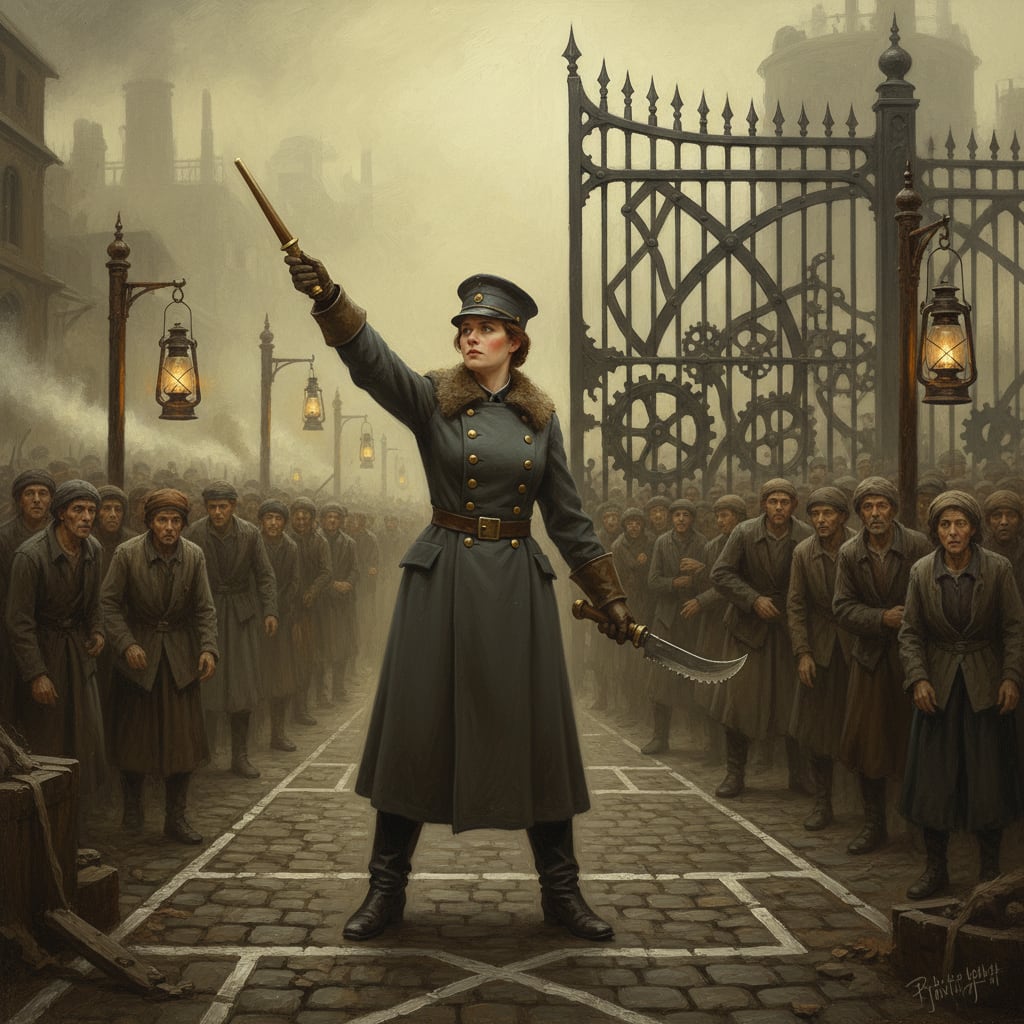
"One beat. One body. One road." — Cadence Corps foundational catechism, ratified A.S. 113
The Synod governs by paper, by bell, and by boot. The paper tells a man what he owes. The bell tells him when to pay it. The boot — the iron-heeled, chalk-dusted, rope-burned boot of the Procession Marshal — tells him where to stand while paying it, and in what tempo, and the Creator help him if he drifts.
I have watched Procession Marshals work the pilgrim convoys at the gates of Strasbourg during the Feast of Writ-Renewal, when forty thousand faithful pour through six gate-lanes in the span of four hours. I have watched them hold a funeral column through the ossuary district of Bastion-Irongate while a levy march crossed the same bridge in the opposite direction. I have watched a single Marshal — a woman named Sergeant-Marshal Yael Dorsk, whom the Bureau of Records lists as "deceased, administrative" and whom I last saw alive on the Schreiber Road — split a surging ration crowd with three whistle-cuts and a rope-knife, bleeding pressure from a choke point that would have produced casualties in ninety seconds.
The profession is simple. The Synod moves people. Pilgrim columns, ration lines, funeral trains, levy marches, penitent parades, reliquary processions, evacuation corridors, ossuary wagons — the Theocracy is a civilization of controlled movement, and controlled movement requires controllers. The Procession Marshal is the controller. His baton sets the cadence. His chalk marks the route. His whistle corrects the drift. His boot, when the whistle fails, corrects it harder.
#On the Founding and the Ashbread Stampede
The Cadence Corps was not born of theology. It was born of arithmetic — specifically, the arithmetic of how many bodies a gate-lane can process per minute before the pressure wave at the rear becomes lethal.
The Ashbread Stampede occurred in A.S. 112, during the same famine winter that produced the Bureau of Mercy's Broth Riots. A ration distribution at the northern grain depot of Bastion-Brest drew an estimated twelve thousand petitioners into a yard designed for three thousand. The gates were opened on schedule. The crowd surged. The rear pressed forward. The front, already packed against the distribution tables, had nowhere to go. The lane ropes — thin hemp, untended, strung by a clerk who had never managed a crowd larger than a confirmation class — snapped in sequence. The crowd folded inward upon itself like a fist closing on its own fingers.
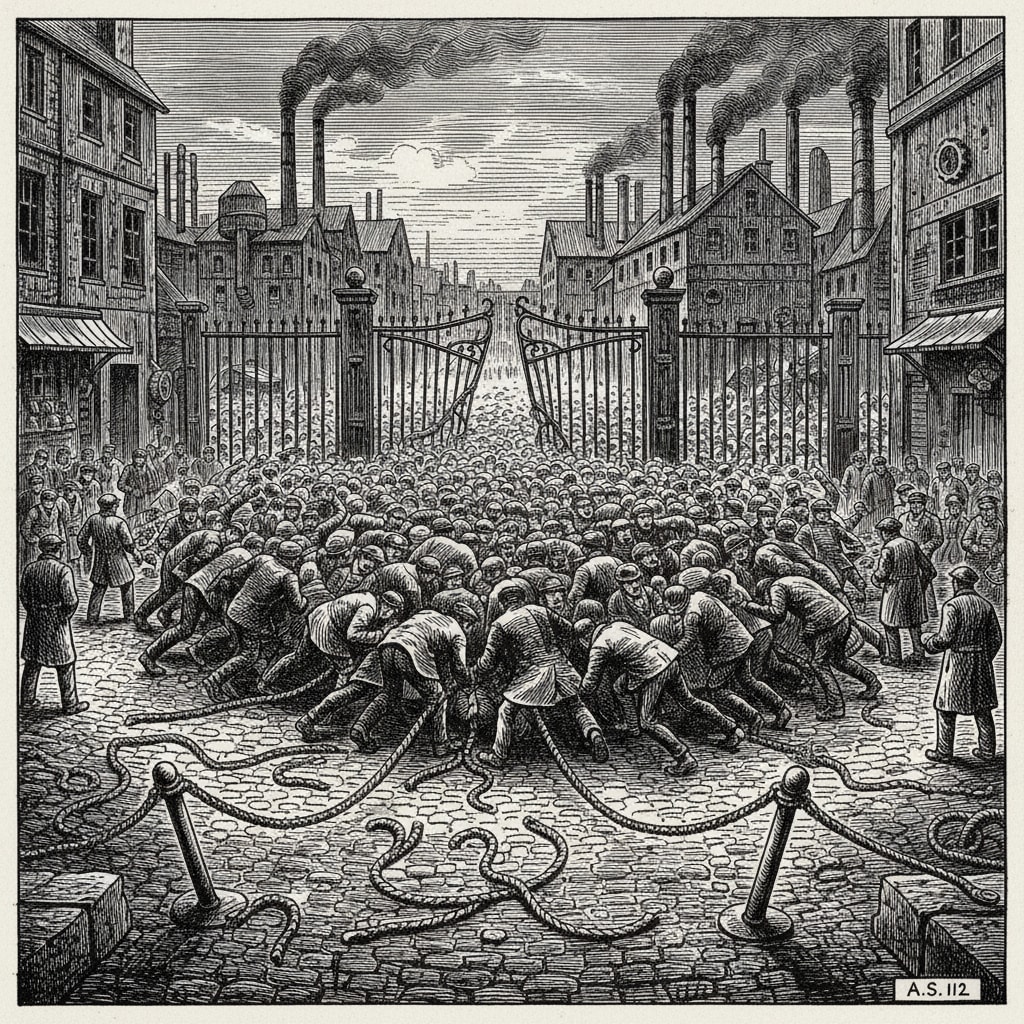
Three hundred and seventeen dead by the Bureau of Records' count, which is to say three hundred and seventeen dead by the count that survived the Bureau's revisions. The actual figure, preserved in a Bureau of Mercy intake log that someone failed to redact, was closer to five hundred. The distinction matters to the dead. It does not matter to the Bureau.
The response was institutional, immediate, and permanent. The Concordat of Civic Cadence, ratified by the Bureau of Rites and the Bureau of War jointly, established the Cadence Corps as a licensed body with authority over all mass movement within Synod territory. Every city above five thousand souls would maintain a corps. Every gate, bridge, and cathedral approach would have a designated Marshal during high-traffic bells. Every funeral, levy march, and pilgrim column would proceed at a cadence set by the Corps and synchronized to the local bellway.
The Concordat's preamble, written by some anonymous theologian with a gift for sanctifying the obvious, declares: "A city that prays in one rhythm cannot be harmonized by the enemy." This is doctrine. It is also, in the Bureau's preferred formulation, true — because the Bureau has observed that synchronized movement suppresses certain predatory phenomena that feed on crowd-noise, and because the Bureau would rather attribute this suppression to prayer than to the mathematics of sound propagation, and because the Bureau is, on this point, possibly correct.
#On the Tools and Methods
The Marshal's kit is specific, functional, and surprisingly old. The baton-staff — hollow ash, sometimes weighted with lead at the tip, always painted in the white-and-black of the Corps — serves triple duty as rhythm-setter, crowd-wedge, and (when required) weapon. The whistle-flute, tuned daily to the civic bellway's dominant tone, cuts through crowd-noise at a frequency the Corps calls "the spine" because it travels through bone before it reaches the ear. The chalk pouch marks routes, choke points, and "do not stop" zones in a colour code the Corps guards with the possessiveness of alchemists: white for passage, red for danger, black for "this lane is sealed and you will be beaten if you cross it."
The cadence itself — the beat around which the Corps organises all movement — is set by drum, by heel-strike, or by whistle, depending on the context. Funeral trains use the drum: slow, heavy, two beats per three steps, the rhythm of grief made regular. Levy marches use the heel-strike: fast, sharp, one-one-one, the rhythm of men who do not want to march and are marching anyway. Pilgrim columns use the whistle: a lilting call-and-response that disguises crowd-control as devotion, which is the Bureau of Doctrine's preferred approach to everything.
The call-and-response commands are standard across the Theocracy — STEP, HOLD, BREATHE, TURN — and a Marshal who cannot bark them in four languages, three dialects, and one liturgical register will not survive the first Feast-day rush. The commands are not requests. HOLD means stop. BREATHE means the lane ahead is clearing and you will move in six seconds. TURN means the route has changed and you will follow the baton or you will follow the guards, and the guards are less patient than the baton.
#On the Night of Two Bells
The second event that shaped the Corps — after the Ashbread Stampede, before the levy reforms — was the Night of Two Bells, an incident the Bureau of Bells has classified as "Atmospheric Interference, Category: Unresolved" and that the Corps itself calls, in the quiet hours of the night watch, "the lesson."
A funeral procession in the cathedral quarter of Strasbourg, approximately eight hundred mourners, drifted off its assigned route during a tolling error. Two bells struck simultaneously — the funeral bell of Saint Erasmus and the vespers bell of the Cathedral of the Perpetual Writ — and the resulting harmonic confused the lead Marshal's whistle, which was tuned to a third frequency entirely. The procession, deprived of its auditory spine, split into three streams. Two streams found their way to side-streets and dispersed harmlessly. The third stream — approximately two hundred mourners — followed the wrong bell into a quarter that had been closed for gas-line repair, where the streets narrowed, the lamps were unlit, and the crowd compressed into alleys that led, eventually, to a canal embankment with no railing.
A prior filing attributed the Night of Two Bells to "sabotage by unknown agents seeking to destabilise civic mourning procedures."
The Bureau of Bells has since determined that the tolling error was caused by a scheduling conflict between two bell-ringers, neither of whom consulted the published bell-table, both of whom rang on instinct, and both of whom were subsequently reassigned to duties that do not involve bells. The canal deaths numbered nineteen. The scheduling conflict has been resolved.
The Corps' response was the Route-Timing Concordat: strict synchronisation of all procession routes with the published bell schedule, mandatory two-bell clearance on funeral routes (meaning no other bell may strike within the harmonic range of the funeral bell during a procession), and the institution of Cadence Architects — senior Marshals whose sole function is to design choke-point solutions and train junior staff in the mathematics of crowd flow.
#On the Profession's Daily Work
A Marshal's day begins before dawn with throat oil — a camphor-and-salt preparation that the Corps' medical officer insists prevents vocal damage and that the Marshals insist tastes like a punishment for sins they have not yet committed. The whistle is calibrated to the day's dominant bell. The route is walked, choke zones marked in chalk, assistant Rope-Runners positioned at lane anchors with fresh hemp and iron stakes.
The morning bells bring the first crowds: ration queues, gate petitioners, early pilgrims, work-levy columns assembling at muster yards. The Marshal sets the beat and the crowd, however reluctantly, follows — because the crowd has learned, over generations, that the beat means safety, and that the absence of the beat means the Ashbread Stampede, which every schoolchild in the Theocracy has been taught to fear more than demons.
Midday is the pressure peak. Pilgrim convoys arrive at gates. Ration lines reach their longest. Port gangways disgorge workers and refugees and the Bureau of Pilgrimage's tour groups, who are always lost, always entitled, and always walking at a tempo that suggests they believe the city was built for their convenience. The Marshal manages competing flows with a combination of whistle-commands, rope-lane adjustments, and what the Corps calls "micro-stops" — brief, precisely timed halts that bleed pressure from a choke point the way a surgeon bleeds a swollen joint. The art is in the timing. A micro-stop held two seconds too long becomes a blockage. A micro-stop released two seconds too early becomes a surge. The Marshal counts heartbeats, because the Corps learned long ago that a heartbeat is more reliable than a pocket-watch in a crowd.
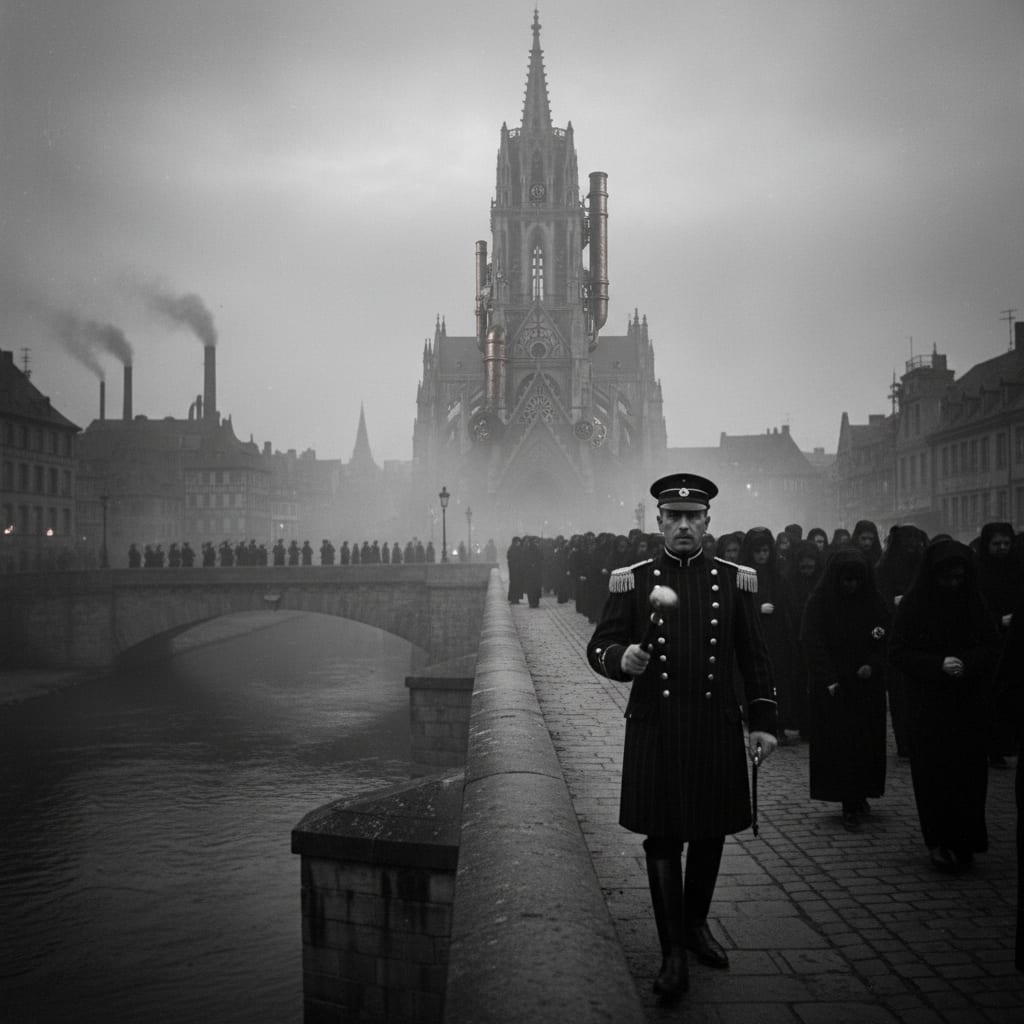
Late afternoon brings funerals and levy columns — the two rivers of human movement that define the Synod's cities. The funeral trains are slow, rhythmic, heavy with grief and incense and the sound of the Bureau of Bells' prescribed tolling. The levy columns are fast, sharp, heavy with fear and the sound of boots on stone. When both cross the same bridge — and they always cross the same bridge, because the Synod's cities were built for prayer and retrofit for war, and the infrastructure does not care about the Marshal's schedule — the Marshal must time the crossing so that the dead do not mingle with the condemned and the condemned do not mingle with the dead. The distinction is theological. The consequence is practical. A levy column that sees a funeral train tends to desert, and a funeral train that sees a levy column tends to riot, and both outcomes produce paperwork that the Marshal would prefer to avoid.
#On the Spiritual Hazard
The Corps does not discuss the spiritual hazard in its official literature. The Corps' official literature describes crowd management in terms of throughput, lane capacity, and bell synchronisation. The spiritual hazard is described in the Corps' unofficial literature, which consists of chalk marks on barrack walls, whispered conversations in the canteen, and the phrase "off-tempo is a doorway" — repeated so often and so seriously that it has passed from slogan into catechism.
The hazard is this: synchronised human movement produces a sound. The sound is predictable, controllable, and — in the Corps' experience — safe. Desynchronised human movement also produces a sound. That sound is less predictable, less controllable, and, in certain acoustic conditions that the Bureau of Rites has catalogued but not explained, attracts attention from beyond the Sagittal Line.
[SEVEN LINES REMOVED — BUREAU OF DOCTRINE, STANDING ORDER 44-C. THE RELATIONSHIP BETWEEN CROWD ACOUSTICS AND DEMONIC AUDITION IS CLASSIFIED UNDER THE CONCORDAT OF SILENCE, A.S. 155.]
The Corps calls the phenomenon "echo-beats" — a rhythm that enters a crowd from no identifiable source, overrides the Marshal's cadence, and moves the crowd in a direction and at a tempo that serve no human purpose. Echo-beats have been documented at Bastion-Shipka (where Syrion's time-fog compounds the effect), at Bastion-Przemyśl (where trench-line levy columns are vulnerable to harmonic interference from the Wire Orchard), and at Constantinople (where the sheer density of processions provides acoustic cover for intrusion).
A Marshal who detects an echo-beat has one instruction: cut the crowd. Split it. Break the mass into fragments too small to sustain the foreign rhythm. The whistle-command is SCATTER — the only command in the Corps' vocabulary that the Corps hopes never to use, because SCATTER means the cadence is lost, the lanes are abandoned, and the crowd becomes weather.
A previous edition of the Cadence Corps Manual, Section 7, listed "choirwind" as a natural atmospheric phenomenon caused by the interaction of bell harmonics and river-valley acoustics.
The term "choirwind" has been reclassified. Its new classification is not available in this edition of the Manual. Marshals encountering choirwind are instructed to cut the crowd, signal the nearest Bureau of Rites station, and refrain from listening.
#On the Internal Factions and Their Quarrels
The Corps is not unified. It has never been unified. It contains, at present, three factions whose disagreements have produced more internal disciplinary actions than any external threat.
The Doctrine Marchers hold that the procession is a sacrament — that synchronised movement is prayer made visible, and that the Marshal's first duty is to preserve the chant's purity. They favour slow cadences, liturgical call-and-response, and the absolute authority of the bell schedule over all other considerations. They are beloved by the Bureau of Doctrine. They are despised by the Bureau of War. They produce beautiful processions. They also produce bottlenecks, because a slow cadence through a narrow gate means fewer bodies per minute, and fewer bodies per minute means the queue extends into the next lane, and the next lane feeds the bridge, and the bridge is already at capacity because the Doctrine Marchers on the other side are also running a beautiful, slow, liturgically perfect procession that is backing up traffic to the river.
The Flow Marshals hold that the procession is a logistics problem — that the Marshal's first duty is to move people safely, and that chant purity is a luxury the Corps cannot afford during famine winters or levy surges. They favour fast cadences, minimal call-and-response, and the absolute authority of throughput metrics over bell schedules. They are beloved by the Bureau of War. They are despised by the Bureau of Doctrine. They move crowds quickly. They also move crowds roughly, and a crowd moved roughly is a crowd that remembers, and a crowd that remembers is a crowd that resists the next time the Marshal's whistle blows.
The Iron Wedges hold that the procession is a threat to be managed — that the Marshal's first duty is to prevent disorder, and that both chant purity and throughput are secondary to the maintenance of absolute physical control. They favour wedge formations, forced dispersals, and the liberal application of the baton to anyone whose tempo deviates by more than half a beat. They are beloved by nobody. They are tolerated by the Bureau of Purity, which appreciates their enthusiasm for discipline. They produce zero-crush records. They also produce hatred, which the Corps' psychological assessors have determined is, in strictly operational terms, a form of crowd-energy that feeds back into the system in ways the assessors would prefer not to quantify.
#On What the Profession Costs
The physical toll is catalogued in the Corps' medical records, which I have read, and which read like an anatomy of sustained violence: crush injuries to the ribs and hands, voice damage from years of shouting over crowd-noise, hearing loss from bell proximity, knife wounds sustained in lane disputes, rope burns on every finger, and a form of chronic foot injury the Corps calls "iron-heel syndrome" — a degradation of the ankle joint caused by years of marching on stone in metal-capped boots.
The psychological toll is not catalogued, because the Corps does not catalogue what it cannot stamp and file, and what the profession does to a person's capacity for mercy cannot be stamped and filed. A Marshal learns to step over the fallen. A Marshal learns to keep the beat while a woman screams for a child who has slipped between the lane ropes. A Marshal learns that "three steps to mercy" — the Corps' slogan for the small concessions that prevent riots — means three steps, precisely three, and the fourth step is weakness, and weakness kills.
The burnout endpoint, as every senior Marshal will tell you if you provide enough drink and enough darkness, is the moment you stop seeing people and start seeing flow. Fluid dynamics. Throughput. Lane capacity. Bodies per minute per metre of gate width. The mathematics are clean. The mathematics work. The mathematics do not scream when the lane rope breaks.
The Corps' patron, Prefect Malven "Iron Step" — real or invented, saint or fiction, it matters less than the myth — is said to have marched a plague quarter into quarantine without breaking cadence. The lesson the Corps draws from this story is that discipline saves lives. The lesson the plague quarter drew from this story is unknown, because the plague quarter is dead, and the dead do not file cadence reports.