
#On the House Before the Fire
The monastery of Saint Alexios stood in Dalmatia, and the Ledger can certify that much. It cannot say where in Dalmatia, who built the walls, in what century, of what stone or under what charter. Every surviving word about the house reaches this office through one friar's file, and a friar's file describes only the rooms he used.
So the house is known by its rooms. There was a cell, where a letter was later found. There was a refectory, which had a door. There was a library, or at least a librarian, because somebody signed the quarterly assessments. There was a garden, kept by a brother whose eyes were failing. Manuscripts were copied there, and monks died there.
The dedication survives, but the saint behind it does not, at least in any record this office holds. The Ledger files no life of Alexios, and I will not borrow one from the dead calendar to make the entry look furnished. A house can keep its patron's name long after the archive that explained him has gone up in smoke. Most do.
The house's tie to the Church runs through Brother Tomislav, a professed friar of the Order of Friars Minor. Saint Alexios may have belonged to that Order outright, or housed its friars, or simply taken in one Franciscan who was useful with a pen. The house's charter would settle the question, and the charter burned.
#On the Brother and the Records
Tomislav came from Split. That was his origin, and it is not necessarily the monastery's address, since the coast has more than one bell tower. The admission register puts his age on entering Saint Alexios at somewhere between nineteen and twenty-three. A margin of four years tells you the clerk was guessing and admitted it. Tomislav took his vows there, kept the garden and copied manuscripts.
The librarian gave the same verdict three times: "adequate penmanship, deficient eyesight." Two medical dispensations excused him from choir duty because of "persistent inflammation of the left orbit." Taken together, those five pages describe the brother the house actually had. He could barely read the antiphoner from the choir-stall, but his hand was steady enough to keep him at the copying desk. He also worked in the garden, where a crooked furrow is forgiven sooner than a crooked line of script.
That last point is my own inference. The dispensations do not say why he worked the garden. They say only that he was excused from choir.
The parent entry counts eleven documents in his dossier. Seven belong to the house: the register, the three assessments, the two dispensations and an unsent letter to his sister. The baptismal record belongs to Split. The intake form, the deposition and the death certificate belong to the road and the ridge.
This leaves a problem I cannot resolve. The house's archive burned in the first week of the Sundering. The parent entry says so plainly, and I have no reason to doubt the fire. Even so, the register, the assessments and the dispensations reached the Bureau of Records. So did the letter, which the dossier says was "found in his cell after the evacuation." Nobody recorded who went back into that cell, what bag the papers travelled in or which checkpoint they passed. One man's personal file survived, and the house's archive did not. A less careful chronicler would fill that gap with a named salvage party. I leave it empty, because empty is accurate.
#On the Refectory Door
The Sundering began on the first of November, A.S. 45, which the dead calendar counts as 1755. Saint Alexios burned within its first week.
That is the whole of the operational record. No surviving report names who or what set the fire, and nobody inside the walls left an account. The Sin-Generals were loose in the Balkans that season. It would flatter the archive to write Maldrake's name across the ashes, and some entries in this Codex have come close. They had no witness, and neither do I. The Bureau may note that the fire and the Sundering fell in the same week. It may not turn the shared date into a cause.
The archives burned and the monks died. The record does not say how many died. The community's roll was kept inside the building that burned, so it left no list of its dead.
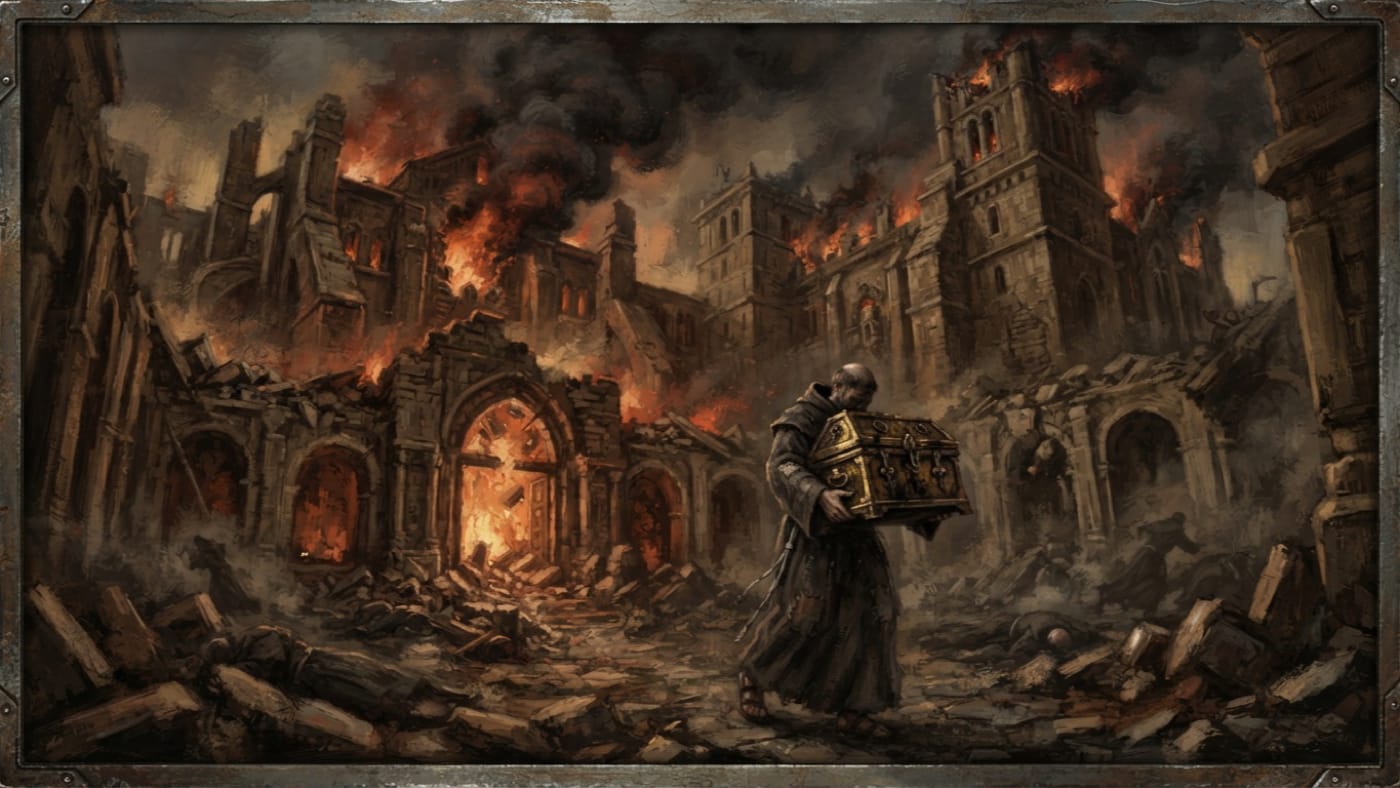
Somewhere in that house a brother with one clouded eye held the Reliquary of Saint Isidore. It was a casket of gold and iron, and it held one finger bone of the saint. He carried it out through the refectory door, and the ceiling came down behind him.
The Ledger records a door, a casket and a ceiling, in that order. It records no prayer and no vision.
This record shows Tomislav walking out. It does not say whether he was the only one who did, and I will not let the drama of the scene supply a survivor count the documents withhold.
#On Custody After the House
Before the fire, the casket belonged to the house in the ordinary sense. The house kept it under whatever arrangement had brought the bone there, from whatever date it arrived. Those arrangements burned with the charter. After the fire, the casket belonged to the man carrying it, and no house remained to dispute him.
No deed of transfer exists, and no prior, abbot or chapter signed the casket over. Long afterward, the Bureau of Relics drew up a custody chain that covers the whole matter in one arrow: MONASTERY OF SAINT ALEXIOS → BROTHER TOMISLAV (UNILATERAL). "Unilateral" is the Bureau's word for a transfer in which the other party is dead.
On the road west, clerks asked him to surrender the reliquary for cataloguing, and he refused. The record places him at Osijek, at Vukovar and at the camps near Zagreb. Those are scattered sightings, not a continuous route. The clerks who asked him were refugee clerks working from refugee forms. The Church had emerged in public only weeks or months earlier, and its offices were improvised. A provisional council was still about five years away, and the Synod would not form until A.S. 90 at Strasbourg. The man at the table near Zagreb had a pen, a stamp of uncertain origin and no authority Tomislav was obliged to recognise. Tomislav told him so.
"One Bureau of Records intake form, completed in a refugee camp near Zagreb." — this Codex, entry on Brother Tomislav
A refugee clerk took down the form at a camp near Zagreb in late A.S. 45 or early 46. No Bureau stood behind him, because the office that later claimed the paper did not yet exist in that form. The Bureau of Records holds the form now, but it did not write it. The "Bureau of Relics" named in the intake exchange is the later office's name for an early custody desk. Either the transcript supplied that name or the clerk was claiming more than he had; the record does not show which. The retrospective title is corrected here. The refusal stands as recorded.
#On What Reached Kalnik
The casket that left Saint Alexios held one bone. The casket raised on Kalnik Ridge in the spring of A.S. 48 held seventeen sacred objects, and most of them had never been to Dalmatia. They reached Tomislav during the Great Retreat through the Cellar Saints and other hands, and apostolic phalanges were among them. The house that burned in A.S. 45 owned none of them. I record this because pilgrim pamphlets now credit Saint Alexios with a treasury of seventeen relics. It kept one, and it was destroyed in the week that one was carried out.
At Kalnik, a provisional rearguard of soldiers, clergy and displaced civilians held a ridge in the Croatian highlands. The parent entry calls them the Continental Levy. The Levy's first decree dates from A.S. 110, and the men on that ridge had never heard of it. Tomislav raised the reliquary and the seventeen relics ignited. Maldrake's vanguard recoiled, and forty-three defenders survived. Tomislav was found kneeling as warm white ash, still holding the casket up. The Bureau has listed him as Venerable (Provisional) ever since, because his death certificate is disputed and the Church canonises no one without a confirmed death. The Miracle belongs to the ridge, but the bone came from Saint Alexios.
The emptied casket now rests in the sealed vault at Strasbourg. It sits at the end of an arrow that the Bureau of Relics drew backward from its own vault to a refectory it never inspected. In the Ledger, Saint Alexios is chiefly the first link in somebody else's custody chain. The Church keeps no feast for the house and licenses no pilgrimage to it. Its rooms are known only because one half-blind gardener used them.