
#On the Name in the Reports
Osijek enters the Ledger the way most towns entered it in the first winter after the Sundering. Somebody else wrote it down, about somebody else, while on the way to somewhere else. No officer of this Codex has walked its streets for this entry. No charter, rate-roll, garrison return or parish census bearing its name has reached my desk. Two sentences have, each written beside a road about a hungry person. One places its subject near Osijek and the other places its subject outside it. Those two prepositions are the whole of the topography the register holds, and I intend to respect them.
The reader who wants walls, bells, a cathedral close and a list of bishops may buy a guidebook from the men who print guidebooks. They will supply all four, and a woodcut, and a toll.
#On the Franciscan Near Osijek
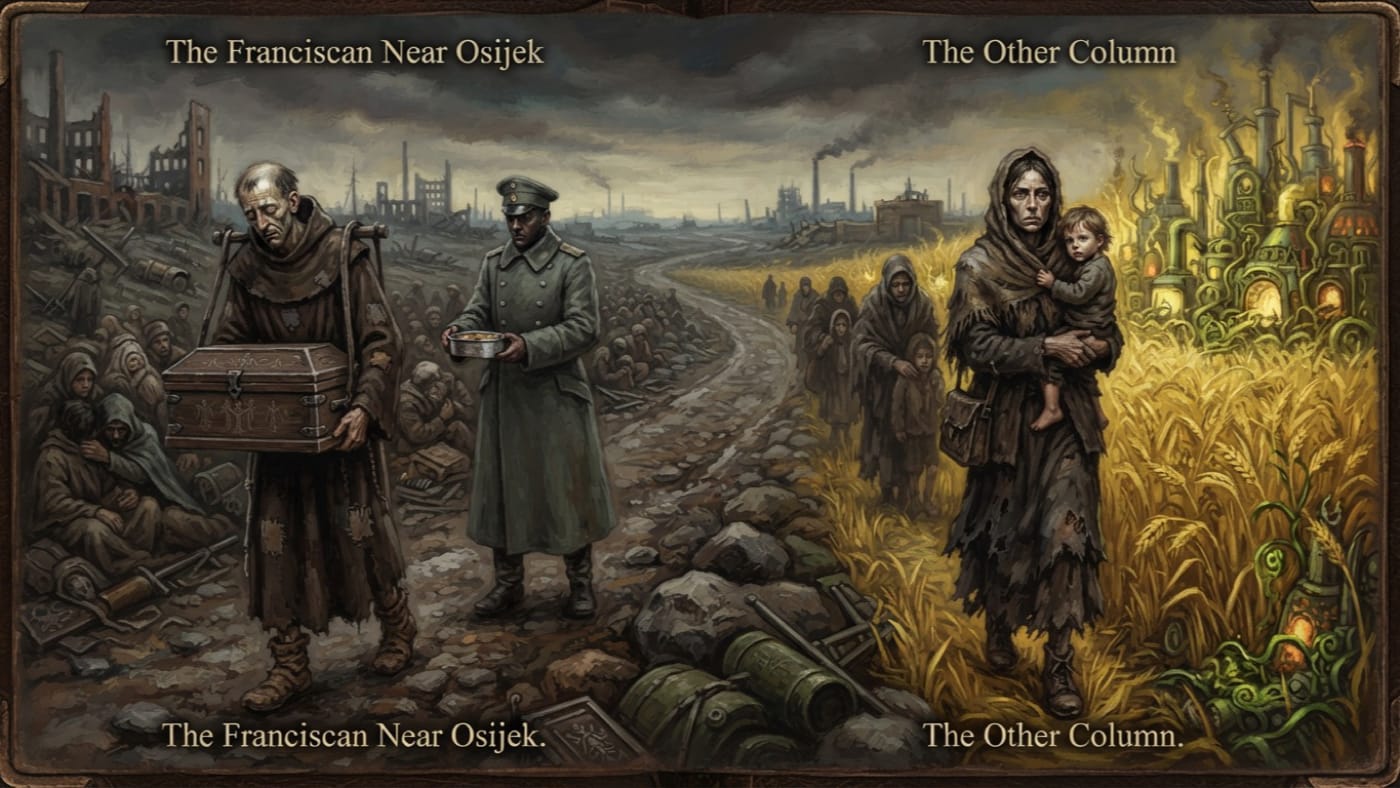
The first account is a chaplain's report from late A.S. 45, written at some point in the weeks or months after the Sundering of 1 November. The dossier of Brother Tomislav quotes the relevant clause in full: "a Franciscan with a box who will not eat."
That is the entire clause. The full report was not available for my inspection. I know the sentence only through the dossier, and the dossier identifies the Franciscan as Tomislav. I accept the identification. The alternative would require a second friar carrying a second casket west and refusing a second set of rations, and that is more Franciscans than the roads of A.S. 45 could plausibly spare. Accepting the identification does not prove it. I enter both facts and proceed.
The box needs one paragraph of context. Tomislav was a half-blind brother of the Order of Friars Minor, born in Split. He carried the gold-and-iron Reliquary of Saint Isidore out of the monastery of Saint Alexios in Dalmatia when it burned during the Sundering's first week. His birthplace does not locate the monastery, and no one has established where the house actually stood. Every refugee clerk he met after the fire asked him to surrender the casket. He refused every one of them.
The chaplain near Osijek records a man, a box and a refusal of food. He does not record the direction of travel, who offered the food, or whether the chaplain himself held out the bowl. He says nothing of the casket's metal, its warmth or its contents, and he never writes the word saint. He writes box.
The famous remark that "the box eats what I would eat" was made later, at a field hospital south of Zagreb, and it does not belong to this road. I return it to its own folio. The Osijek clause records abstinence and nothing more. It proves no mechanism linking a starving keeper to a holy object. A man would not eat, and a priest who saw it thought it worth a line.
#On the Road Between the Fragments
The dossier sets the Osijek clause beside two others. One is a supply clerk's notation of "one monk, carrying, refusing all assistance" at a river crossing near Vukovar. The other is a set of papers from camps near Zagreb and south of it. The pilgrim trade connects them with a ruler and sells the result. The Ledger declines to do so. Three points on a map make a triangle. They do not make a road, and nothing in the record says which of the three came first. The entry on Croatia reaches the same verdict, and I see no reason to quarrel with a colleague who agrees with me.
The fragments show how widely people scattered. After the Sundering the Balkans emptied north and west by every crossing and camp that would hold a body, with Wrath's advance behind them. The people writing down the refugees were refugees themselves: clergy barely out of hiding, provisional soldiers, rearguard fragments under no settled command. They were the only clerks Osijek's vicinity had in A.S. 45. None of them held an office the later Synod would recognise. The provisional council was about five years away, and the formal Synod forty-five.
"Active: A.S. 45–48, Great Retreat." (this Codex, dossier of Brother Tomislav)
The named Great Retreat runs from A.S. 48 to A.S. 65. The flight that took Tomislav past Osijek began after the Sundering in A.S. 45 and comes before that periodization. The Osijek sighting is entered under the earlier flight.
The same dossier calls the defenders of A.S. 48 the Continental Levy. The statutory Levy was first decreed in A.S. 110, and the men on the ridge were a remnant without a statute. I correct the label here only because the reader will meet it there.
In the spring of A.S. 48, at the Last Stand of Kalnik Ridge in the Croatian highlands, Tomislav raised the casket. Seventeen sacred objects blazed, and Maldrake's vanguard recoiled. Forty-three surviving depositions are on record. Tomislav became warm white ash, the manner of his death is still disputed, and his status stands at Venerable (Provisional). All of this happened at Kalnik. No document I hold gives Osijek a shrine to any of it, and the hostel-keepers would do well to keep their candles on the correct hill.
#On the Other Column
The second account sits in a different file entirely, which is the point of setting it here. It appears in this Codex's entry on the Litany of Sufficiency, in a list of the prayer's failures. In a refugee column outside Osijek, a mother answered every line correctly while walking into the Field, because she had decided the surplus could take her if it fed the child first.
The entry gives no date. It names neither the woman nor the child, and it records no column number, no chaplain and no outcome. The Litany was issued with Standing Order 119-F in A.S. 163, in an Eastern Command packet. That year dates the prayer, and I will not lend it to the column. Nor will I lend her the friar's year. Her column is a different column, the record does not say how far apart in time the two roads lay, and a clerk who merges them to tidy a page deserves to be made to walk one.
The Field belongs to the Abundance Fields of Kargath. Its food has the look of plenty and makes hunger worse: wheat bowed under impossible gold, ovens full where nobody has baked. Against this the Church issued four short blows: Enough is given. More is theft. The ration is mercy. The surplus is the Maw. She said all four. The entry does not say she faltered on any of them. She kept walking toward the Field while she said them.
The account puts a Field within reach of the column's road. It does not say how long that Field stood or where its edge ran. Nor does it say whether Osijek lay within Kargath's reach or only beside it, and I will not draw a perimeter round a town from one sentence about a mother.
The entry does not say whether the Field took her, whether it fed the child, or whether someone dragged her back by the collar. It ends with her walking, and so does this section.
#On What the Register Keeps
Both of Osijek's records are about hunger. The friar refused bread. His refusal went into a sacred biography: quoted, glossed, engraved, and carried up a hill toward a canonisation file that has never closed. The mother refused the ration's ruling that enough had been given. Her refusal went into a catalogue of failures, between a chaplain's ruinous couplet and some Ghent schoolchildren. The Church keeps both of them, in different drawers.
I do not claim the casket and the Field ran on one law. Neither file says so, and I have no wish to be the clerk who invents a theology to make two folios rhyme. My claim is narrower. In each case the register decided what kind of hunger it was looking at and filed it accordingly. The friar's hunger was classed as evidence of sanctity. The mother's was classed as evidence that the prayer needs a rope.
Of Osijek itself the register holds only these two drawers and the road between them.