
#On the Shard and the Failed Voice
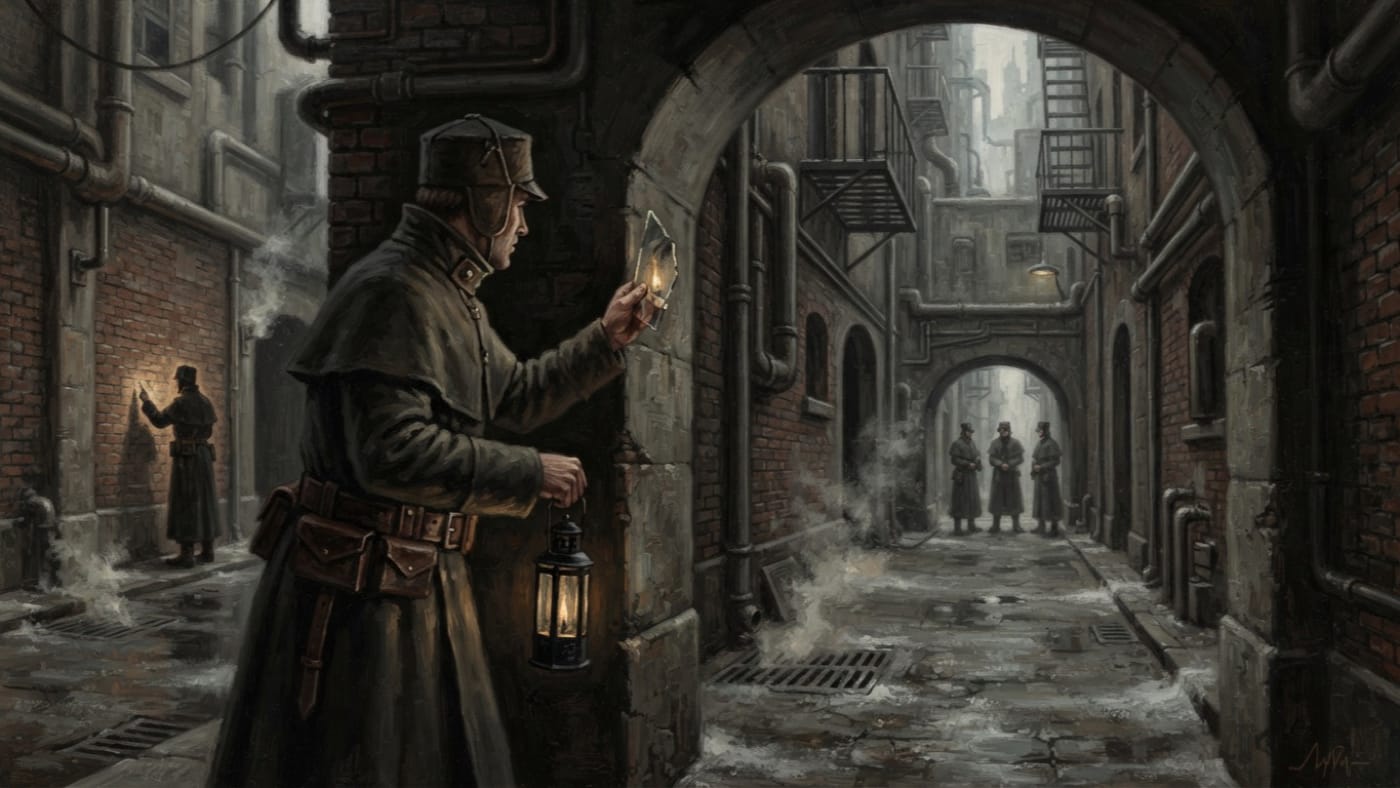
Mirror-Flash is how a Brother of the Circle of Mute Radiance gives an order with a lantern and a piece of broken glass. He half-hoods the lamp, holds the shard in the slit of flame and tilts it until the glimmer lands on brickwork or in another Brother's eye. The order goes exactly as far as the light goes.
The Circle needs the shard because its streets will not carry a voice. In the bell-dead alleys, dome-scar districts, hush corridors and quake-splits named in its charter, the Bellway arrives flat or not at all. A shouted command hits the wall and slides down it like spoiled wax. The ground has been surveyed under Hush-Zones, and I do not propose to walk it again.
The masonry accounts for only half the Brothers' quiet. The rest comes from Silence-Order, their own mandate: no screams, no gatherings, no audible truth. Close speech still carries in a quake-split, and a mother can hush a child at arm's length. The Brothers forbid what the bricks would have allowed. The shard saves them the embarrassment of whispering an order to stop whispering.
Signal Law requires every Circle command to pass by hand-code or mirror-shard flash, and it allows no shouted orders. The fingers have their own folio. This one is about the glass.
#On the Recorded Flash
The record gives one pattern. A shard flashed 1–2–1 means Circle converge.
That notation is the entire entry. It does not say how long each flash lasts. It does not give the pause between the one and the two, or explain how a watching Brother tells two quick pulses from one long tremor of a tired wrist. It names no receiver, records no acknowledgement and describes no relay. The published account says a Brother three lanes over will come. That shows one summons being answered. It does not certify a range, and it does not show light bending round masonry. A clerk who cites it as either should be made to walk the three lanes with a lamp and report back.
The instrument has three requirements: a clean shard, a steady wrist and clear sight. Soot on the glass dulls the flash. A trembling hand throws it about the alley like a drunkard's censer. Smoke stops it, and a corner stops it entirely. Ash and wet brick are normal in those streets, which is why the Brothers wash their shards in ash water before dawn. The rite is cleaning, and the Circle has dignified it.
Three pulses with one meaning make a summons. They do not make an alphabet. Anyone who writes about the Circle's "code of light" has supplied the other letters himself.
The summons ends with arrival. The flash does not order a Mouth-Seal, assemble the silent formation or authorize a removal. What follows the Brothers' arrival is decided by means the record does not describe.
#On the Hand, the Light and the Chalk
The Circle has three channels, and each has its own audience. The hand gives the patrol its orders at close quarters. A bent finger means halt. Two fingers across the throat mean seal the mouth. Palm down with three taps at sternum height means crowd pressure at the left flank. A closed fist claims that the speaker has ceased to be a citizen for five minutes, a lapse that no parish register has ever entered. The shard gives the patrol orders at a distance, and it has one word. The chalk is for residents: three parallel lines meaning speak softly or not at all. It sets a condition on a wall, and no Brother takes an instruction from it.
None of the four hand signs means converge, and no flash means halt. The record gives each channel its own vocabulary and no table of equivalents. The Hand-Code folio counts four signs, one pattern and one mark. Signal Law's older "five signs and a fist" remains in its own folio, unreconciled, and I will not invent a sign to make the sum come right.
The described daily order is narrower still. At Curfew Silence the patrol pairs deploy "hand-code only." The line does not mention the shard. I record the phrase as written and invent no hour at which the glass comes back into use.
The grammar came from the trench. Under the Silence Domes the Line passed its orders by hand-shapes, by mirror-code angled off lantern-shards and by knotted rope. The Lantern Brotherhood brought the hands and the shards into the city for its night work and left the rope at the front. Nobody recorded who carried the mirror over, in what year or from which stretch of the Line. A borrowed drill shows that somebody remembered it. It does not show that a hush corridor and a Dome have the same cause.
#On Speech Before the Offices
The Bureau of Records once asked, for filing purposes, whether a mirror-flash counts as speech. The Bureau of Doctrine said yes. The Bureau of Bells said no. The Bureau of Shadows requisitioned the memorandum and sent it back blank, and the blank was treated as consensus. The Ledger settles quarrels it cannot afford to resolve in exactly this way. No one has defined the flash in law since.
Doctrine has the better argument, and I say so as one of its servants. A flash is intended, sent and understood, and it assembles men for a purpose. That is speech in everything except its effect on the ear. On Doctrine's reading, a Circle that forbids audible truth talks all night, in a channel its own mandate cannot reach. Bells answers from its own registers. A Bellwarden licenses choirs and couriers by peal and corridor, and a flash makes no sound his instruments can measure. If it is not speech, no permit of his covers it, and Bells loses nothing by saying so. Shadows prefers to keep the question open, for reasons Shadows does not file.
The Bureau of Orison and Song has settled a narrower question for itself. Its Silence Dome Pass lets the bearer signal by hand and mirror inside a Dome without later prosecution. The pass licenses the signal and restores no sound. The Circle holds no Orison seal, its alleys are not Domes, and drills learned in the trench carry no pass with them. No one has certified that a Warden, a Bellwarden or an Orison pass-holder can read 1–2–1 at all.
The Circle's own licence is thinner. It exists under the auxiliary clause of the A.S. 94 Ordinance of Quiet Hours, which tolerates "auxiliary vigil personnel, locally licensed, subject to revocation without notice or appeal." It carries no Bureau commission, no officer's rank and no authority to arrest. A flash can fill an alley with Brothers before a Warden has noticed that his shout died on the wall. What they do once they arrive is silent detention, and the light that called them carried no warrant.
#On Drill and Unentered Patterns
The practice is kept up in the Hush Loft, the attic of Dome-Split Tenement 4B, inside a bell-dead zone. Mirror-flash drills are marked on the floor beside the hand-code diagrams. Cloth hangs on the walls. The shrine candle is kept barely lit, because a fuller flame makes a noise in the glass.
At dusk come breath drills, the shard check and the hood clamp test. Before dawn the field notes are burned, the training marks are reset and the shards are washed in ash water. The Breath Oath belongs to the same discipline. An initiate carries a lit lantern down a corridor without audible breath for a count of one hundred. He may breathe, but he may not be heard doing it. A wrist that has learned that much can hold a shard still.
Spark Jani Kest is attached to the Circle and reportedly sees patterns in mirror-flashes that are not in the manual. The Circle admires the report, and Shadows has taken an interest in it. No one has written down what the Spark sees or explained why, and I will not do it for them.
#On the Present Practice and the Quiet Congregation
As of A.S. 201 the drills are still chalked on the Loft floor, and 1–2–1 still summons the Circle in the streets it claims. The Circle remains conditionally tolerated under quarterly review. Standing Order 14-V, revised in A.S. 199, caps any Circle at thirty licensed operatives. The figure is a ceiling, and it says nothing about how many Brothers Mute Radiance actually musters.
The quiet congregation is the case the glass handles worst. A Lantern Mercy Preacher speaks softly in a bell-dead alley. The listeners stand close and make no noise, and they go home carrying something the Synod never licensed. A Brother who sees them can flash 1–2–1 and have the Circle there within the minute. The charter forbids gatherings. Later Brotherhood folios describe such congregations as compliant. Nobody has reconciled the two, and I will not set a size or a volume at which one becomes the other.
Earlier Brotherhood manuals instructed Mute Radiance patrols to "silence all unauthorised preaching."
Corrected by marginal order after the Cologne disputes, year not entered. Unauthorised preaching may already be silent. The proper instruction is: interrupt the congregation before meaning accumulates.
The flash can bring Brothers to the congregation. It cannot tell them how much the congregation has understood. No pattern on record measures meaning, and the correction requires the Circle to act before meaning has gathered. The Brothers are left to guess when that is, with a lamp in one hand and a shard in the other.