
#On the Closed Door
The Hush Beating is the punishment the Circle of Mute Radiance keeps indoors. The Circle's charter gives it one line among its favoured punishments. That line calls it non-lethal and methodical, done behind closed doors so that no story escapes. I have filed confessions longer than that line, and some of them were signed by men who could not write.
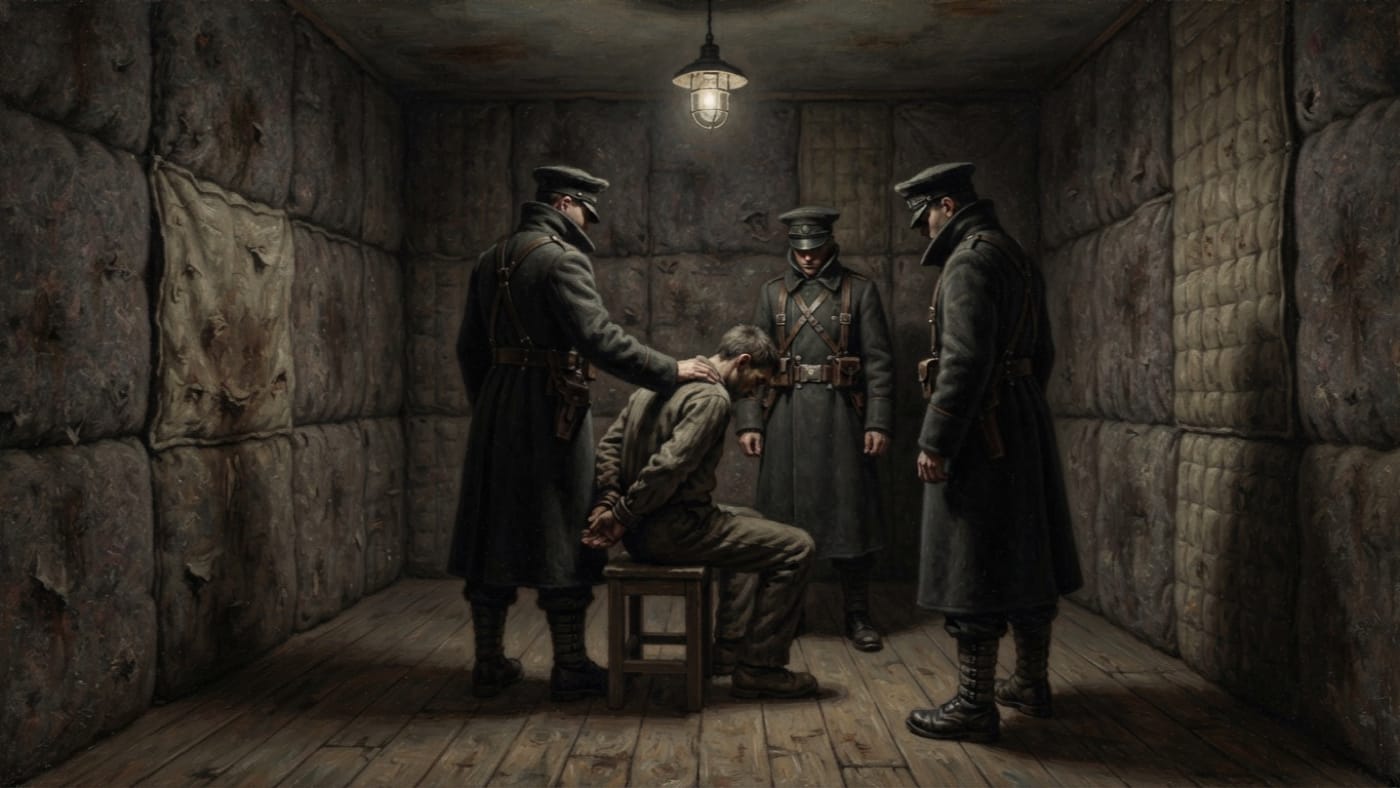
The Circle's published folio adds the furniture: soft cuffs, cloth on the wall and three Brothers. Nobody shouts and nothing is staged. The offender is not walked back through the alley that watched him offend. He is taken in, and later he comes out alive. The street outside stays calm the whole time. The Circle calls the Hush Beating a mercy, and it rests that claim on those two outcomes.
I enter the claim as the Circle's reasoning, which it is. A Brotherhood return measures mercy by what is missing at the end of the night: no corpse to bury, no crowd on the stair, no cry that a neighbour must later decide whether to repeat. The charter says the beating is non-lethal. It does not say harmless. It records no surgeon and no bandage roll, no period of rest, and no assurance that the man who walks out walks as well as he walked in. A blow struck behind cloth is still a blow. It simply never reaches the return.
The parent folio places the lesson in the ribs. I read that as rhetoric. The record names no other target. It gives no implement, no count of blows and no duration. It does not say whether one Brother holds while another strikes, or whether all three take a share. The imagination will supply the rest, but the imagination is not a filing office.
#On the Mandate
The beating serves Silence-Order, the Circle's mandate. The charter states it in one line: no screams, no gatherings, no audible truth. The Circle claims bell-dead alleys, dome-scar districts, hush corridors and quake-splits. In those places a tower's warning arrives flat or never arrives, and a Warden's bellow hits the brick and slides down it. The ground itself is surveyed under Hush-Zones. The masonry swallows the shout and leaves close speech alone, so a whisper still carries at arm's length. The Circle's prohibition is aimed at exactly that close speech. The bricks allow it. The charter does not.
The bargain sold to the Church is panic suppression: stampede prevention and quiet crowd control where no bell can order a crowd to stand still. The Brothers give orders by hand-code and mirror-flash. When compliance fails, the charter says, the Circle escalates instantly and quietly. That one sentence is all the doctrine that connects a disobedient street to a closed room. It names no offence that earns the beating. It sets no number of warnings, no volume and no count of repeat offences. The Brother decides. He decides without speaking, which spares him the inconvenience of explaining himself.
#On Separate Corrections
The charter lists two favoured punishments side by side, and the Circle keeps a tolerated sin as well. The main difference between them is who is meant to see them.
The Mouth-Seal is a dab of wax at the centre of the lips. It is symbolic and humiliating, and the wearer carries it to the pump, where the whole stair can read it. It teaches in public. The Hush Beating teaches in private. The lesson stays with the offender, and the alley learns only that he was gone for a while and came back quieter. Removal, the tolerated sin, teaches by an absence that does not end. Its motto is No sound, no record — unless we choose to write one.
The street confuses the three. So did an earlier folio.
"Punishment begins with the Mouth-Seal."
Corrected. The charter lists Mouth-Seal and Hush Beating together and sets no order between them. The wax is the public instrument. The beating is the private one. Neither is a required step toward the other, and removal follows from neither.
The punishments form no ladder. No record sends a sealed mouth upstairs to the cloth, and no record makes a beaten man the next candidate for removal. The patrol's tools are not punishments under other names either. Brothers carry cloth gags, hood clamps and soft cuffs on every watch. Two fingers across the throat mean seal the mouth, which calls for neither wax nor a room. A 1–2–1 flash means Circle converge. Three Brothers converging and three Brothers in a cloth-hung room share a number, and the manual connects them no further. What each sign compels is a question for Signal Law.
#On the Quiet Return
The Circle detains people without any authority to detain them. Its toleration rests on the auxiliary clause of the A.S. 94 Ordinance of Quiet Hours, which tolerates "auxiliary vigil personnel, locally licensed, subject to revocation without notice or appeal." The clause grants no Bureau commission, no officer's rank and no power of arrest. The street says the Brothers arrested a man. The Ledger says silent detention. The Ledger is correct, and nobody asked the man which word he preferred. A Wick-Sergeant may hold rank inside the Lantern Brotherhood, but that rank does not make him an officer of the Church. Toleration is not ratification. No council has adopted the Hush Beating as Church law, and no Bureau has entered it in a penal schedule.
The daily order frames the practice without containing it. It runs from dusk drills, through deployment at curfew by hand-code and the dispersal of gatherings in early night, to midnight. Midnight brings quiet removals and sealed-mouth detentions, and no witnesses are retained. Leak hunts follow, and the field notes are burned before dawn. The order does not set an hour for the Hush Beating. A reader who puts every beating at midnight has merged two lines of the schedule because it makes a better scene.
The return survives the fire. The field notes go into the grate and the return goes to the Bureau of Records. Records reviews the Circle every quarter under Standing Order 14-V, revised A.S. 199. That order caps any Circle at thirty licensed operatives, a ceiling that tells nobody how many Brothers Mute Radiance actually keeps. The return does not say how many beatings were given. It says the street was calm. Both facts could sit on the same page, and the Circle has learned to write only the second.
The room is not on file. The Hush Loft, in the attic of Dome-Split Tenement 4B, is the Circle's headquarters and training floor, and cloth hangs on its walls. Cloth also hangs in the descriptions of the punishment. Two rooms with linen on the walls are two rooms with linen on the walls. The record puts drills, chalk and a low shrine candle in the Loft. It puts no beating there. Nobody has entered an address, a city or a plan for the room where the Hush Beating happens.
#On the Quiet Congregation
A Lantern Mercy Preacher speaks softly in a bell-dead alley. The listeners stand close and hear every word, and they disperse when the chalk appears. Nobody screams. The street stays calm, and a calm street is the very thing the Hush Beating exists to protect.
The charter forbids gatherings without qualification. Later Brotherhood folios call these quiet congregations compliant. No clause sets a size, a volume or a length of time at which listening becomes assembly. No record says whether a listener who understood too much is a candidate for the cloth. The Bureau of Purity recommends post-watch confession for Brothers assigned to preacher contact. That recommendation shows that Purity worries about the Brothers. It says nothing about the listeners. I decline to decide the case. Every night a Brother decides it for me, by eye and without a word, and none of his decisions reaches my desk.
#On the Present Practice
As of A.S. 201 the Hush Beating is still used in the streets the Circle claims, and the Circle remains conditionally tolerated under quarterly review. Nobody recorded who devised the beating, when it was first used, who first received it or when it entered the charter. The charter's own author and date of adoption are unrecorded too. The A.S. 94 clause dates the Brotherhood's toleration. It dates nothing that has been done under it.
One rumour sits on the review desk. The Tongue Cabinet is said to hold trophies from removals. The Bureau of Shadows keeps it under watch. Its Review File 18-H names a tenement, but naming a tenement is not naming a room. Nothing in the record connects the cabinet to the Hush Beating. The beating returns its subject. The rumour concerns the people who were never returned.