
#On Command Without a Voice
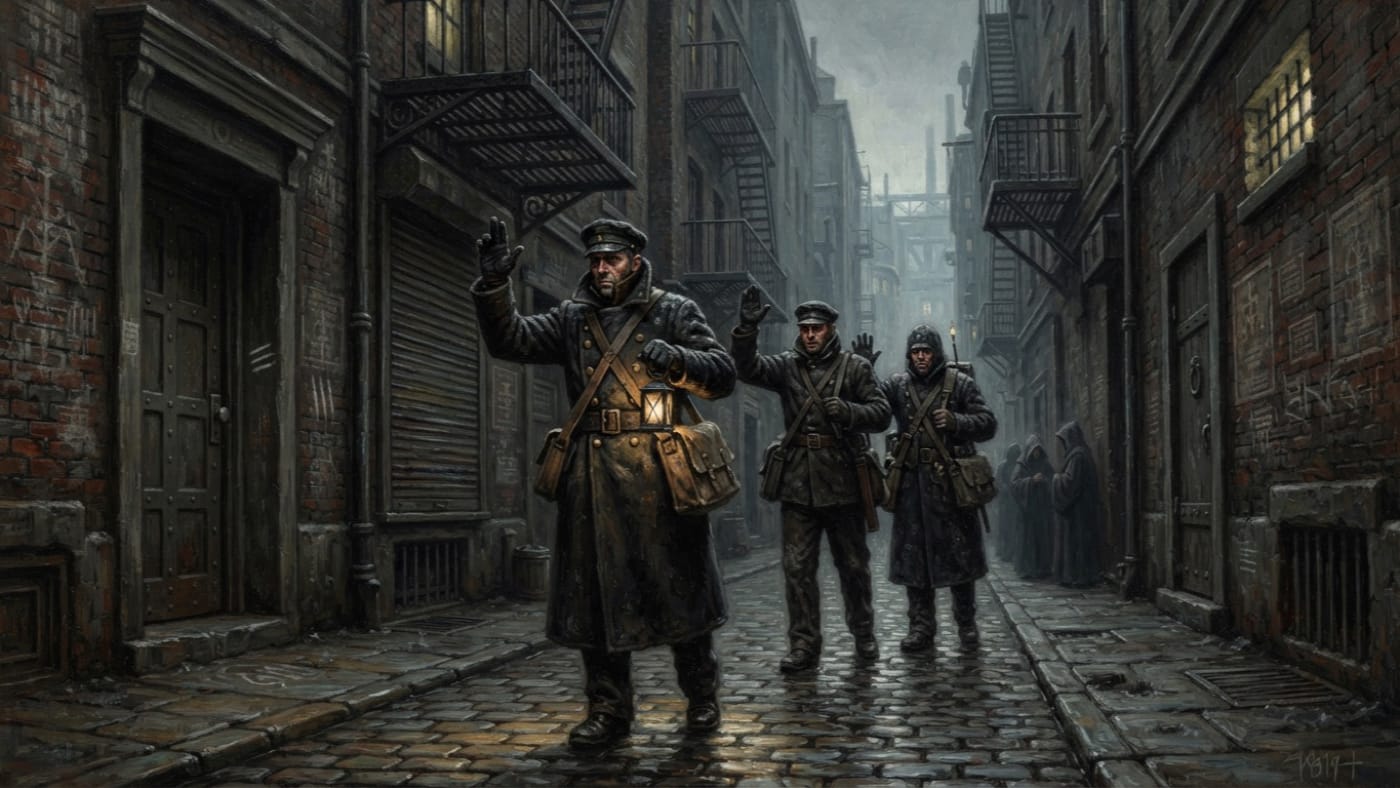
Hand-Code is the set of manual signs the Circle of Mute Radiance uses to give orders in streets that will not carry a voice. A Brother bends a finger and his partner halts. That is the entire instrument, and the Circle has built a great deal of fear on top of it.
The need for it begins with acoustics. Doctrine came later. In the bell-dead alleys, dome-scar districts, hush corridors and quake-splits that the Circle claims, a shout hits the brickwork and slides down it like spoiled wax. The terrain is surveyed under Hush-Zones. A Wick-Sergeant who barks an order there has wasted his breath and given away his position. The Circle's ban on speech is a separate matter. Its own charter lays that ban over the failure. The masonry swallows the shout, and the Brothers forbid the whisper. Readers who confuse the two have usually been taught by a Brother.
The hand gives the order. Signal Law is the charter's claim that the order binds everyone in the alley, and Silence-Order is the mandate the order serves. Each has its own folio, and I will not copy them out again. This folio is about fingers.
#On the Recorded Signs
The record gives four manual signs and says nothing more about them. I will not improve on it.
A bent finger means halt. The sources do not say which finger, which hand or how far it bends. I have watched Brothers in the Hush Loft make the sign three different ways, and nobody was corrected. The meaning holds while the knuckle varies.
Two fingers drawn across the throat mean seal the mouth. Visitors take it for a death sign. It is an order for silence, and the gesture does not say what follows. It might be a cloth gag, a hood clamp, the wax of the Mouth-Seal, or a resident who simply takes the hint. No manual I have handled prescribes one over another. The street assumes the worst, and that saves the Brothers a good deal of wax.
Palm down, three taps at sternum height, means crowd pressure at the left flank. The count is three, and I once saw a Spark corrected for tapping four. No source says whose left is meant. I will not give the Circle a reference frame it has never troubled to write down.
A closed fist means, in the Circle's practice, that the speaker has ceased to be a citizen for the next five minutes. It is the only sign residents learn without being taught. In law it does nothing. The Bureau of Records has no form for a five-minute lapse of citizenship, and the man's line in the parish register reads the same afterwards as before. For those five minutes he is handled as though the register said otherwise. The fist works on the man and leaves the register untouched, and of the two the man is easier to correct.
Signal Law speaks of "five signs and a fist," and that arithmetic has embarrassed better archivists than me. Four hand signs are written down. A generous clerk might count the mirror-flash as a fifth, or a hurried one might count the chalk. The Circle might also keep a sign off paper altogether. I record four. Anyone who wants to fill the gap with an advance, a retreat or a sign for take him may do so in his own folio and answer for it at his own confession.
#On Drill and the Hush Loft
The grammar came from the trench. Under the Silence Domes, the Line drilled its soldiers to take orders through the fingers, bent or splayed, for volleys, pushes and retreats, and to pray with their hands when the air ate their voices. The Lantern Brotherhood carried that battlefield signal-liturgy into its urban night work. Nobody has recorded who brought it over, in what year, or from which stretch of the Line. A borrowed drill proves that somebody remembered it. It does not make a hush corridor into a Dome, and the shared symptoms do not prove a shared origin.
The drilling happens in the Hush Loft, the attic of Dome-Split Tenement 4B, inside a bell-dead zone. Hand-code diagrams are chalked on the floorboards beside the mirror-flash drills. Cloth hangs on the walls. The shrine candle is kept barely lit, because a fuller flame ticks in the glass. At dusk the Brothers practise breath discipline, check their shards and test their hood clamps. At curfew they go out in pairs without a spoken word, with Hand-Code as their only means of command. Before dawn they reset the training marks, burn the field notes and wash the shards in ash water.
A Spark learns the signs early, because a Spark runs messages, and a message that cannot be spoken has to travel in the hand. Most signs in a squad come from the Wick-Sergeant. Under all of it lies the Breath Oath. The candidate carries a lit lantern along a corridor for a count of one hundred without audible breath. He may breathe, but he may not be heard doing it. Candidates who confuse the two turn a devotional shade of blue around sixty and are carried out quietly, which at least keeps to the theme.
#On the Hand, the Shard and the Chalk
The Circle uses three channels, and only one of them is the subject of this folio.
The hand belongs to the patrol. The mirror-shard also belongs to the patrol, but it speaks in light. A lantern-shard tilted 1–2–1 against the brickwork means Circle converge. It needs a clear line of sight, a clean shard and a steady wrist, and smoke or a corner will stop it. The chalk belongs to the residents. Three parallel lines on a wall mean speak softly or not at all. That is a condition laid on the street, and no Brother takes an instruction from it. The trench also used knotted rope, and the rope stayed at the front. Nothing in the record puts it in the Circle's alleys.
A gesture is limited by its medium. It has to be seen, and the eye that sees it has to understand it. In a shuttered alley at midnight, whether a bent finger can be read depends on the angle of the lamp. I have found no record of a relay procedure, an acknowledging sign or a reliable range, and I will not invent them for the Circle's convenience.
The signs also belong only to the Circle. A Warden patrol may watch a bent finger and see a bent finger. A Bellwarden keeps his own peal tables, and the Bureau of Bells has never asked to borrow the Circle's hands. The Silence Dome Pass issued by the Bureau of Orison and Song protects its bearer's signalling inside a Dome, and its holders drill from a different book. No one has certified that any of these offices can read the others' signs.
Spark Jani Kest, who is attached to the Circle, reportedly sees patterns in mirror-flashes that are not in the manual. The Bureau of Shadows has taken an interest. Those patterns are in the flashes, and nothing she has reported adds a sign to the fingers.
#On Obedience and Its Limits
Hand-Code is how the Circle coordinates its quiet response. The silent formation puts three Brothers at the front, two along the wall and a Spark behind, with lanterns shuttered to a slit. Six men cannot take up that shape in silence unless something passes between them, but the record does not say which sign assembles them, so I name none. The formation advances without footfall, and most crowds dissolve before it arrives.
A hand can start what comes after. The throat sign can come before the Mouth-Seal. The fist can come before a man is handled as though he had no standing. Behind closed doors there is the Hush Beating, which is methodical and non-lethal. Further on lies removal, the Circle's tolerated sin. No source sets these out as a sequence, and no sign is obliged to lead to the next.
Whatever the hand begins stays within one limit. The Circle exists under the auxiliary clause of the A.S. 94 Ordinance of Quiet Hours. That clause gives locally licensed toleration, revocable without notice or appeal, and it gives no Bureau commission, no officer's rank and no authority to arrest. The street says arrest. The Ledger says silent detention, and real arrest stays with the Bureau of Purity and its proper paper. A closed fist can make a man afraid, but it carries no writ.
Hand-Code has no sign for the quiet congregation. A Lantern Mercy Preacher speaking softly in a bell-dead alley draws no bent finger, because nobody is moving, and no throat sign, because nobody is loud. The listeners scatter at the chalk and take home something the Synod never licensed. The charter forbids gatherings. Later Brotherhood folios describe such congregations as compliant. The quarrel among the factions of the A.S. 178 Cologne Schism has made the dispute worse and settled none of it.
Earlier Brotherhood manuals instructed Mute Radiance patrols to "silence all unauthorised preaching."
Corrected by marginal order after the Cologne disputes, year not entered. Unauthorised preaching may already be silent. The proper instruction is: interrupt the congregation before meaning accumulates.
The correction tells a Wick-Sergeant when to raise his hand. It does not tell him what shape the hand should take, and no finger can measure how much a listener has understood.
#On the Present Practice
As of A.S. 201 the signs are still drilled, chalked fresh on the Loft floor each night and used in the claimed streets. The Circle remains conditionally tolerated under quarterly review. Standing Order 14-V, revised in A.S. 199, caps a Circle at thirty licensed operatives. That is a ceiling, and it says nothing about how many hands Mute Radiance actually keeps. Four manual signs are on record, along with one shard pattern and one chalk mark. The fist still claims five minutes that the register has never granted.