
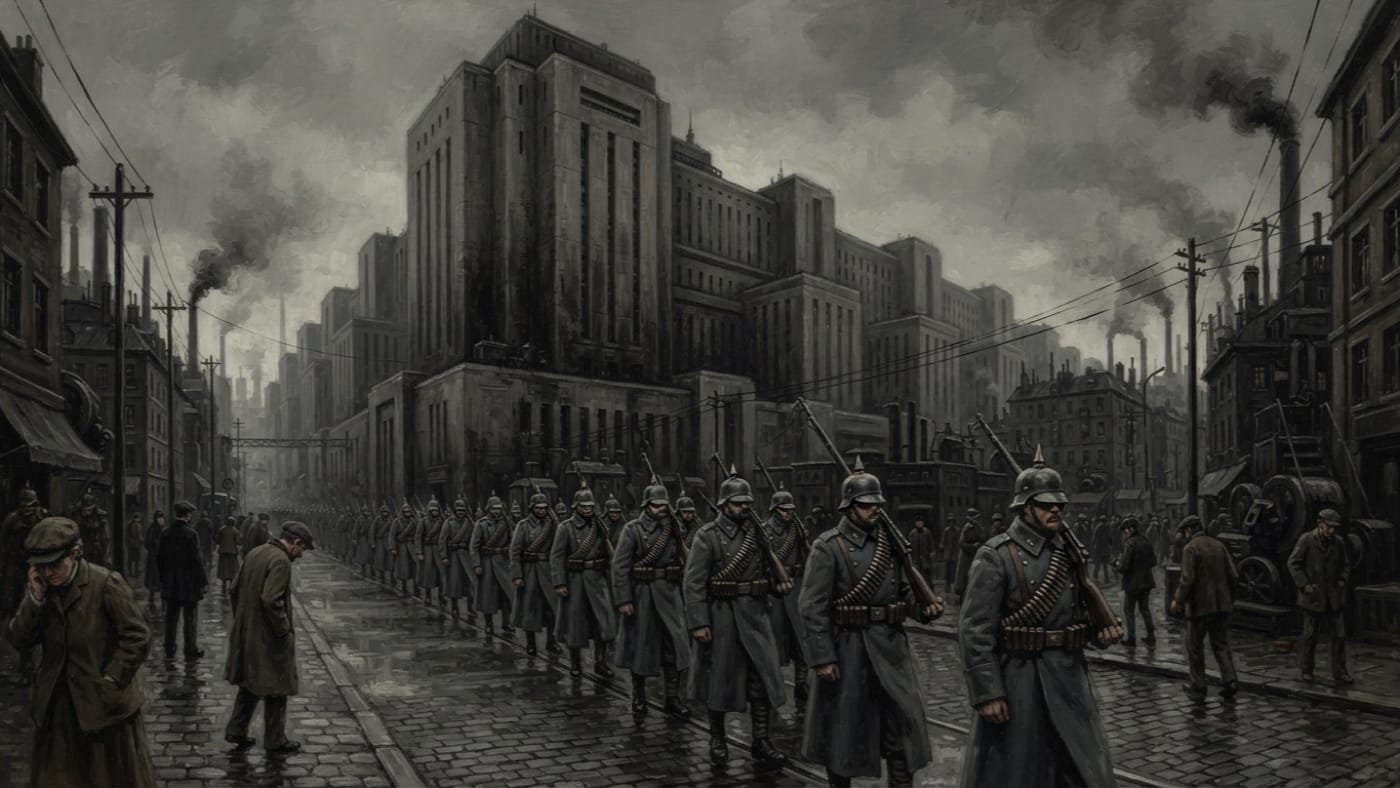
#On the Name and the Thing
The Ministry of Civic Security was the office of the Rationalist Republic to which the Republican Guards answered after A.S. 30. That sentence holds nearly everything the Church can certify about it. I put it first so that the reader may admire its economy before I spend the rest of this tract being uneconomical.
The name survives in the Forbidden Stacks, filed with the papers on the Guards' reorganization, like a signature at the foot of a warrant: legible, official, and belonging to no one in particular. Civic promised the citizen. Security promised that the citizen would be kept. The Republic kept a great many of them, in cellars, in ledgers, and in parish ground that nobody was permitted to consecrate.
Of its minister, its house, its seal, its clerks and its accounts, the Stacks say nothing. An archive's silence is not emptiness. It is a shelf waiting for the correct hand.
#On the Passage from Magistrate to Ministry
The Guards are older than their master. They began as public order companies attached to Rationalist magistracies in the first decade after De Vera Luce, when the Rationalists governed by local bench and local writ. A company answered to its magistrate. The magistrate answered to his own vanity and to whatever assembly had seated him. It was a parochial tyranny, and it knew the names of its victims' fathers.
The detachment at Saint-Malo marched under that older arrangement: a writ, a sergeant to read it, and a volley to finish the reading. No Ministry was needed to kill pilgrims at the Porte Saint-Vincent. The Republic managed it on municipal stationery.
An earlier catechetical chronology placed the Massacre at Saint-Malo in A.S. 17.
Corrected to A.S. 10 / 1720 CE. The error moved the first blood seven years nearer the Ministry, which had not earned it. Saint-Malo belongs to the magistrates. They may keep it.
The Night of Knives at Kraków, on 17 Martius A.S. 18, and the surrender of Aachen in A.S. 25 also fell within that era of local command, while the Atheist Wars were still being decided by men who could be found at home of an evening.
Then came the Treaty of Regensburg, A.S. 30 / 1740 CE. Rationalist administration had existed long before it. Regensburg gave that administration a constitution and a Republic, and divided the territory into thirty-seven Philosophical Prefectures. In the same settlement, the Guards' district columns were taken from the local Rational Magistrates and placed under the Council's Ministry of Civic Security.
The record does not say what the magistrates kept: whether they could still requisition a cohort, countermand a captain, or only sign the receipt for the bodies. I will not say it for them. The direction of travel is enough. Command left the town hall and went to an office no petitioner could find. A magistrate has neighbours. A ministry has correspondents.
#On the Instruments It Commanded
Three laws carried the Republic's unbelief into the street: the Secular Gatherings Act, the First Black Census, and the Edict of Ironmouth. The Guards enforced all three. After Regensburg the Guards answered to the Ministry, so the Ministry held the leash while those laws were enforced. On that much the folios agree.
They agree on nothing further. No surviving page shows that the Ministry drafted any of the three, heard the cases they produced, or tallied the census returns. The Republic was proud of the distance between its rooms. Law was composed in one, judged in another, and carried out on the cobbles by men who had read neither the composition nor the judgment. This principle of administration is sound enough that the Church, by pure coincidence, arrived at it on its own.
I decline to give the census or the Edict a year that the consulted folios will not swear to. They belong to the Republic's constitutional span, between the treaty and the ruin. That is enough to hang them by.
The work itself is well documented, because the Guards' own papers recorded it without shame. Under the Gatherings Act, a crowd kneeling in the street became an unlawful assembly once it grew large enough to inconvenience a magistrate. A column cleared the street, took the shrine, and carried the reliquary off to be weighed in public. Under the Black Census, the Guards stood at the elbow of the census table. A citizen who would not declare unbelief vanished from the ledger first and from the street soon after. Under Ironmouth, a spoken prayer became treason of the tongue, and the arresting party came with iron wire, because the Republic had learned at Kraków that a bound mouth is easier to classify.
Above the street, documents moved. Captains reported to the prefectures, and after A.S. 30 the column's chain ran up into the Ministry. Somewhere in that ascent a seized chalice became a line item, a priest became a detainee, and a kneeling widow became "ritual obstruction, dispersed."
#On What the Record Will Not Say
The parent record gives approximately four hundred thousand Republican Guards under arms by A.S. 30. Some of my colleagues have read that figure as the Ministry's establishment. They are wrong, and worse, they are imprecise. Four hundred thousand is the strength of the instrument. It says nothing about the hand on the hilt. The office above them might have been nine men in a cold room or nine hundred in a palace. Paper does not tell us, and I will not pretend that it does.
The same record counts the prefectural militia, the philosophical police, the municipal watch and the informants with armbands separately from the Guards. Whether any of them answered to the Ministry is unrecorded. It is tempting to drag every armed Rationalist under one ministerial roof. That temptation belongs to pamphleteers.
The Paris field directive of A.S. 13 is the one that reads Assemblies: disperse. Relics: catalogue. Clergy: detain. Resistance: correct. It is often quoted beside the Ministry's name, and it is seventeen years too early to be the Ministry's. It is a prefectural paper of the magistrates' era and stays filed there.
#On the Collapse of the Office
The Ministry's years were the years of the omens. There was the Year Without Dawn in A.S. 32, the Red Flood of the Danube in A.S. 34, and the Eastern Silence in A.S. 38. Each was explained, filed and forbidden as a subject of alarm. An office charged with civic security reported that security continued. Its columns stayed in good order and its ledgers stayed clean. The Republic's confidence in its Guards was administrative before it was military: a belief that whatever had been counted could be held, and whatever had been classified could be fought.
On 1 November A.S. 45 / 1755 CE came the Sundering. The legions of the Great Deceiver did not match the categories assigned to them. The Guards broke at Debrecen, burned on the Iron Plains, and deserted along the Danube in whole blocks, many of them begging for the priests their Republic had driven into the cellars. The Ministry broke with them, or after them, or some time before. No folio records its last working day. No decree of dissolution survives, and I suspect none was written. A ministry of security is not abolished. It stops receiving reports, and the silence is mistaken for peace until somebody opens the door to its rooms.
Guards survived. Some became Cellar Saint informants. Some taught the Church's early officers how the Republic had moved men, guns and writs. In time the Bureau of War took the drill and the Bureau of Records took the ledgers. Survivors are not an office, though, and a manual is not a charter. The Church that came into public view after A.S. 45 found Republican paper lying everywhere, and it picked up what was useful.
#On the Disposition of the Name
What remains is a name and a single sentence of command: district columns, Rational Magistrates, Regensburg, the Council's Ministry of Civic Security. From that sentence the Church may lawfully conclude that the Republic centralized its armed enforcement in A.S. 30 and that an office stood above the Guards until the Sundering ended it. Everything beyond that point is conjecture, and conjecture goes in the stove.
The Republic built an office to make its coercion orderly and gave it a name to make the order sound kind. The Bureau of Doctrine records the name and the office's subordination, and declines to supply it with a face.