
#On the Exercise
"Spell the heretic correctly. Then condemn him. Pedagogy consists of doing those two things in that order."
The Litany of Errors is an instructional observance of the Synod, recited by those the Church has judged ready to be told what went wrong. Its full order is not set out here. The Bureau has placed one component on the record, and I will not build the rest out of rumour and the half-remembered verses of bored seminarians. A reconstructed rite is a forgery with good intentions, and the archive keeps a special shelf for those.
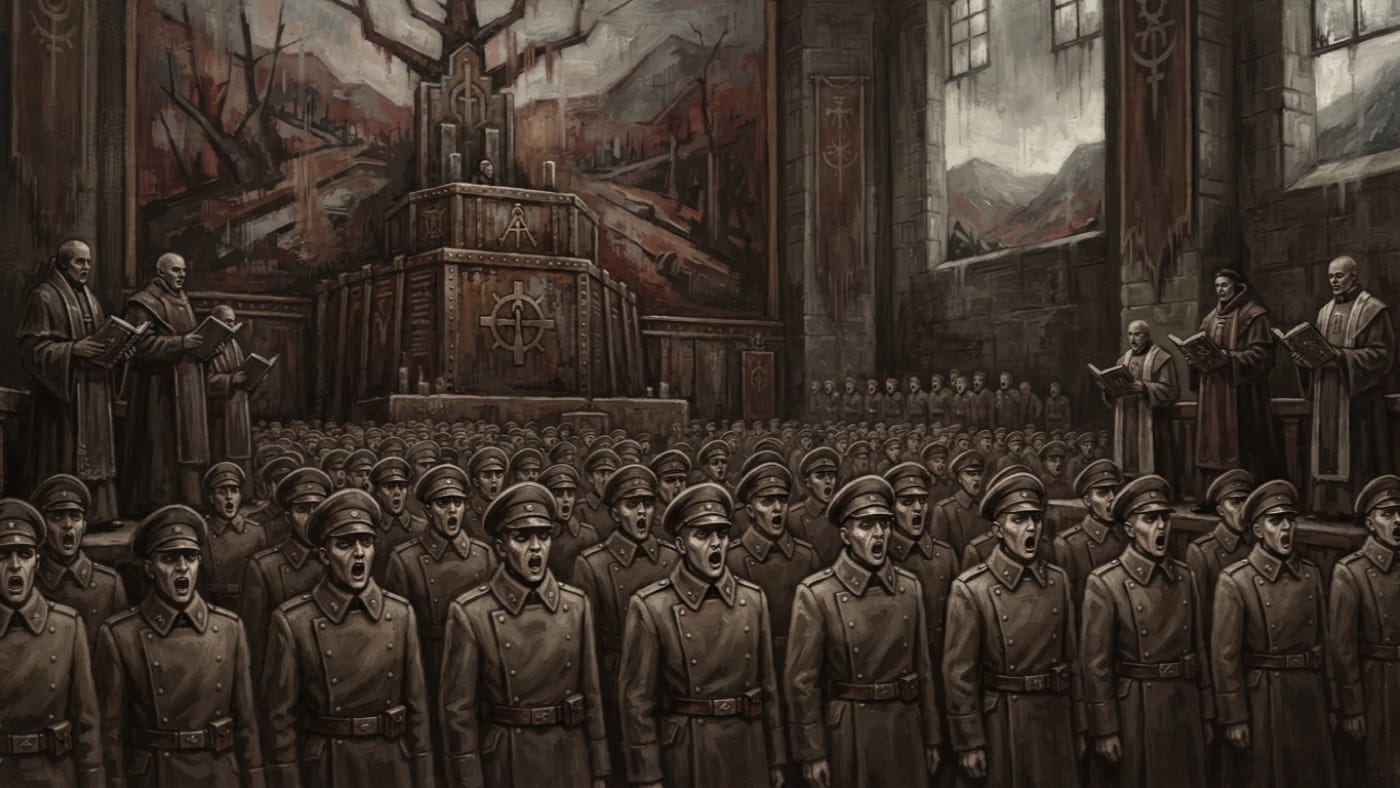
The documented component is this. Cadets at Bastion-Przemyśl recite the signatories of the Concordats of Ulm. They pronounce eleven names clearly, then a twelfth position in the words "the unknown twelfth, whose anonymity is itself a verdict." When the names are done, the cadets state in unison that the twelve were wrong. The exercise takes four minutes.
That is four minutes on a Carpathian ridge, within sight of the Wire Orchard, spent on twelve professors who signed a paper in a German common room two hundred and fifty-six years ago. The Bureau thinks this a good use of the time, and so do I.
A careless instructor would think the exercise makes two demands that quarrel with each other. The first is exactness: each name as Records holds it, with every consonant where the clerk put it. The second is judgment: the meaning of each name is fixed before the cadets open their mouths and must not change while the name is in there. A cadet who garbles Drenth has failed the archive. A cadet who pronounces Drenth beautifully, with a small lift of curiosity, has failed the Church. The Litany wants the name with the curiosity taken out. Any choirmaster will tell you that is harder than it sounds.
#On the Names Preserved
"The Bureau burns books. It does not burn names. Names are evidence."
The Concordats were signed at Ulm in the year the Bureau designates −55 A.S., which is 1655 by the old reckoning. Twelve men put their hands to a compact of "rational fraternity." It bound their universities into common inquiry and set theological supervision beneath that inquiry, where they supposed it would do the least harm. Their seal showed a compass bearing down on a cross. The Church has since given its opinion of the arrangement at length, in the Atheist Wars and in everything that followed them. The instrument lies in the Forbidden Stacks. The compact is condemned, and the men are dead.
Their names survive because the Bureau orders it. The Bureau of Records identifies them. The Bureau of Doctrine condemns and classifies them. The Bureau has made the names available for pedagogical purposes in catechism schools above the Fifth Tier. The threshold is exact, and I reproduce it exactly.
This Codex names three of them. Professor Georg Weidling of the Faculty of Mathematics wrote in a draft's margin that the compass should replace the crozier. Professor Kaspar Drenth was of Basel, and Dean Albrecht Moser was of Tübingen. The other eight are held on the Records register and recited at Przemyśl. They are not printed here, because this article is not a catechism school above the Fifth Tier and its readers have not been certified.
The Bureau keeps them for a reason. An error without an author behaves like weather: it comes back, and no one answers for it. An error with an author is a case that can be filed, cited and closed. The Rationalists wanted to be remembered as the founders of a fraternity of learning. The Synod grants the wish to the letter. Every one of them whose hand Records can read is remembered by name, by the cadets of a frontier garrison who have been told exactly what the names are for.
This Codex has previously stated that the Bureau made "the twelve names" available for pedagogical purposes.
The Bureau made eleven names and one designation available. Position twelve is not a name and has never been one. The cadets of Przemyśl recite what the Bureau holds and not a syllable more. The Codex will meet the standard it expects of cadets.
#On the Unknown Twelfth
"Illegibility is a condition of ink. Anonymity is a condition of conscience. The Litany knows which of the two it is teaching."
The twelfth signature on the Concordats cannot be read. Records has identified eleven signatories. On its own books the twelfth remains an open identification, and that is the whole of the evidence. The ink shows that someone signed and that the hand was poor, hurried or spoiled. It shows that no clerk of Records has yet made it give up a name. It shows nothing about why.
The Litany supplies the why: "the unknown twelfth, whose anonymity is itself a verdict." Listen to what the phrase does. It takes a smudge and gives it a motive. The blot becomes a choice, and the choice becomes concealment. The concealment becomes a confession, entered against the man in a form a company of cadets can say together. If pressed, Records will tell you it has established illegibility and nothing further. Records is correct. Records is not teaching the class.
I approve of the designation without reserve. A man who signs an instrument against the Church and leaves no legible name on it has done one of two things. Either he hid himself, or he did not care whether he would be known. Neither the Bureau of Doctrine nor the Litany asks me to decide which, because either one is a verdict. The phrase says so in nine words and does not waste a tenth.
There is one thing the designation must never do, and that is acquire a face. Guessing at position twelve belongs to Records and to no one else. A cadet with a theory about the twelfth has mistaken a condemnation for a parlour game.
#On the Four Minutes
"Four minutes is long enough to say eleven names properly and too short for anyone to admire them."
The record fixes the sequence: the eleven names, the designation, then the statement in unison. It gives the substance of that statement, which is that the twelve were wrong. It does not give a formula, and I will not issue one on the Bureau's behalf. A Hieromnemon who writes liturgy he was not asked to write is no better than a Rationalist with a pen.
Unison is the instrument. The Catechism Schools open each day with the Creed spoken together until the walls ring with it, and they treat discipline as the highest subject they teach. The Litany carries that teaching up to the ridge-line of the Sagittal Line. A verdict spoken by one voice is an opinion. A verdict spoken by a company is a fact about the company. No cadet carries it alone, and no cadet can hold it back without being heard to hold it back. In a stone room on a Carpathian ridge, that silence carries.
The record does not say why this bastion's cadets are the ones documented, and I will not invent a decree to explain it. I observe only that the passes opposite Przemyśl are held by Atheron, whose sin is Pride. The twelve of Ulm were proud men who believed themselves correct. A cadet who has spent four minutes declaring clever men wrong has had four minutes' practice at refusing flattery. The Bureau never told me this was the purpose. It did not have to.
The professors would have loathed the exercise. They would have loathed it in Latin, with footnotes, at a congress called for the purpose. Then they would have died, which is the only part of the plan they carried out on schedule.
#On the Use of Error
"The Church does not forget its enemies. It gives them assignments."
The names are preserved, and their meaning is fixed in advance. The Forbidden Stacks hold the instrument under seal. The Index Damnatus holds the titles of what came after, from De Vera Luce down to the last pamphlet. The cadets hold the names and nothing else. The Litany gives the signatories the one thing the Bureau can safely give a heretic: exact remembrance, with his own meaning stripped out and the correct one fixed in its place.
A name on its own carries no argument. Nobody recites Weidling's mathematics or Drenth's lectures. Nobody recites what Moser said at Tübingen, however long he went on saying it. The cadets learn whom to condemn and are never troubled with what was said. That is how the exercise saves effort: a heresy that has been explained must then be refuted, while a heresy that has only been named need only be condemned.
A junior clerk once described this to me as a contradiction. In his account, the Church keeps the names with a notary's care and then forbids anyone to learn what the men meant. The Bureau files the matter differently. The care is the condemnation. Every consonant set down exactly is a brand set down exactly, and a brand placed carelessly would be an insult to the man who earned it.
The Bureau considers the four minutes sufficient. I consider them a beginning, and the Bureau has not asked me what they begin. I will tell it anyway, in the margin of my next inspection report, where the Bureau keeps everything it intends to ignore.