
#On the Barefoot Anniversary
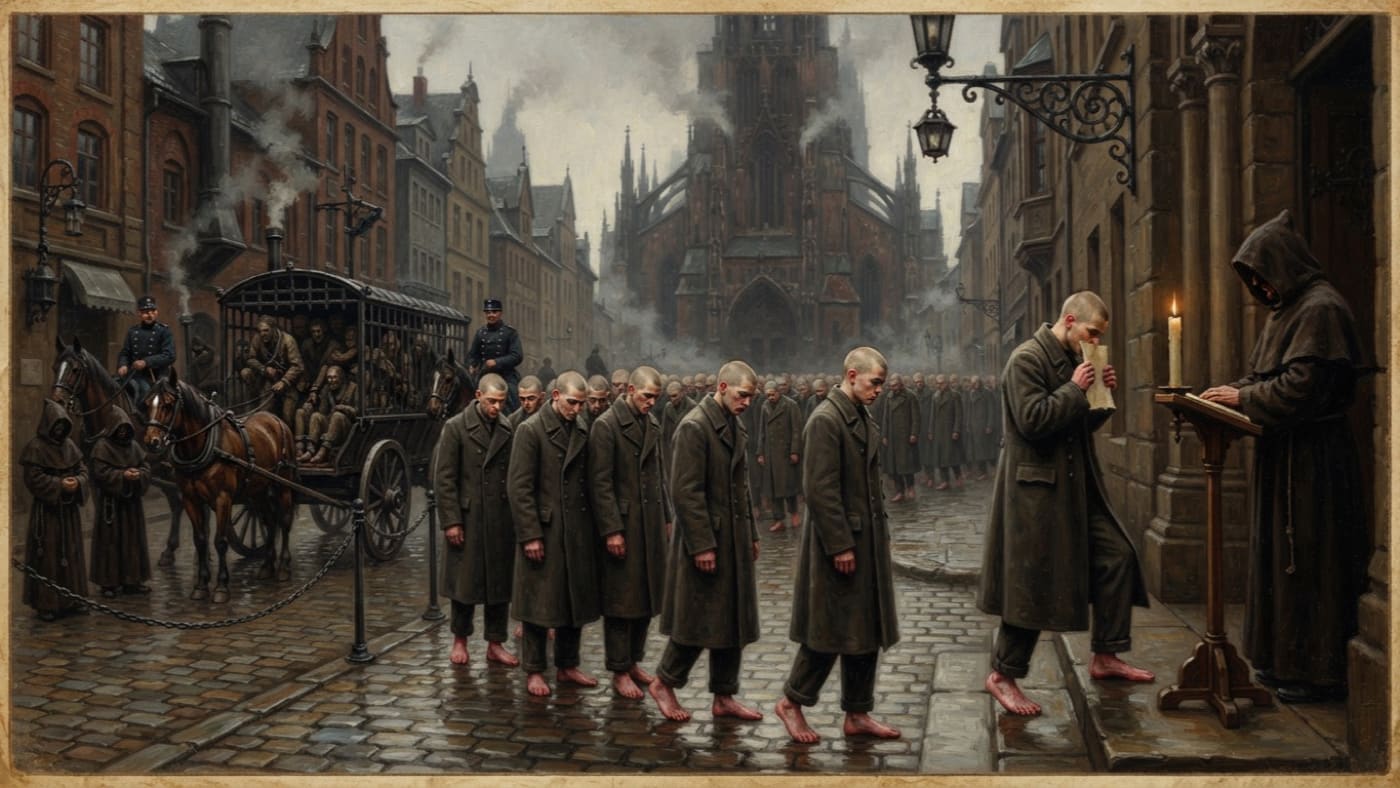
On the anniversary of the signing of the Concordats of Ulm, the students of Ulm go barefoot from the university court to the cathedral. There they recite the Litany of Twelve Errors. Each of them kisses a blank page, and after the kiss they move in silence. The municipal calendar lists the occasion among its penitential observances. I list it among the few civic ceremonies in the Heartlands that waste nothing.
Look at how little it spends. The route is one city's width. That is short enough to finish before anyone faints and long enough for every sole to learn the stone. The walkers are Ulm's corrected scholars. They study in doctrinal colleges housed in halls that once belonged to the Rationalists, and once a year they owe the city proof that the correction has held. Nobody asks whether a student wishes to walk. Asking would suggest that the answer had a use.
Whatever weather the anniversary brings, the stone does the rest. Ulm's streets were cut for carts. The students walk them in rank, with the spire ahead and the faculty court behind, and the city watches its young carry their learning from the place it was given to the place it must be excused.
#On the Twelve Who Are Meant
The compact was signed in −55 A.S., which is 1655 by the old reckoning and fifty-five years before the Bureau's calendar begins. Twelve professors and academic dignitaries put their hands to it. Its first article freed their inquiry from theological supervision. Its second set up an annual congress and a common curriculum. Its third gave them a seal: a compass bearing down on a cross. The Bureau of Records has identified eleven of the hands. The twelfth cannot be read, and the identification remains open. The rite's title counts twelve, and the compact supplies twelve: eleven names, Dean Albrecht Moser among them, and one hand no clerk can read.
The full words of the civic Litany are not in the files before me. The officiants have them and the students recite them. The Codex needs only to know what the rite concerns. I will not invent twelve errors to decorate a page the city keeps blank on purpose.
Corrected Ulm sends its students back to 1655 every year because they study in the compact's rooms. The faculty rooms where it took shape were consecrated, exorcised and turned into halls of doctrinal instruction. The presses that once carried it across the learned continent now print the Index Damnatus. The Bureau of Doctrine teaches that the compact cracked the foundation, and that every later weight widened the crack until the Great Deceiver's legions walked through. That is Doctrine's judgment of an instrument. By address, Ulm's young scholars are the instrument's nearest heirs. Once a year the city reminds them whose desks they sit at.
#On the Walk, the Words and the Kiss
The order is fixed: court, street, cathedral, recitation, kiss, silence. Each stage takes something from the body. The shoes go first. The voice is then handed over to approved words, the mouth is put to paper, and finally the voice is withdrawn altogether.
That is a whole education in one procession. The Rationalist professor trusted the mind to direct the mouth. Ulm reverses the arrangement and finds it more efficient. The observance prescribes the speech and prescribes the silence, and nowhere in the sequence does a student get a word of his own. The Catechism Schools spend years teaching children that discipline is the first subject. Ulm's university students take the lesson again every year, and they take it through the feet.
The students are also made to watch the convoys. Condemned scholars, scribes, clerks and their families go out along the Mine Road, and the Mines receive convoys twice weekly. During the observances the students are stood where they can see them. The record gives a single verb, watch, and leaves the convoy's place in the procession, its length and its noise to the imagination of anyone fool enough to supply them. The verb suffices. A young man has recited his errors on bare feet. Then he sees a cart of people whose learning was not corrected in time. He has been given the whole syllabus without reading a page.
#On the Sheet
The page is Ulm stock, and it is unmarked. Ulm stock comes from the Paper Mines outside the city. Condemned scholars, scribes, clerks and their households work there without names under Anonymous Productive Penance. Doctrine holds jurisdiction. The Bureau of Silence holds production custody. The galleries turn out archival paper, sermon stock, penitential forms and the vellum Silence uses for redaction. The Bureau has never explained how paper is mined from stone. It ships the product, and in Ulm that counts as an explanation.
So the student renounces unlawful learning on a sheet that unlawful learning made. A binder would admire the fit. The lawful scholar's mouth goes on the unlawful scholar's labour, and the only thing between them is a Redactor's eye.
Officially the blankness is the meaning. A corrected student has nothing to add to the sheet, so he gives his assent with his lips. A pen would leave evidence. A kiss leaves spit, and spit dries.
Sometimes the page warms under the mouth.
The municipal extract does not call this a scandal. It treats it as a contingency, which is worse and more honest.
Read the instruction the way a clerk reads it. It provides for darkening. It provides for text. It sends the matter upward to the presiding Redactor, and it forbids the student to read. It shows that the city expected something and wrote down what to do about it. That is the full extent of what it shows. What such text would say, whose hand it would be in and how often the contingency has been used all lie outside the extract. I hold no darkened page and no account of one. I will not supply the words the instruction forbids a student to read.
#On Neighbouring Litanies and the Present Use
Two other rites share a word with this one, and devout readers run all three together.
At Bastion-Przemyśl, the Litany of Errors has cadets pronounce the eleven identified signatories, give the twelfth position as a designation, and then state in unison that the twelve were wrong. It takes four minutes. Both exercises are on record, and neither record shows a shared wording, a shared length or a common descent. They condemn the same compact, and the Codex joins them on that point and no further.
The Litany of Saint Aldebrand belongs below the hill. A nameless labourer recited it in Gallery Three in A.S. 156, during a recovery Records has sealed. It was never a civic spectacle, and it gives the civic rite no origin, no text and no power. The bone is the saint's concern. The blank page is the city's.
The Codex entry on the Litany of Saint Aldebrand states that the Litany of Twelve Errors "renounces learning and calls on no bone."
Corrected. The municipal extract requires the student to renounce unlawful learning. Doctrine once ruled that, at Ulm, the adjective was the heresy. Here the adjective is the licence. Strike it and the city must close its colleges, and the Church cannot run on illiterate clerks. The clause about the bone stands as written.
That adjective governs Ulm in A.S. 201. The doctrinal colleges work in the old halls, under watch. The presses print approved paper at sanctioned volume. A young man may read what he is given, copy it, recite it and pass his examinations on it. Inquiry that goes on without supervision travels the Mine Road. There, in due course, it becomes the page a later year's students will kiss.
The students move off in silence. The page has been kissed. It is blank, and the Redactor has seen it.