
#On the Recorded Voice
The Litany of Saint Aldebrand appears in the Ledger once. The voice that recites it has no name attached. The gallery it comes from takes names away at intake. On the day it was heard, the people present could not see the table they were being counted past. Everything else about it is missing from the file. Its author is unrecorded, and so are its words. So are its responses, its melody, its language, the diocese that first sang it and the feast it belongs to. Records does not write down what a numbered labourer says while being counted. Records counts.
What survives is the circumstance. In Ulm's sealed account of the healing beneath the third of the Paper Mines, one recovered labourer began reciting the Litany of Saint Aldebrand. That labourer had been nameless for eleven years. No authorised devotional texts were kept below Gallery Three. The account places those two facts beside the recitation and then moves on, as accounts do when their authors have quotas.
I have no verse to offer. The temptation to supply one is considerable, and pious forgers have raised whole chapels on less. I decline. A litany invented in the Codex would become the first authorised devotional page ever issued for Gallery Three, and Doctrine would rightly ask who licensed it.
#On the Seventh Hour
The miners date the episode "when the pulp went sweet." The most stable record dates it A.S. 156. I use the record's year for the index. I keep the miners' phrase because it is the only line in the file that sounds as if a person said it.
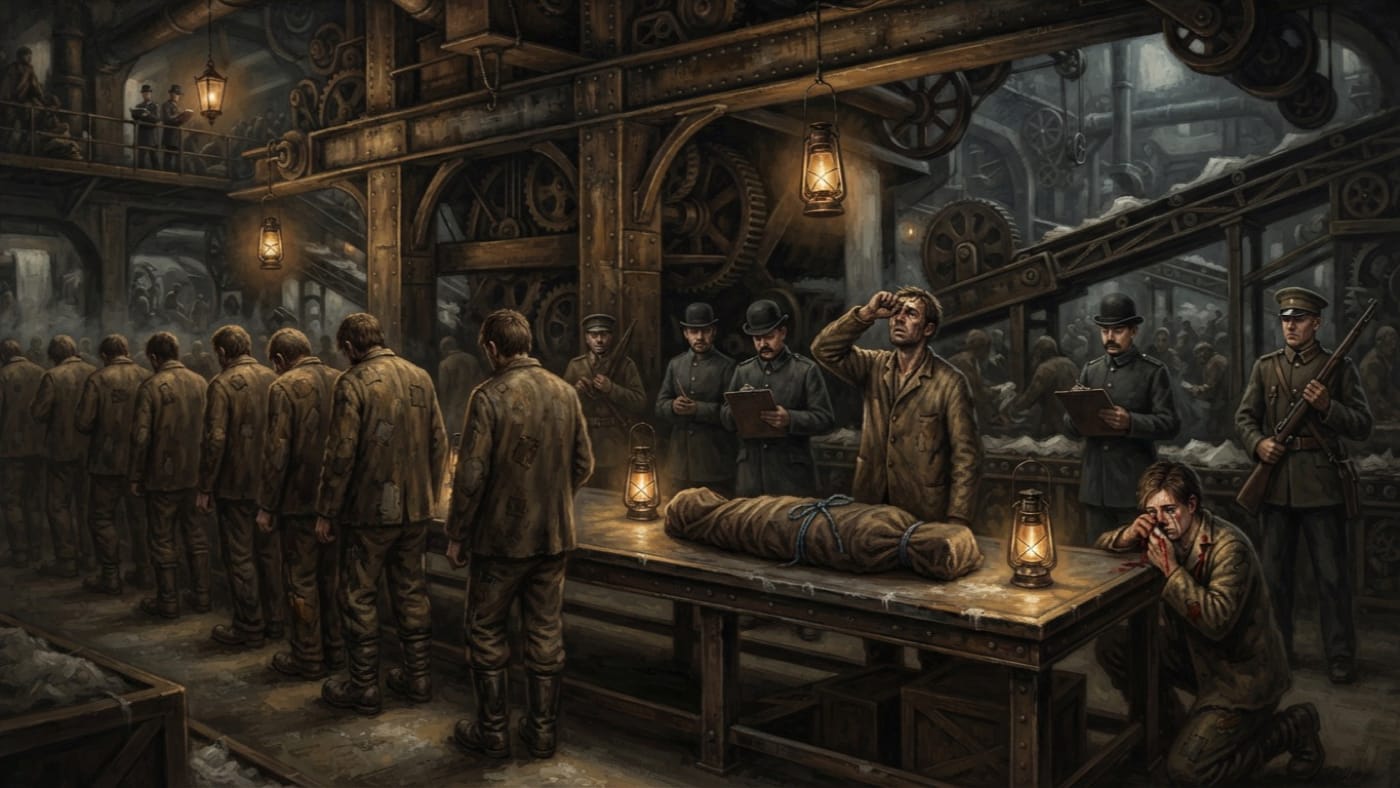
A white bloom of paper-dust filled a cutting gallery beneath the third Mine, and a shift of nameless labourers went blind in it. Three offices observed one catastrophe and filed three different ones. The overseer recorded occupational exposure. The Mercy surgeon recorded total corneal opacity. The guards recorded reduced productivity. I admire the guards. They alone wrote down what the institution actually minded.
At the seventh hour a wrapped object lay on the inspection table. It was bone-length, warm and unlabelled, tied with blue cord of pre-Synodic make. No guard admitted placing it there. None of the labourers could have seen it arrive. The blind were then ordered past the table to be counted, because a shift that cannot see can still be counted, and counting does not stop for catastrophe.
Each recovered their sight within arm's reach of the object. One wept blood. One began the Litany.
The order matters, and I defend it against every devout pamphleteer who would rearrange it. The account links recovery to nearness to the object. The recitation comes after. Nothing in the file says the chanting opened anyone's eyes. Nothing says the one who wept blood and the one who recited were the same person. Anyone who has defended a file before Doctrine should resist the urge to merge them into one convenient witness. There were two people and two entries, and neither has a name.
Records classified the event as occupational recovery. The miners called it a miracle and credited it to Aldebrand. Records' classification is the official one. Only the miners' version has a litany attached.
#On the Saint Whose Inventory Failed
Why Aldebrand? The account does not say, and I will not pretend to read the reciter's heart. Still, anyone who knows the saint's file can see why the miners chose him. He is patron of disputed relics, inconvenient bones and late vindications. His biography is historically incomplete. Approved and popular accounts both place him among the sick. Whether he healed there is a matter for the lives of the saint, and a saint's life is not a certificate.
His relic history reads like a charge sheet against every office that ever held it. In the Year of Letters, A.S. −32 / 1678 CE, Amsterdam's scholars attacked his relic claims as fraud, and his reliquary was declared absent from inventory. In A.S. 11 / 1721 CE the Trial of Saint Aldebrand in Amsterdam made sport of the femur count. In A.S. 95 / 1805 CE, during the Siege of Vienna, Clemens Stahlhand struck with the reliquary and the siege broke. Doctrine ratified the blow in A.S. 104 / 1814 CE. From the Year of Letters to Vienna is 127 years, and from the trial it is 84. Older catechisms say "sixty years," or "centuries later." Older catechisms say a great many things.
Several Aldebrand summaries state that the Bureau of Records declared his reliquary apocryphal in −32 A.S.
Corrected. There was no Bureau of Records in A.S. −32. The erasure was the work of the old ecclesiastical hierarchy under the Holy See of Vienna. Records inherited the decision along with the shelving. It has defended both with the zeal of an heir who never read the will.
Cologne holds seventeen notarised femurs. Strasbourg and Vienna dispute custody of the principal reliquary. None of this identifies the bundle on the Gallery Three table. It was bone-length and it was wrapped. Nobody in the record unwrapped it, and I will not unwrap it here. The A.S. 104 ratification concerns Vienna. It certifies nothing in Ulm.
What Vienna offers is a precedent of temperament: a saint whose bone keeps turning up where the inventory says it cannot be. A labourer kept under a number, in a sealed gallery the citizens above were never told about, had good reason to know that name.
#On Devotion Without an Authorised Page
Intake at the Mines takes names, belts, rings, letters and family prayers. Surnames are suspended and given names are sealed. The work is entered under Anonymous Productive Penance. The galleries produce archival paper, sermon stock and penitential forms. None of that paper goes back down as a prayer book for the hands that made it. The Bureau of Doctrine holds jurisdiction and the Bureau of Silence holds production custody. Between them they own every sheet in the hill.
They do not own memory. I say this as a matter of jurisdiction rather than sentiment. A clerk may confiscate a page, and a clerk may seal a name. To confiscate a recited text, you must confiscate the person reciting it. Whatever else the Mines economise on, they keep their labourers alive enough to count.
Eleven years nameless means exactly that. It does not mean eleven years mute or eleven years without prayer. It does not prove that the Litany had been forgotten and that Heaven dictated it back. Words pass from mouth to mouth anywhere mouths are allowed to breathe dust. The reciter may have carried the Litany down from a parish above. Another labourer may have taught it in the dark. The file does not say, and I will not have the file say it on my behalf.
Three things must be kept apart, because devout people will mash them together the moment my back is turned. First, the saint's short prayer, Aldebrand, whose bone remembered, make us remembered when our files are lost, belongs to his cult and his infantry. Nothing establishes it as the Litany's opening, refrain or summary. Second, the cult's pastoral advisory permits siege litanies as a general category, and that permission grants no licence to this named rite. Third, the Litany of Twelve Errors belongs to Ulm above ground. It is sung by students on the anniversary of the old Concordats and ends with a blank page kissed in the cathedral. It renounces learning and calls on no bone.
#On the Names Afterward
The object left in a lead-lined case. It has appeared in no public inventory since. The record names no one who carried it out, and it shows no interest in who carried it in.
Seven of the recovered labourers later lost their names again through ordinary procedure. Mark the word ordinary. They had their eyes back, and the next round of processing stripped what processing strips, with no remark on the miracle in between. I cannot tell you what they had briefly regained in order to lose it. The file says again and leaves the word to fend for itself. Seven is the number stripped, not the size of the shift.
Between A.S. 157 and A.S. 159, a name appeared faintly in the watermark of penitential forms. The Bureau attributes this to fibre contamination. No record ties the name to the reciter or to the one who wept blood. Those sheets were penitential forms, so somewhere someone made a confession on paper with a stranger's name pressed into it, and signed underneath.
No pardon followed and no release. Sight was returned, and the account records nothing else returned with it. Below Gallery Three, numbered labour has gone on uninterrupted.
The Litany's words are not in Codex hands. The record neither shows nor rules out its continued use in the galleries. The incident is sealed.