
#On the Lamps Above the Water
"If it shines, don't follow." — Marshworks proverb, still in circulation
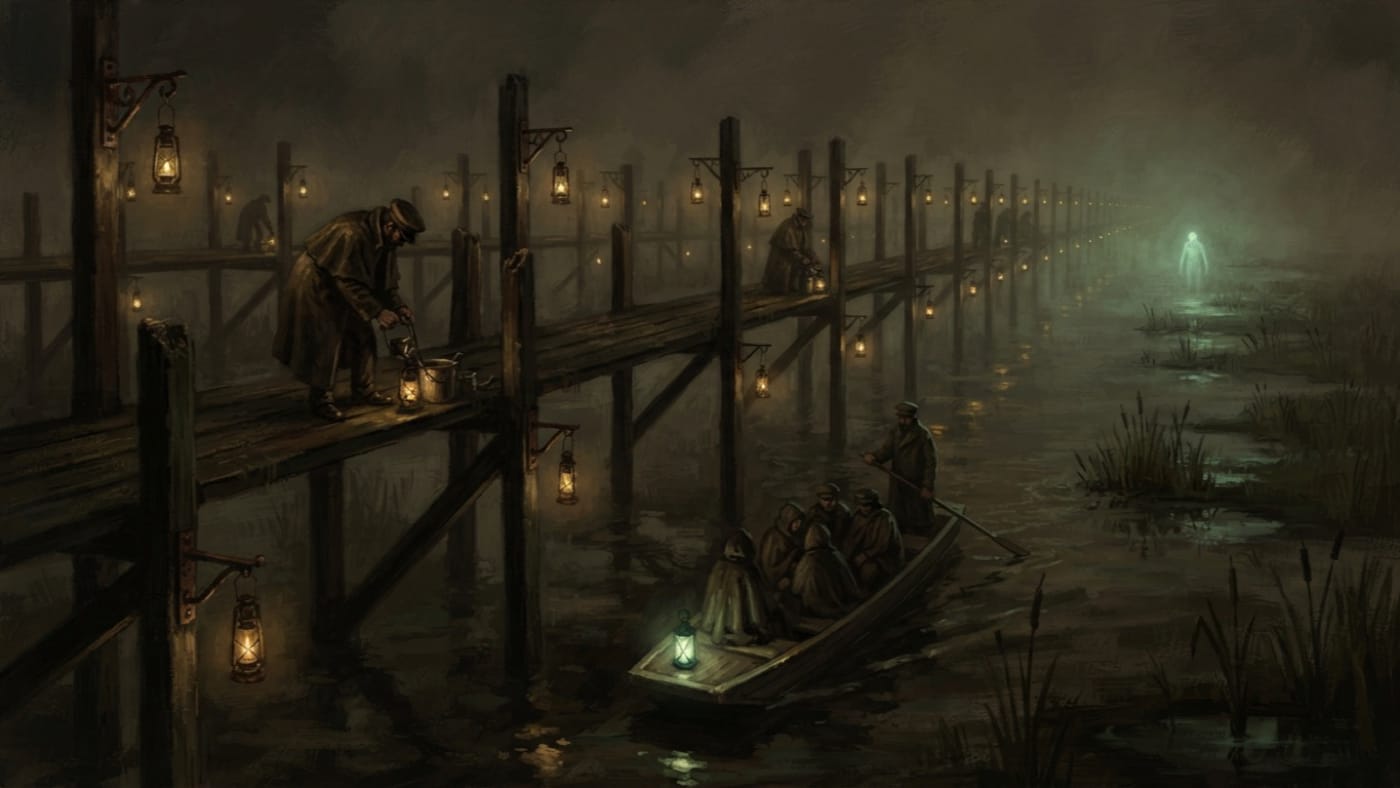
Fog rises off the Danube at the hour the Glyphyard stakers put down their muffled mallets. With it comes the only civic amenity in the Ash-Glyph Marshworks for which anyone has ever thanked the Creator. The Lantern Rackway is a chain of tallow lamps hung from iron brackets bolted to the stilts of the Ropewalk, the raised timber spine that carries the settlement from the Causeway Gate in the west to the Charnel Moorings in the east. The lamps hang a little above the waterline, low enough for a punt pilot to read them and, on a bad tide, low enough for the water to read them back.
Nobody has filed a length, a lamp count, a bracket spacing or an engineering drawing with the Bureau of Records. Officially the Rackway is a row of fixtures on someone else's causeway. Unofficially it is the reason a barge reaches the Moorings after sundown instead of the bottom of a sinkhole.
You measure it by its labour. Riggers work their way along the brackets with wick-shears and tallow pails, wet rope over one shoulder, rust coming off on their palms. Below them the lantern punts pole between reed beds and brackish pools. Farther out are the burial shallows, the channels that shift between one season's map and the next, and the sinkholes, which make no distinction between a keel and a clerk. Barges laden with the dead of the Sagittal Line wait in the fog for the lamps to tell them where to go.
The lamps answer in sequence: shuttered, unshuttered, held, doubled. A pilot who can read the sequence goes home. The pilot who misreads it enters the Bureau's records under "Weather."
#On Who May Set a Route
"The rigger decides who gets home by which light he hangs." — Reed Market saying
Every wick, every bracket, every route designation and every coded light on the Rackway belongs to the Lantern Guild of the Third Brine. Guildmaster Orren Pike holds the Guild, and with it the practical right to travel the Marshworks after dark without drowning. His assigned chaplain has reported that he speaks in route codes even at prayer. I believe the chaplain. I have heard Pike order soup.
The Guild's authority can be counted in objects. A boat that wants to move at night needs a brine-mark, the Guild's route permission, carried as a lamp token. Its master pays a lantern fee. The Guild's own people wear sashes knotted in a code that the rest of the settlement can recognize and cannot read. Some acts are forbidden outright. Lighting a forbidden colour on the Rackway is one of the Marshworks' red lines, and the Guild settles such matters without help from the magistrates.
The documents are thinner than the Guild's confidence. The published account of the Marshworks records a Lantern Guild Compact sealed in A.S. 88 and countersigned by the offices we now file as War and Bells. Those offices were not yet Bureaus. The Office of Bells had stood since A.S. 52 and the formal Synod would not exist until the Concordat of Strasbourg in A.S. 90, so any Bureau title on that seal is a later clerk's courtesy. The Marshworks charter is dated A.S. 74. Neither date tells us when the first bracket went into the first stilt, when the Guild began, or who began it. The Records hold no answer to any of those questions, and I will not invent one.
What the Records do show is the dependency. Salvage leaves Diver's Gut by water, corpse barges come in to the Moorings by water, and after dusk all of that water belongs to Pike. The Bureau of War declines to acknowledge the Guild's authority. Officers of the Bureau of War posted to the Marshworks obey the Guild's lamp codes without exception. Nobody has asked War to reconcile these positions, and War has no intention of trying.
#On the Answer and the Refusal
"We have classified it. Classification is not the same as knowing what it is." — marginal hand on a Bureau of Alchemical Standards file, unsigned
The Rackway's enemy is a light that knows its codes.
Over the burial shallows and the sinkholes there blooms what the Marshworks calls corpse-light, a green-white phosphorescence that the Bureau of Alchemical Standards designates anomalous bioluminescent discharge. That designation names an organism and a mechanism, and the Bureau has established neither. It describes what the clerks were told. The pilots tell it this way: the glow mimics channel markers. When a Rackway crew runs a sequence, a recognizable sequence sometimes comes back from a stretch of water where no lamp stands and no bracket has ever been bolted.
The Guild's men draw a distinction that outsiders find pedantic until they are on the water. A reflection belongs to its lamp. It lies beneath it, shivers when the lamp shivers, and dies when the lamp is doused. The reported answers stand somewhere else, apart from any bracket, in the place where a channel ought to be. Pilots argue on any given night about which of the two they are seeing. The argument is the danger. No riddle or proof exists that settles it, and anyone who sells you one is selling you a sinkhole.
The Guild's response is called Do Not Answer. When the water returns a sequence, the crew covers or extinguishes its lamps under black cloth. Vinegar smoke is raised. The rowers are blindfolded and pull to a bell-click cadence, counting strokes, keeping to Guild-marked routes. Dead names are never spoken over open water; bead-codes carry them instead. The bell is permitted, and so is the count. What is withheld is the light, and the name.
The Guild says this is the only procedure that works. That is the Guild's confidence. The Bureau has never ordered a comparison, and nobody volunteers to row the control boat. The Glow Choir holds that the light is calling, and the Reed Market claims that the right lamp pattern can redirect it. Both beliefs are attributed to their holders and certified by nobody.
In A.S. 196 came the Seventh Bloom. The account records that the light reproduced the stake geometry of the Glyphyard, that a barge followed those false markers into a sinkhole, that three men drowned, and that the markers were gone by dawn. The official finding was navigational error compounded by atmospheric conditions. The record does not say whether the crew answered or refused. I will not say it for them. The older catastrophe is undated: a convoy drawn into the shoals with hundreds drowned in sight of the lantern crews. It belongs to the Marshworks' memory and should not be confused with these three.
The Bureau has spent thirty years declining to address the corpse-light's answers.
The Bureau of Alchemical Standards first noticed the corpse-light in A.S. 143. The review has therefore stood open for fifty-eight years as of this assessment. A first notice does not establish a first occurrence. The Bureau regrets the earlier arithmetic and has added twenty-eight years to its own patience.
#On the Night Shift
The highest mortality in the Marshworks belongs to the night lantern shift. No number has been filed. The Rackway kills without leaving much paperwork. A rigger reaching for a guttering wick reaches a hand's width too far and goes into black water among the shallows, where the current, the cold and the mud all claim him before anyone can. Others kill nobody in a single night. They spend years in wet wool, standing in brine fog with the fumes of burning tallow in their lungs.
Volunteers are scarce. Debtors are not. The causeway fees outrun the salvage wages, so a season's diver or barge-hand learns that leaving costs more than staying. The settlement's quarantine has been temporary since A.S. 112, eighty-nine years, and it keeps the arithmetic sealed. Debt is worked off on the night shift. When the burial surges come with the offensives and the Moorings fill with barges, the Guild's ranks are filled by forced crews, and nobody asks them whether they can read a sequence.
The Rackway is necessary, and that does not make the Guild sovereign. The Ashbound Wardens hold the Causeway Gate and sell the quarantine exemptions; the night routes stop at Pike's last bracket. Cartographer-Provost Lysa Vane holds the burial maps, and a lamp sequence cannot move a grid. "Softstep" Maro holds the salvage intake, and nothing the Guild brings in by night is worth anything until it crosses his tables. Four powers, four ledgers, and the riggers owe a debt in all of them.
#On the Present Condition
"Too bright to work safely." — Guildmaster Orren Pike, on the marsh in A.S. 201
This entry follows the present-condition survey of the Marshworks for A.S. 201. The water is reported to be brighter. The Mortuary Cartography Office demands higher recovery yields, which means more barges, more night crossings and more brine-marks issued. Pike has said the marsh is too bright to work safely. The Office has noted his remark and raised the quota.
The lamps are lit every evening anyway, because the barges are still coming. The riggers go out along the brackets with their shears and their pails. The punts take their tokens and push off into the fog. Somewhere past the last bracket the water may run its sequence back to them, and the pilot must decide whether it is a reflection.