
#On the Answer from Unmarked Water
"If the light answers your oar, it wants your name." — Marshworks saying, current among the punt crews
Every night the Lantern Guild of the Third Brine lights its tallow lamps along the Rackway, the chain of iron brackets bolted beneath the Ropewalk of the Ash-Glyph Marshworks. Every night the barges at the mouth of the Danube steer by them. The arrangement is simple: the Guild lights a sequence, the sequence names a route, and a crew follows it. The corpse barges bringing the dead of the Sagittal Line's eastern theatres move this way after dark. So do the salvage punts and the couriers of three Bureaus. All of them assume that a lamp in the sequence was hung by a rigger who answers to the Guild.
Sometimes the water replies. A rigger lights a route, and the same route is lit back to him from open water, low on the surface, where no bracket stands. A crew looks for a channel marker and finds one, evenly spaced and steady, set over a sinkhole. These returns come from the corpse-light. Its nature has an entry of its own and will not be settled in this one. This entry concerns the returns. They look like authority and carry none.
For such nights the Guild keeps a precaution, and a family of coded patterns to go with it, under one name: Do Not Answer.
#On the Guild's Authority
The Codex can say who keeps the protocol. It cannot say who wrote it. Guildmaster Orren Pike holds the lamps, the brackets, the route designations and the codes. With them he holds the only licence to cross the Marshworks after dark with a reasonable expectation of breakfast. Nothing before this office shows that he invented Do Not Answer. He inherited it, or inherited the habit that became it, and he keeps it the way a sacristan keeps the plate.
The Guild's charter is the Lantern Guild Compact, sealed in A.S. 88. The settlement's own record says it was countersigned by the war office and the Office of Bells. Both were Bureaus in substance. The constitutional name arrived two years later with the Concordat of A.S. 90, and the Codex applies it backward with the customary shrug. The compact dates the Guild's standing. It does not date the precaution. No year of promulgation survives and no founding rigger is named, and I will not invent either from a dry desk.
Nor is Do Not Answer a decree of the Church. It binds no parish past the reed line. Its force is local and wholly practical. A crew that obeys usually arrives. A crew that does not usually ends up entered under "Weather." No document I have seen shows the Bureau of War acknowledging the Guild's authority, yet its officers posted to the delta keep the Guild's codes without exception. The Bureau holds one position on paper and another in the boat, and it holds both sincerely.
#On the Procedure
This entry does not reproduce the sequence of lamps that makes up the Do Not Answer pattern. Pike keeps it unpublished, and the Codex follows his example: a printed code can be copied, and the Codex cannot vouch for who reads it at night.
The precautions that go with the sequence are public. They are set down here in the order a crew performs them.
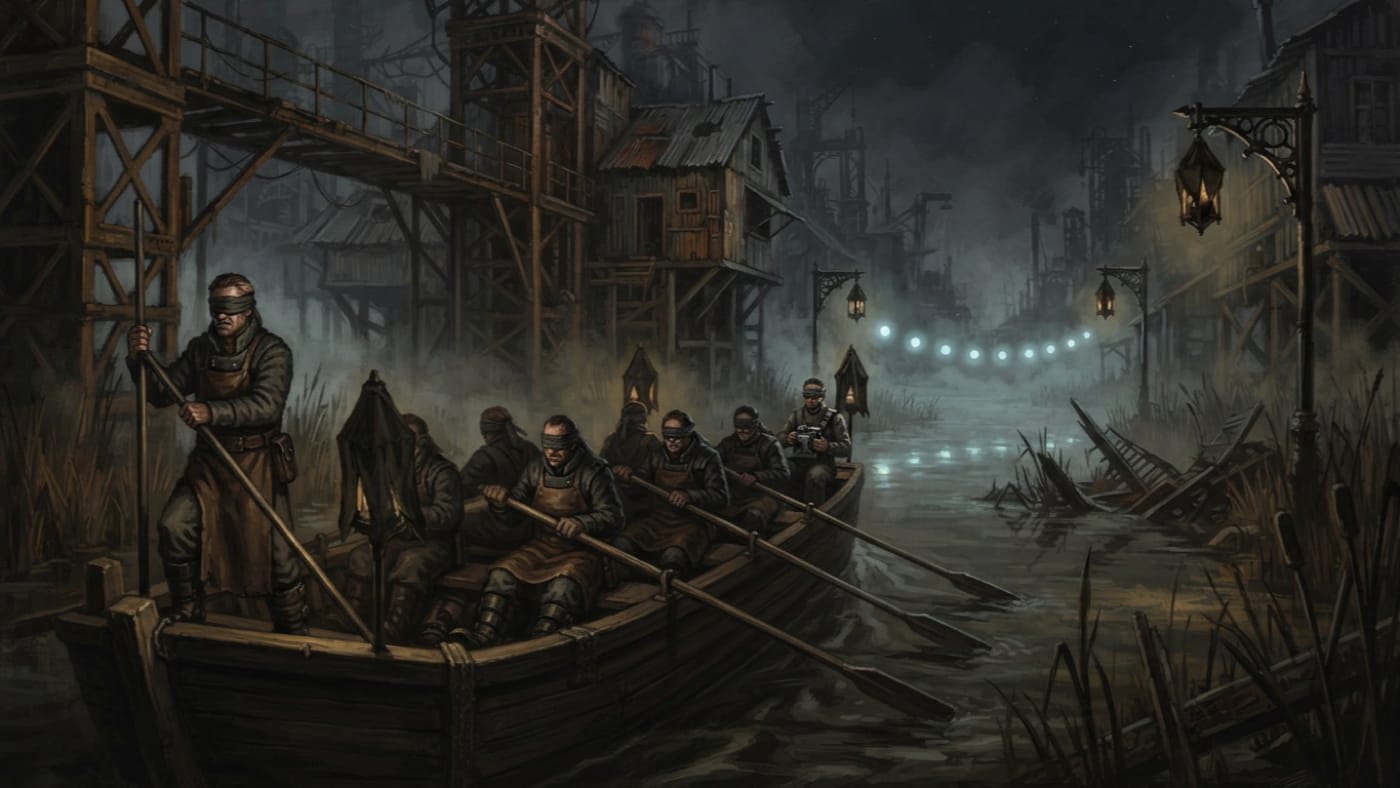
First, the crew puts out its own lights. Lamps are doused, or hooded in black cloth if a rigger may need them again. A lit lamp can be answered. A hooded lamp gives the marsh nothing to repeat.
Second, vinegar is burned where any is to hand. The settlement smells of vinegar already, and the Guild's crews smell of it worse. The records list the smoke among the measures without saying what it does, and the Codex claims no more for it than they do.
Third, a crew already on a Guild-marked route stays on it. The precaution never authorizes a new heading. It forbids the crew to accept one from the water.
Fourth, the oarsmen are blindfolded. Visitors find this comic and boatmen do not. A counterfeit is dangerous because it persuades. A forged sequence copies the true one. A forged grid copies the stakes of Cartographer-Provost Lysa Vane, and the true stakes are themselves reported to stand in different places by dawn. A pilot's eye has been trained for years to trust a familiar arrangement, and that training is exactly what the counterfeit exploits. So the Guild shuts the eye. Every light on the water is shut out, honest lamps with the rest, because a man at the oar cannot be asked to tell them apart at the moment it matters.
Fifth, the crew rows to the bell-click cadence and counts its strokes. The clicker keeps the beat, the count measures the distance, and the marked route holds the line. The intervals and totals belong to the Guild, and they are not printed here either.
The local rule of silence runs alongside the procedure without forming part of it. In the Marshworks no one speaks a dead name over open water. The Guild's men refer to the dead, the routes and one another by bead-codes and by the coded knots on their sashes. The click is permitted, and it is the one sound the procedure requires. A reader who knows Standing Order 22-S will see a family likeness and should not trust it. That order belongs to the Bureau of Purity and its rites. This is a boatmen's rule for a channel, and its silence is aimed at names rather than at sound.
#On the Seventh Bloom
"Navigational error compounded by atmospheric conditions." — Bureau finding, A.S. 196
The cost of trusting a familiar shape is on record. In A.S. 196 (1906 CE), on the night the locals count as the Seventh Bloom, a formation of light reproduced the stake geometry of the Glyphyard. A night crew took it for Vane's markers. Their barge went into a sinkhole and three men drowned. By dawn the markers were gone.
The Codex has no deposition from that barge and will not make one up. The record does not say what the crew saw, whether they had hooded their lamps, or whether anyone aboard called for the precaution. It says only that they followed a pattern they knew and that the pattern was false.
The protocol was made for the moment when what a pilot recognizes and what is safe stop being the same thing. A man who cannot see the counterfeit cannot follow it.
The finding quoted above has not been revised. It calls the error navigational, which is correct, and the conditions atmospheric, which is merely a word. The Bureau of Alchemical Standards keeps the light itself in a file that has been pending since A.S. 143.
"It is an absurd procedure. It is also the only one that works."
This sentence appeared in my account of the Marshworks. Its first half stands. Its second half claims a comparison that no register supports. The Codex has no tally of other procedures tried and failed, and no count of crews saved set against crews lost. "The only one that works" is the Guild's judgment, repeated with conviction by the men who row under it, and it is entered here as their judgment. My separate retractions, concerning the light's supposed intelligence and the thirty years I once gave the Bureau's review, are filed under Corpse-Light.
#On Those Required to Row
A precaution that blindfolds the oarsmen needs oarsmen who will accept the blindfold. The Marshworks supplies them by arithmetic. Causeway fees exceed salvage wages. Debts are worked off in labour, and the labour assigned is either the night lantern shift or the diver rotation. The night shift has the heaviest mortality in the settlement. Most of the men who row under Do Not Answer could not afford to be anywhere else.
The quarantine makes the sum worse. The Marshworks has been under quarantine since A.S. 112. The quarantine is called temporary and has lasted eighty-nine years. The Ashbound Wardens at the Causeway Gate hold the exemptions, and an exemption can be bought. Those who can pay leave by the causeway at noon. Those who cannot go out on the water at night, with hooded lamps at the bow and a strip of dark cloth across their eyes, counting.
Pike's monopoly is what holds this together. Only the Guild may declare a route, so only the Guild may declare a route safe, so the Guild's marks decide who reaches the Ropewalk in the morning. Reed Market talk credits Pike with one fear, that the light will one day choose him. The pastoral reports do not say whether he has confessed it.
The Bureau of Records files the recovered dead, and the Bureau of War delivers the next consignment. Between the two sits a guild that War countersigned in A.S. 88 and declines to acknowledge in A.S. 201.
The Glow Choir stands on the opposite bank. Its members sing to the light from the reed tunnels beyond the permitted boundary. Their theology holds that the light is a calling intelligence and that the proper response to a call is to go. Reports say that on certain nights the reeds hum back. They are still only reports. The Choir answers and the Guild does not. The Guild keeps a count of the delta's survivors, and the Choir has never published one.
#On the Present Application
In A.S. 201 the precaution is in steady use, and the demands on it are rising. The light is reported to be brighter. The Mortuary Cartography Office, run jointly by Records and War, calls for higher recovery yields. Pike calls the marsh "too bright to work safely." The yields are raised anyway, and every increase is paid for in night shifts. Vane redraws her maps each morning and files the discrepancies as drift.
The light's classification has been pending for fifty-eight years. Its first recorded notice, in A.S. 143, falls in the same year as Maldrake's fires over Thrace. The Bureau has filed that coincidence beside it, and no one has shown it to be more than a coincidence. Whatever answers from the water, Do Not Answer takes no position on it. The rule asks nothing about the light. It asks only that a crew refuse to be spoken to.
It is the one rite in the delta that needs no theology, and the Bureau of Doctrine has never been asked to ratify it.