
#On the Mourning Sect
"If it shines, don't follow." — Marshworks proverb, origin unknown
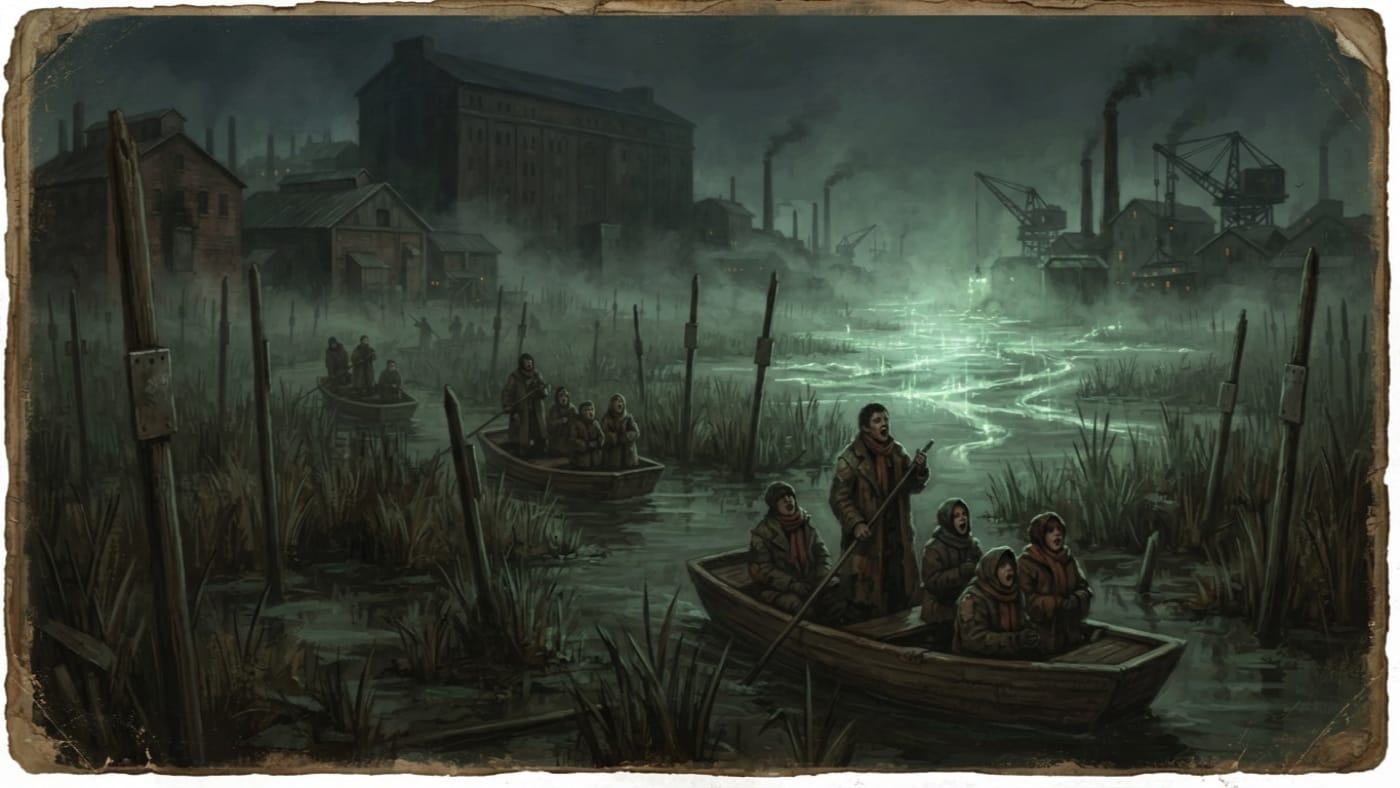
The Glow Choir is a sect of the Ash-Glyph Marshworks, the mortuary settlement at the mouth of the Danube where the eastern dead of the Sagittal Line are staked into burial grids and filed as coordinates. It has no chapel, no charter and no seal. It has a public description, "mourning hymns," and it has a place where it recruits, which is the Reed Market.
The Reed Market trades after curfew in defiance of three Bureau mandates. It sells lamp oil, eel broth, dry cloth and goods whose provenance would upset the tag clerks of Seal Shed Row. The Choir finds its members somewhere among the smoke and the broth-kettles. The record does not say how it finds them. It also does not say how many there are, who leads them, when the sect began or who began it. The Codex will not invent a founder just because a tract looks underdressed without one.
Anything said about the recruits is inference, and I mark it as such. The Marshworks is a settlement of the bereaved and the indebted. Barges bring in the dead by the thousand. Causeway fees outrun wages, and debtors work off what they owe on the night lantern shift or in the diver rotation. A sect that offers hymns for the dead does not have to gather a congregation, because the settlement has already gathered one. It need only open its mouth.
#On the Call in the Reeds
The Choir's public hymns are for the dead. Its worship is directed at the corpse-light, the green-white glow that rises at night over the burial shallows and sinkholes. The light copies the Lantern Guild's coded sequences from water where no lamp hangs, and it has supplied channel markers over ground too soft to bear a keel. The Bureau of Alchemical Standards calls it "anomalous bioluminescent discharge." That is a filing heading. It names no organism and settles no cause, and the classification has been pending for fifty-eight years, since the first recorded notice in A.S. 143 (1853 CE).
The Choir holds that the light is a calling intelligence. In its doctrine a call requires a response, and the response is to go.
The Codex records this as the Choir's theology and as nothing else. The observed facts are fewer. Lamp sequences come back from unmarked water, and markers appear where no stake was driven. Some who attend the singing report that on certain nights the light answers it. Others, attending the same nights, report a vibration in the reeds that they hear as song. These are two different reports, and I file them separately. Neither has produced an intelligible word. No hymn text survives in any register I have consulted, and I will not compose one here to make the sect easier to condemn.
From these observations the Choir infers a mind. The crews of the Rackway infer the same mind and reach the opposite conclusion. The Bureau has inferred nothing, and has done so very diligently, for fifty-eight years.
"They sing to it. The light, on certain nights, sings back — or produces a vibration in the reeds that the Choir interprets as song."
This sentence appeared in my survey of the Marshworks. Its first clause is correct. In the second I gave the light a voice on my own authority and offered the vibration as the lesser alternative, as though the record ranked them. It does not rank them. Both are listeners' reports. The larger error in that survey, my statement that the light is intelligent, is retracted under Corpse-Light, and this retraction follows from that one.
On the larger question the Church's doctrine is not in doubt. The Creator does not summon souls into sinkholes by lamplight, and a voice that asks the faithful to drown more likely comes from the Great Deceiver. I say this as a theologian. As an archivist I must note that the Bureau of Doctrine has issued no finding at all on the Glow Choir. By the only calendar that matters, my condemnation is premature. I record it anyway.
#On Songs, Shoals and Interference
The Choir meets beyond the permitted boundary, in the reed tunnels and on the off-route shoals. No cartographer would call these a territory. The Guild's routes do not run there and the Mortuary Cartography Office does not stake there. The Ashbound Wardens are paid to watch the tunnels and do not enter them after dark. No headquarters has been found, and I doubt the sect needs one. The reeds are enough.
The Choir gathers according to a condition rather than a calendar: a night when the marsh shines without wind. A still night removes one ordinary explanation for moving light. The record does not say whether the Choir gathers because stillness makes the glow look deliberate or because its doctrine counts such nights as calls. It records only that these are the nights when the Choir is active.
In the Marshworks, song was a regulated matter before the Choir sang a note. No one speaks a dead name over open water, and humming while staking is forbidden in the Glyphyard. A sect that sings to the burial shallows at night has broken local custom before it has broken any canon.
The settlement's survey lists the Choir's methods as songs, lures and sabotage. I repeat the words because they are the record. I cannot attach any of them to an operation, a date, a damaged lamp or a drowned man. The delta's wider heresy registers also list "boat-calling" rites. The Reed Market does not always tell a boat-caller from a chorister, but the Codex does.
#On Seven Investigations
The Bureau of Purity has investigated the Glow Choir seven times and arrested no one.
The Bureau has also recorded the Choir's recruiting at the Reed Market in seven consecutive inspection reports. From the files I have seen, I cannot tell whether these are the same seven or whether the investigations and the reports simply share a number. The Bureau of Purity does not lend its files to the Bureau of Records for comparison, and the Bureau of Records has not asked for them.
Three of the Choir's members are informants for the Bureau of Purity. Two more are the children of Seal Shed clerks. The Codex has no names, ranks or ages for any of the five. It does not know what the informants report, how often they report, or to whom. It does know two things. A Purity investigation of the Choir would end up questioning Purity's own sources. An arrest at the Reed Market would put the children of the men who stamp the settlement's dead on the wrong side of a stamp.
None of this makes the Choir immune. There is no warrant of protection and no sealed agreement, and the Bureau has never declared the Choir lawful. In fact it has declared nothing. Its restraint shows only as consequences that never arrive, which in the Marshworks is the most durable kind of policy there is.
My survey gave a third reason: that the Bureau is not entirely sure the Choir is wrong. I keep that sentence as my own reading. No Bureau has put any such doubt in writing.
#On the Guild's Refusal
Every night the Lantern Guild of the Third Brine, under Guildmaster Orren Pike, lights the coded sequences along the Rackway that make the Marshworks passable after dark. When the water returns a sequence nobody lit, the Guild applies the Do Not Answer precaution. Crews douse or hood their lamps and keep to the marked route. The oarsmen are blindfolded and row by bell-click cadence, counting strokes, with every light shut out.
The Glow Choir treats those same returns as invitations.
That is the entire quarrel, and it can kill without any declared feud. The Guild's authority rests on one assumption: that a lit sequence on the water was lit by the Guild. The Choir's worship rests on the opposite assumption, that something else lights the water and does so on purpose. When a rigger sees a sequence answered, he hoods his lamp. When a chorister sees the same answer, he sings louder. Nobody has reported a stolen Guild code, a sealed pact or a fight on the shoals. The two simply cannot both be right about the same light, and one of them rows home blindfolded.
The record shows what it costs to follow a familiar pattern. In A.S. 196 (1906 CE), on the night the locals call the Seventh Bloom, a formation of light reproduced the stake layout of the Glyphyard. A night crew took it for Cartographer-Provost Lysa Vane's markers, and three men drowned in a sinkhole. Nothing in the record links the Choir to that night, and I will not link it. The incident shows only what a convincing light can do to men who trust it.
My earlier survey called the Guild's precaution the only method that works. That claim has been withdrawn because nothing was ever compared against it. The Guild keeps a count of the crews who come home. If the Choir keeps any count, no one has seen it.
#On the Present Boldness
My survey of A.S. 201 (1911 CE) described the Choir as growing bolder. The Codex has no figures to set beside that word. It records no growth in membership, no new meeting place and no completed operation. What it does record is that the light is reported brighter, and that the Mortuary Cartography Office, run jointly by Records and the Bureau of War, demands higher recovery yields. Higher yields mean more night shifts, more debtors on the water, more grief at the Reed Market and more still nights.
The Reed Market says the Choir intends a hymn night to "summon the bright." I record this as Reed Market talk. No summoning appears in any register, and no document I have seen sets a date for one. The Codex makes no prediction from a rumour. The Bureau of Purity has presumably heard the same talk. If the night ever comes, three of its informants will be there.