
#On the Throat of the Marshworks
"Everyone leaves by the Gate. What varies is whether they walk." — Reed Market saying
The Ash-Glyph Marshworks has one road. It is a causeway of tarred timber and bone-lime piling that runs west from the head of the Ropewalk. It crosses soft ground the Bureau of Engineering rates "conditionally solid" and comes out in inland country, a day by wagon from the nearest city willing to admit it needs the place. There are boats, but boats belong to the Lantern Guild and to the corpse-light. Anyone who wants to leave the delta on foot has to pass the Causeway Gate, and so does anyone leaving with a cart, a debt, or a relic sewn into a coat lining. The Gate belongs to the Ashbound Wardens.
They are a militia clique, and I chose the word carefully. They are not a regiment. This office has searched the registers of the Bureau of War and found no Synodal rank for them, though any warden will tell you otherwise and several will show you a seal. Their public mandate is quarantine enforcement. In practice they sell exemptions from the quarantine and dispose of whatever the sale leaves over.
#On the Origin of the Cordon
"Temporary measures remain in force until the emergency is declared concluded." — Quarantine order, Marshworks garrison, A.S. 112
Rot-fever is real. It kills about a dozen workers each season, mostly those who sleep wet and eat whatever the Reed Market sells after curfew. Nobody has ever needed a militia to account for it. The fever was in the delta before the quarantine, and it would still be there if the quarantine were lifted tomorrow. The quarantine will not be lifted tomorrow.
What changed in A.S. 112 was the law. That year the Bureau of War found, in the way institutions find such things, that a declared quarantine let its local garrison restrict movement, seize goods, and detain people without troubling a magistrate. The order was issued as a temporary instrument. It has never been rescinded, and it has now stood for eighty-nine years.
In the first seasons the cordon was held by garrison soldiers. The people who hold it now are something the garrison no longer fully commands. Some are locals, or the sons of locals. Some are debtors who bought a place on the right side of the rope. A few are soldiers whose postings lapsed and who stayed on, because the Gate paid better than the Line.
Marsh accounts say the first cordon went up after workers began coughing dust in a settlement where nobody worked dust. The medical file on the matter is missing. The quarantine is not.
The quarantine order of A.S. 112 is an emergency measure, provisional pending the abatement of rot-fever in the delta.
No one has declared the emergency concluded, so it continues. An order that has governed a settlement for eighty-nine years is not provisional; it is the settlement's constitution. The Gate's posted notice still says "temporary" for the sake of consistent signage.
#On the Instruments of the Gate
"Hook the swimmer. Hook the body. Sort them on the planks." — Warden instruction, as reported by a barge-handler of the Charnel Moorings
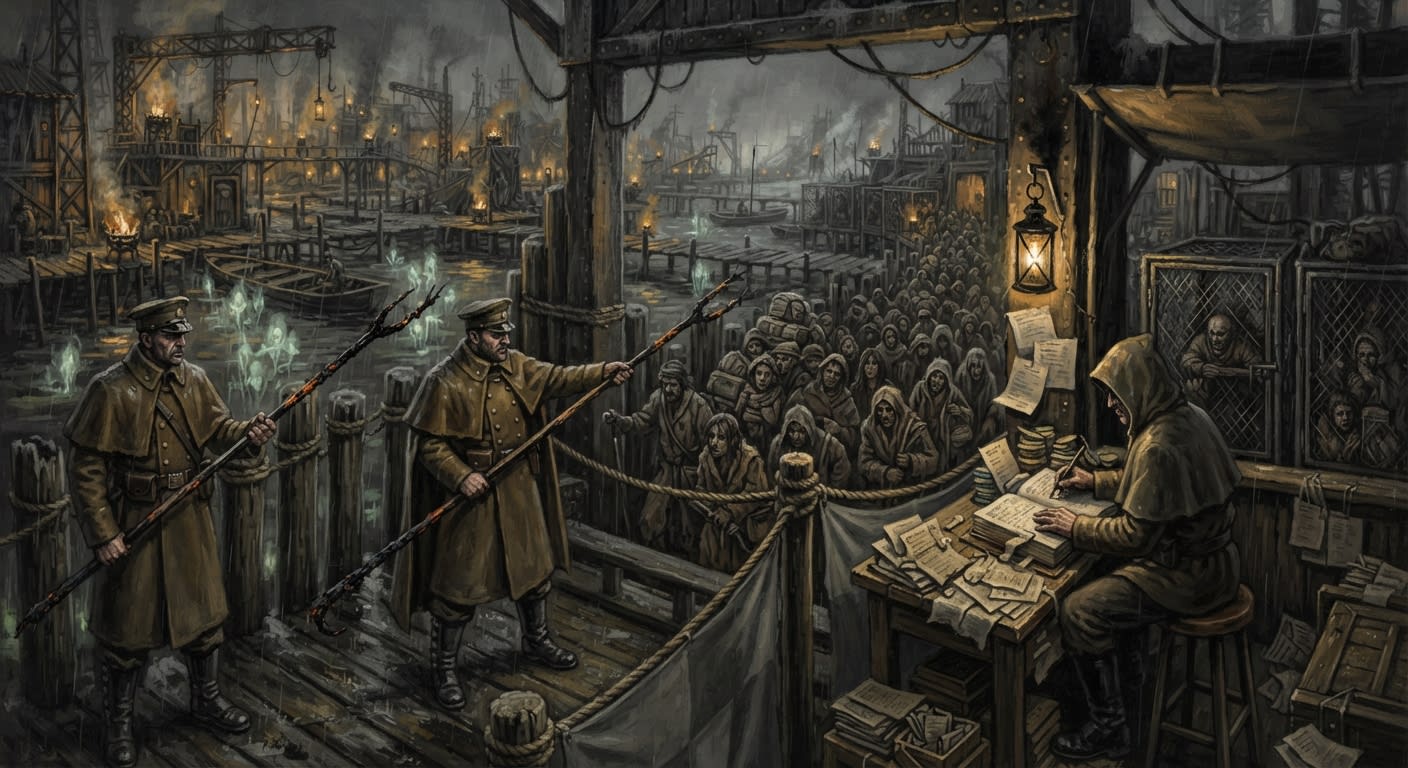
The hook-pole is the Warden's badge, weapon and trade: twelve feet of ash shaft ending in an iron gaff, with a backward barb for grip. It pulls corpses off the moorings when a barge fouls. It also pulls suspects out of the reeds when they try to get around the Gate through the water. The Wardens handle both the same way. Whoever holds the ledger sorts them afterward, on the planks.
The ledger is the second instrument. It is brine-stained, bound in waxed canvas, and kept in a hand the Bureau of Records would not recognize. It lists passes issued, fees taken, arrests made, and "releases to service." The third instrument is the cordon itself. It is a set of rope lanes and quarantine-grey flags strung along the causeway approach. The Wardens can move it in a quarter of an hour to close the Gate, to open it, or to shift a family from the departing lane into the holding lane.
The holding lane ends at cages on the moorings. The cages are officially for observation, and observation lasts until the prisoner pays a fee or accepts a labour assignment.
The Wardens close the Gate on any of the following:
- a plague rumour
- a riot
- a corpse-light bloom near the causeway
- a burial surge
- a crush at the Gate
- the arrival of an audit
Every closure is a reason to close, and every closure is a reason to charge for reopening. Only one thing at the Gate cannot be bought. A man caught tampering with a Glyphyard master stake is not sold passage at any price. The Wardens deliver him to the stake-line, and the stake-line does not issue receipts.
#On the Administrative Charge
"It is not a toll. A toll would require a charter." — Warden at the Causeway Gate, to a departing lime hauler
A causeway pass costs more than a season's salvage wage. That fact is the whole economy of the Marshworks, and the Wardens are the ones who do the sums.
They call their take the administrative charge. They levy it on entry and on exit. Carts pay by the axle and bundles by the weight. People pay according to the Wardens' guess at how badly they want to leave. Coin is accepted, but most people pay in the Marshworks' real currencies: lamp oil, dry cloth, "fresh ink" for a tag clerk's forgeries, or a salvage tag with the provenance line left blank. A diver with a medallion hidden in his cheek pays with the medallion. A barge crew carrying more corpses than its manifest lists pays by not asking where the extra ones go.
The Gate does not turn away people who cannot pay. It keeps them. A kept debtor is assigned to service, either night shifts on the Lantern Rackway or diver rotations in Diver's Gut and off the False Shore. The night shifts kill more people. The diver rotations produce more of what the Bureau of Records files as "cognitive irregularity." The debtor does not choose between them. The Warden holding the ledger chooses, and the choice has a price.
The Bureau of Mercy has been invited to inspect the Marshworks four times, and it has declined all four over eleven years, citing difficulties of scheduling. Mercy is the only Bureau the Wardens have never needed to bribe.
On the Line, the Gatewarden-Notaries stamp passage, and at Latchford the queue-marshals keep it in order. Both answer to a register, however badly kept. The Ashbound Wardens do not stamp passage or order it. They own it, and the register they answer to is their own.
#On the Company They Keep
Cartographer-Provost Lysa Vane needs the Gate shut at the right hours. A burial map stays believable only if nobody leaves the delta to contradict it, and the Wardens keep the witnesses in. She has never signed their ledger. She has never had to.
Guildmaster Orren Pike resents them. Wardens pull debtors off his night crews to run their own errands and walk his rackway without knowing the codes. During surges they treat his lamps as their own signal lanterns. When the marsh blooms near the causeway, though, Pike needs every hook-pole the Wardens have. Both sides know it, and the price of their help rises as the glow gets brighter.
"Softstep" Maro pays the Wardens when paying is cheaper and goes around them when it is not. The Mud-Relic Syndicate's relics leave the delta through the Gate. For accounting purposes, then, the Yesterday Finders and the Ashbound Wardens are one business keeping two sets of books. The Reed Market buys the Wardens' blind eye one night at a time.
The Glow Choir buys nothing. It moves through the reed tunnels, which the Wardens are paid to watch and do not enter after dark. The Bureau of Purity watches the Choir with the same care it has shown across seven consecutive reports.
#On the Present Condition
"If it shines, don't follow." — Marshworks proverb
This is the Gate in A.S. 201. The corpse-light grows brighter every year. Yesterday finds tripled between A.S. 194 and A.S. 200, and each one leaves the delta through the Gate in someone's lining, with a fee paid. The Mortuary Cartography Office wants higher recovery yields. Higher yields need more divers, and the Gate supplies them.
About three thousand nine hundred people live on the Marshworks' boards and platforms. During a burial surge that becomes between fifteen and twenty-three thousand, with forty barges queued at the moorings and a single road out. The Wardens' drill for a bloom near the causeway is to close the Gate. Their drill for a riot is also to close it, and so is their drill for a plague rumour. A surge brings all three conditions at once.
The barge widows say that what the Marshworks fears is a bloom that climbs the causeway. The Wardens' contribution to that night is already settled. They will be at the Gate with the cordon drawn and the ledger open. Behind them will be the whole settlement with its dead, sealed in with its paperwork in order.