
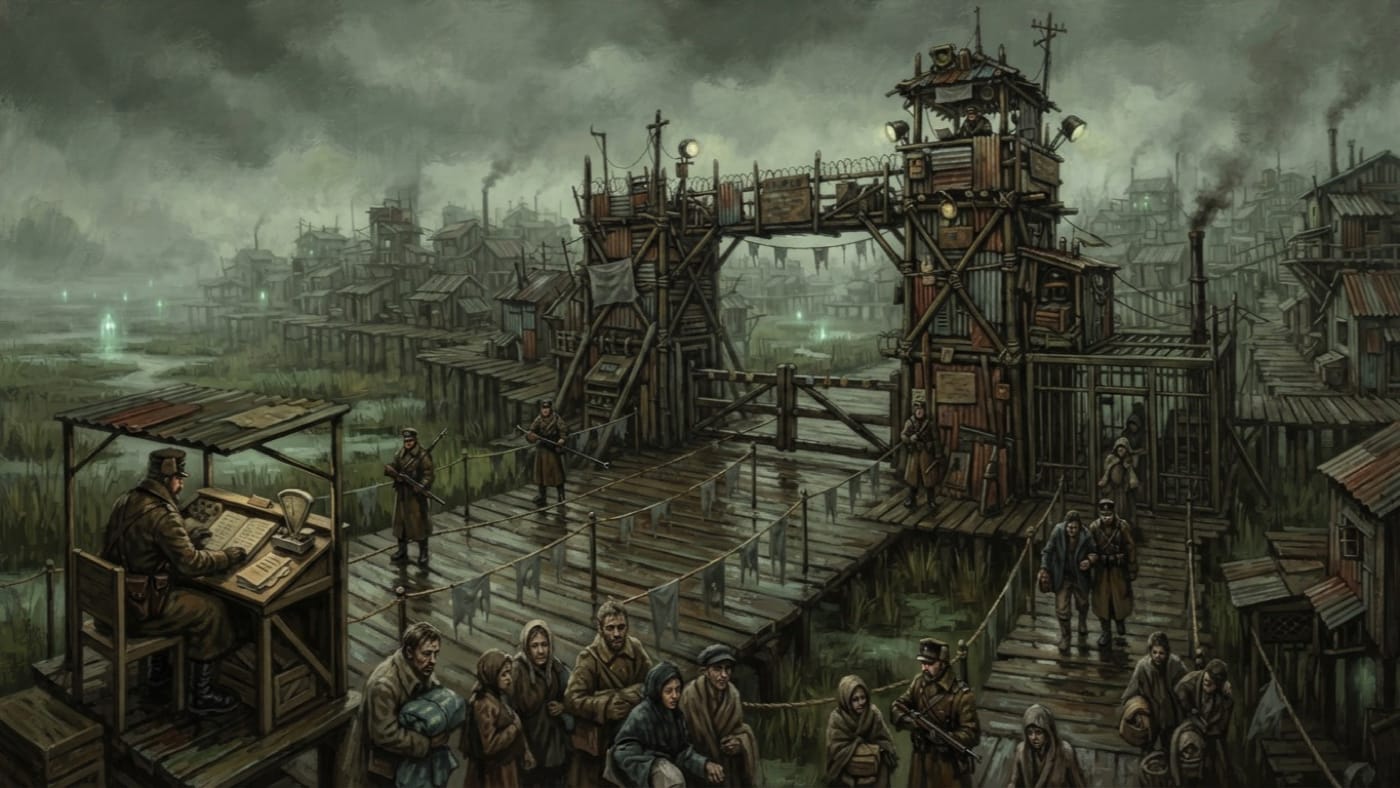
#On the Western Approach
"Everyone leaves by the Gate. What varies is whether they walk." — Reed Market saying
The Ash-Glyph Marshworks has one road, and the Causeway Gate stands at the end of it. The Ropewalk runs the length of the settlement, from the Charnel Moorings in the east to this western head. Past the Gate the same lashed and tarred timber, set on bone-lime pilings, carries on inland across reed marsh, brackish pool and mudflat. That ground will swallow a cart to the axles and a man to the collarbone. The Bureau of Engineering rates it "conditionally solid." The haulers rate it by how many of their cousins it has kept.
The nearest inland city is a day west by wagon. The delta's papers leave it unnamed, and so does this office.
The saying overstates the case, as Reed Market sayings do. Skiffs leave the delta, and so do barges. Smugglers leave through the reed tunnels with mud in their teeth. Anyone leaving by land, with a cart, a bundle or only a pair of boots, has to pass the Gate. The name covers two things: the checkpoint on the causeway, and the cluster of planking, rope lanes and wet sheds around it, which the clerks treat as a district of its own. It smells of tar and metal. Hook-poles tap on the boards, and the reeds hiss on both sides of the road. On still evenings the bells from the moorings carry the whole length of the Ropewalk and arrive faint and late, like a summons served on the wrong house.
Nothing on file records when the Gate was built or who built it. The Marshworks received its mortuary charter in A.S. 74, sixteen years before there was a formal Synod to file it under. The offices that sealed it are called Bureaus now, out of courtesy and hindsight. That date belongs to the settlement. The Gate has never claimed a date of its own.
#On Inspection and the Cordon
"Temporary measures remain in force until the emergency is declared concluded." — Quarantine order, Marshworks garrison, A.S. 112
A traveller coming in from the west reaches the cordon before the Gate. It is a set of rope lanes strung along the approach and hung with quarantine-grey flags that never dry. One lane leads in and one leads out. The third is the holding lane, which no traveller would choose. It ends at the far end of the settlement, at the observation cages on the Charnel Moorings, where observation lasts until the person observed pays or agrees to work. The Wardens can re-rig the lanes in a quarter of an hour. A family can start the morning in the departing lane and end it in the holding lane without taking a step.
The Gate inspects the papers the delta recognises: causeway permits, quarantine passes, salvage tags and corpse-barge manifests. Seals are checked. Travellers are assessed for fever, by whatever standard the Warden on duty brings to the work, and their cargo is opened. The Gate refuses untagged bones, unsanctioned relics, unmapped dead, plague cloth and blank seal books, and in the Marshworks the blank seal book is the most dangerous item on that list. Every decision goes into the ledger, which is brine-stained and bound in waxed canvas. It records passes, fees, arrests and releases to service.
The keepers of that ledger are the Ashbound Wardens, a local militia clique whose public mandate is quarantine enforcement. Strangers are misled by the name. They hold no Church rank of Warden, and when this office searched the registers of the Bureau of War it found no Synodal rank for them either. Out on the Line, Gatewarden-Notaries stamp passage and queue-marshals keep it in order, and both answer to a register. The Causeway Gate answers to its own.
The quarantine order dates from A.S. 112 and has stood for eighty-nine years. Rot-fever is real and kills about a dozen workers every season. The order tells the truth about the fever. Its only lie concerns the calendar.
The cordon at the Causeway Gate is a temporary measure, to be withdrawn when the emergency abates.
In eighty-nine years nobody has declared the emergency concluded, and nobody at the Gate is paid to declare it. The cordon is permanent. Any surviving copy that calls it temporary is retained for consistency of signage.
#On the Administrative Charge
"It is not a toll. A toll would require a charter." — Warden at the Causeway Gate, to a departing lime hauler
The Wardens call it the administrative charge, and they levy it at both ends of a stay, once on entry and again on exit. Carts pay by the axle and bundles by the weight. People pay according to how desperate they look. Coin is accepted. The Gate prefers lamp oil, dry cloth, or the "fresh ink" a tag clerk needs to make an old tag new. Exemptions from the quarantine are for sale at the same counter. The rope that keeps fever on one side of the road will lift for anyone who can pay to stand on the other side.
A salvage worker comes in from the west for a single season. Entering is affordable, and the Gate makes sure of that. Leaving costs more than the season paid. The parent registers record this as a structural feature of the settlement, and the Wardens' own practice confirms it: a pass out costs more than a season's salvage wage. A worker who did the sums only on arrival never gets to make the departure.
Their households wait on the approach. Wives, mothers and hauling partners sit on the wet boards outside the cordon with bread wrapped in oilcloth. They wait out each closure, ask for each name, and are told every time that the ledger is being updated.
The Gate keeps anyone who cannot pay. The ledger enters them as releases to service, which means night shifts on the Lantern Rackway or rotations among the divers. The night shifts kill more people. The diver rotations produce more of what the Bureau of Records files as "cognitive irregularity." The debtor does not get to choose. When a burial surge comes down the river, quarantine service requirements go up and forced crews are assembled, and the holding lane supplies the men. The Gate does not merely tolerate the debt it creates. It depends on it, because the debt is how the Marshworks is staffed.
#On the Powers Beyond the Barrier
"If the light answers your oar, it wants your name." — Marsh superstition
The Gate holds the road. It does not hold the Marshworks. Every seal it checks comes from somewhere else.
The Mortuary Cartography Office issues the maps and manifests. Cartographer-Provost Lysa Vane rules the Glyphyard and the official cartography of the dead. The Wardens' account, and this office's reading of it, is that she gains from a road that stays closed at the right hours. A burial map stays believable while no one leaves the delta to dispute it. No signature of hers appears in the Gate ledger, and none has been needed. The one boundary the Wardens never sell is hers. A man caught tampering with a Glyphyard master stake cannot buy passage at any price.
The water belongs to Orren Pike and the Lantern Guild of the Third Brine. Leaving by skiff after dark means leaving on the Guild's terms, by the Guild's lamp codes, through channels that the corpse-light imitates. The light blooms green-white over the burial shallows and the sinkholes. It mimics the safe lantern channels, and sometimes it answers signals. For those nights the Guild has its Do Not Answer protocol: the crew covers or douses its lamps and rows blindfold, counting strokes to the click of a bell. On the night of the Seventh Bloom, A.S. 196, three men drowned on the water. None of them was on the road. Pike resents the Wardens for taking debtors off his crews. He also needs their hook-poles whenever the marsh blooms near the causeway, and both sides price that need accordingly.
"Softstep" Maro controls what comes in from the salvage, and he pays the Wardens when paying is the cheaper option. The intermediaries of the Reed Market buy tolerance a night at a time. Relics carried out by land have to pass the Gate. Whether a forged tag passes along with them depends on whose ink was used and how fresh it is.
#On the Present Condition
The Gate in A.S. 201 stands on its pilings in good order, and the dead keep arriving behind it. About three thousand nine hundred people live permanently on the boards. During burial surges the settlement holds between fifteen and twenty-three thousand. Those are the settlement's totals. The Gate keeps no count of its queue, or at least no honest one. Anomalous recoveries are becoming more frequent, and total relic recovery rates tripled between A.S. 194 and A.S. 200. The Mortuary Cartography Office wants higher yields. Higher yields require more divers, and the Gate can always supply them.
The Wardens close the causeway for any of six causes: a plague rumour, a riot, a corpse-light bloom close to the road, a burial surge, a crush at the Gate, or the arrival of an audit. A surge brings most of these at once. Each closure costs something to lift, and somebody pays that cost in coin, in oil, or in a season pulled out of the mud.
The Bureau of Records first noted the corpse-light in A.S. 143. Its classification is still pending after fifty-eight years. In the meantime the marsh has settled on its own fear: a bloom that climbs the causeway and maps the living. It has not happened. The Wardens are already prepared for it. The cordon has been drawn for eighty-nine years, and the ledger is open.