
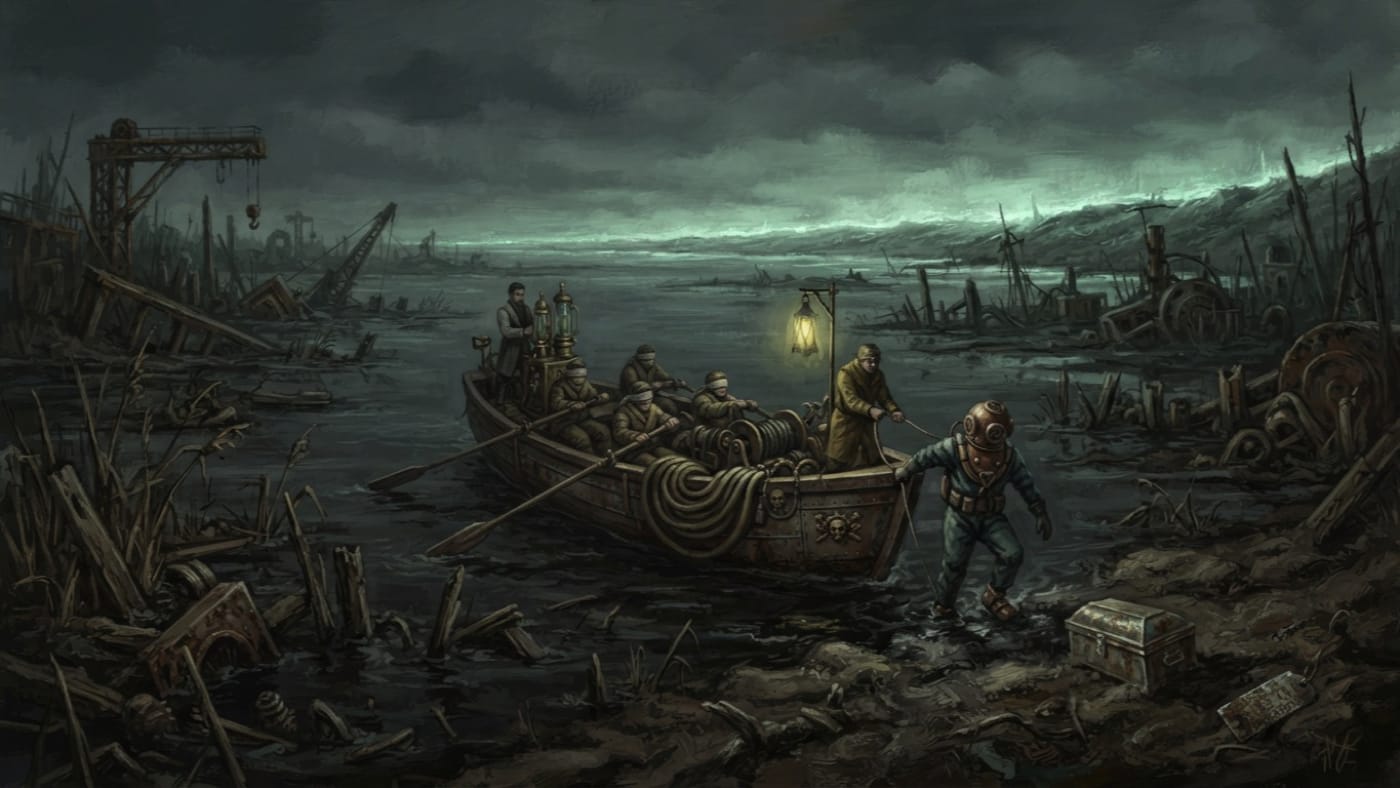
#On the Shore's Position
"If it shines, don't follow." — Marshworks proverb
The False Shore is a stretch of delta bank somewhere off the Ash-Glyph Marshworks, at the mouth of the Danube. "Somewhere" is the most precise word the archive will support. The Shore is no settlement. No guild keeps it, no warden taxes it, and no clerk has filed a dimension for it. It is a shoreline, which is the whole of its civil standing, and it cannot hold even that in one place.
The country around it is the ordinary delta of the Sagittal Line's eastern drainage. There is reed marsh, brackish pool, mudflat, grave berm and wreck shoal, and much of it is soft enough to take a man to the waist without ceremony. Against all this the False Shore shows a low bank that looks firm. The divers say, and the Marshworks survey repeats, that it changes position with the tides: it stands out of the water on one approach and is gone on the next. Crews report the smell of ozone, the sharp odour left after a lightning strike, and a cold light lying along the mud where the bank appears to be. Drownings are recorded there. Some of the relics that come up there come up fresh.
The record does not say whether the bank moves, whether the eye is cheated, whether the maps fail, or whether all three happen at once. It records only the consequence. A place that cannot be entered on a chart cannot be given a grid, a route or a fee, and the Marshworks knows no other way of owning anything.
#On Approaching the Water
The bank is the lesser danger. The water between the Ropewalk and the Shore holds every hazard the delta has. Sinkholes open under a planted pole. Tides come in faster than the crews expect. Rot-fever gets in through any cut, and cold finishes what exhaustion starts. Over the burial shallows and sinkholes the corpse-light blooms green-white in the patterns of safe channel markers. It has returned lantern sequences from places where no lamp stands. The crew that knows the way home is the easiest crew to show a convincing alternative.
At the Seventh Bloom in A.S. 196, false markers resembling the Glyphyard stakes led a barge into a sinkhole, and three men drowned. The record does not place that night at the False Shore. I cite it because every crew bound for the Shore remembers it.
"What the locals know — and what the Bureau's pending review has scrupulously avoided confirming — is that the corpse-light is intelligent."
The Codex's survey of the Marshworks stated this as knowledge. The record supports less than that. Crews hold the belief, and the Glow Choir worships by it. What has actually been observed is mimicry of channel markers and lamp sequences returned from places without lamps. Intelligence is an inference from those observations, and the Bureau of Alchemical Standards has classified nothing. The sentence is corrected here as it bears on the False Shore.
Night passage belongs to the Lantern Guild of the Third Brine, under Guildmaster Orren Pike, which controls the route marks and their coded lamps. When lights answer from the water, the Guild's recorded response is Do Not Answer. Lamps are covered or put out, the oarsmen are blindfolded, and the boat is rowed by bell-click cadence while the strokes are counted. The dedicated survey also lists vinegar smoke and strict keeping to Guild-marked routes. Crews swear by the procedure. No Bureau has tested it against any alternative, and the Guild has not invited one to try.
Local law forbids speaking a dead name over open water. Bell-clicks break no such law, and crews pass names by bead-code. A diver therefore reaches the False Shore blindfolded, silent about the dead, and usually in debt.
#On the Recoveries
Ordinary delta salvage comes up in the condition the mud intends. Iron is blistered, bronze is pitted green, bone has softened to the colour of weak tea, and timber has gone to sponge. The divers have hauled up such material for generations. A corroded medallion from the Shore draws no more remark than one from any other shoal.
The False Shore is known for its exceptions. The Marshworks survey names it as the source of the most significant "yesterday finds": reliquary fragments, saint medallions and consecrated instruments that rise with no corrosion and no water damage. Divers who work the Shore report that some of these come out of the mud already warm, as though a hand had recently held them. Elsewhere in the Marshworks, some yesterday finds have arrived with salvage tags already attached, stamped with dates not yet reached. These are three separate observations, and the archive keeps them separate. A fresh object need not be warm, and a warm object need not be tagged. Nobody has shown that any single recovery had all three.
From the boat, everything goes to Diver's Gut. There Diver-Boss "Softstep" Maro controls the intake and takes his percentage at the sorting tables. From the tables a find passes to Seal Shed Row for tag, seal and countersign. The Mud-Relic Syndicate, known on the Reed Market as the Yesterday Finders, plants relics and launders their provenance with forged tags and bribed clerks. The fraud is real and it pays well. Nobody has shown that it accounts for what the divers describe at the Shore, or that it doesn't.
From A.S. 194 onward, the Bureau of Alchemical Standards inspected eleven anomalous recoveries from the Marshworks. It certified eight as authentic and recorded three as indeterminate. The survey does not say how many of the eleven, if any, came from the False Shore. That kind of examination establishes what an object is. A relic authenticator can tell genuine metal from a forgery, but no one at the table can certify a bank that was gone the next morning. Material and provenance are separate questions, and the seal answers only the first.
#On the Casket of A.S. 199
Only one incident at the False Shore has reached the record with particulars. It occurred in A.S. 199 (1909 CE). The particulars are few, and I give them as the record gives them.
A recovery team at the Shore brought up a reliquary casket containing a finger-bone. According to the Marshworks survey, the Bureau of Alchemical Standards found that the bone matched no known saint, no known soldier and no known species of primate. A salvage tag was attached to the casket, bearing a date three days after the recovery. The finger-bone was confiscated, and the divers were reassigned.
That is the whole case. The file does not hold the day and month of the recovery, the inscription on the tag, the names of the crew, a case number, or the hand that ordered the confiscation. The Bureau's finding says only what the bone was not. It names no donor and no new creature, and this entry will not supply one. The date on the tag came and went three days after the recovery, and nothing in the record marks its passing.
The survey speculated that the object might rest in a vault in Strasbourg. That was a guess, and I withdraw the confidence while keeping the guess. The bone's present custody is unconfirmed. On what became of the casket, the record says nothing at all.
#On the Present Work
In A.S. 201 the Marshworks is asked for more relics than its water can safely give. Recovery rates across the settlement tripled between A.S. 194 and A.S. 200. The Mortuary Cartography Office, which the Bureau of Records and the Bureau of War administer jointly, calls for higher yields still. Guildmaster Pike reports that the marsh is too bright to work safely. Both statements are on file, and only one carries a quota.
The quota reaches the Shore by the shortest route. More yield means more night work. At the False Shore, night work means blindfolds and bell-clicks and a bank that may have moved by the time the boat arrives. The Ashbound Wardens, who enforce the quarantine and collect its fees, assign the rotations, and debt keeps them full. Cartographer-Provost Lysa Vane revises her maps daily. That serves the Glyphyard but does nothing for a recovery whose paperwork names a location the delta has since taken back. Seal Shed Row stamps whatever reaches it, and the Syndicate puts a price on whatever it can launder.
The crews fear a night when the light, the tide and the bank all agree on a false landing. No such night has been entered as an event. I leave it in the column the Bureau keeps for the future, ruled and blank until a clerk has something to put there.