
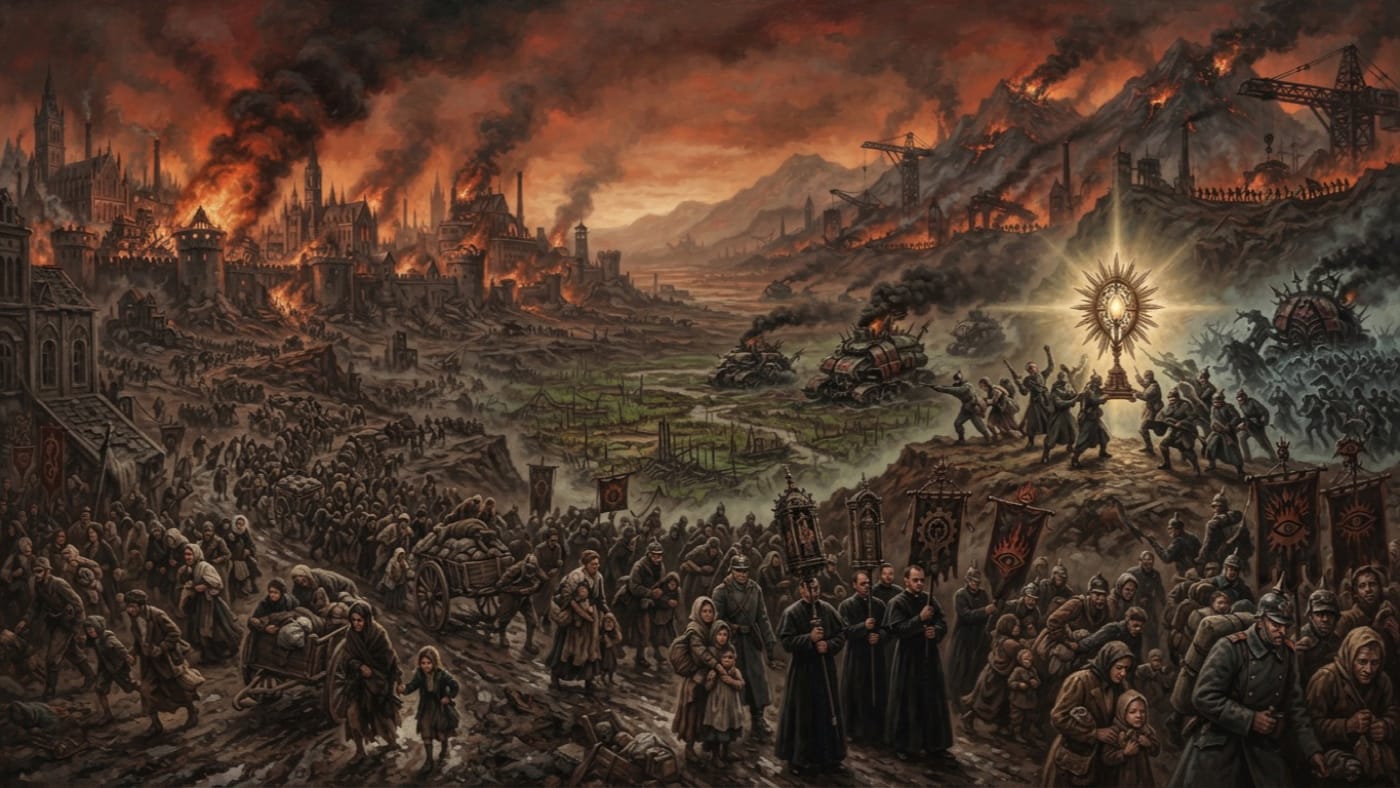
#On the Kingdoms That Fell
The Bureau's general account uses the phrase "Eastern Kingdoms" because a clerk needs one heading for many losses. No single crown fell. No federation signed a surrender or sent one last ambassador to the west. What fell was a broad country of separate jurisdictions: the Balkan valleys, the Serbian plains, the Thracian mountains and the Danubian flats where Hungary's grain once went to market. Each had its own garrisons, tax-farmers, bishops in hiding and quarrels over the price of salt. Each lost them along a road of its own.
The Bureau records the event as the failure of every ordinary instrument by which people are governed. Couriers stopped arriving. Granaries stopped feeding anyone. Garrisons stopped holding anything. Parish registers survived where a priest could carry them, and burned where he could not.
That is the true measure of a kingdom. The question is whether anyone still answers its letters. Its walls and banners matter less.
#On the Warning Before the Breach
The Eastern Silence of A.S. 38, or 1748 by the suppressed reckoning, was a warning and should not be read as the conquest. The difference matters, and the Rationalist Republic paid for it.
The Silence began with the post. Letters from Balkan villages stopped. Caravans set out and never reached their destinations. Scouts went east under orders and sent no reports back. Refugees crossing westward told of forests that moved by themselves, churches blackened overnight, and fog that filled whole valleys and drained out again leaving something wrong behind. The councils of the Republic, ruling since the Treaty of Regensburg had made Reason a constitution, studied this testimony and found the word they always reached for: plague.
They declared quarantine. They banned travel. Accounts of monsters were filed as superstitious hysteria, and the people who brought them were treated as carriers. The Republic had seven years to reconsider and spent them maintaining its quarantine notices.
It deserves stating that the Silence did not empty the East. Most of its towns were still standing, taxed and governed in A.S. 38. They were only unheard. Doctrine calls this mercy, offered and refused. I note only that the quarantine kept the warnings in and let the rest of the world sleep.
#On the Breaking of the Garrisons
On 1 November A.S. 45 / 1755 CE came the Sundering, which has its own entry and needs none of my repetition here. Doctrine calls it an instructional consequence of the Atheist Wars and their settlement. The mechanism is still open, and the Bureau keeps that file under seal.
Its effects need no seal. Hosts came out of the blackened mountains of Thrace and across the fog-covered plains of Serbia, led by the Seven Sin-Generals of the Great Deceiver. Readers who picture the Seven sitting at one campaign table with a shared map and agreed boundaries flatter them. They came as rival dominions, and their territories still overlap and devour one another's margins like parishes in a boundary suit.
The first blows fell on Skopje and Novi Sad. The registers record the garrisons there as overwhelmed within hours, and a garrison is an expensive thing to lose in hours. It represents years of conscription, powder bought on credit, and officers who had studied their manuals of fortification. Then the cities burned. Those who could not run were enslaved. Those who could run took their goods west in barrows, which choked the very roads the relieving columns needed.
At the Battle of the Iron Plains, somewhere on the Hungarian flatlands (the registry gives no more than a broad, inconsistently qualified association), whole divisions were consumed by fire falling from a cloudless sky. The Republic's artillery had been drilled to answer guns. Nobody had drilled it to answer weather.
Debrecen was a different kind of failure. There Kargath, Sin-General of Gluttony, devoured in one night the rations of a hundred thousand men, and in the morning those men broke and fled. The number records soldiers who ran. It is not a count of the dead, and anyone who quotes it as one will be corrected. Gluttony as Kargath practices it has little to do with a fat man at table. It is hunger that persists while food lies all around. His Blightmarsh still creeps over what were once the granaries of empires, bringing famine ahead of his armies. In his cursed fields the refugees ate their fill and starved anyway.
To the south, Maldrake of Wrath brought a cruder ruin. Thracian plains and Serbian valleys became slag and glass, and the mountains became forges where enslaved men worked the bellows until their lungs filled with embers. Kargath takes away a land's power to feed anyone. Maldrake takes away the land.
#On the Retreat and the Reliquary
The flight started at once. The Bureau later filed the Great Retreat under A.S. 48 to 65, and that range is a periodization for indexing. Nobody on a burning road in the first winter after the Sundering waited for the Bureau of Records to declare his retreat open. Families left in carts and on foot. Garrison remnants marched beside them with no supply line behind them. Each district had its own date of collapse, and many of those dates are lost for good.
In that retreat, at some point the registry has never fixed with any confidence, came the Last Stand of Kalnik Ridge. A ragged company of priests and conscripts carried the reliquary of Saint Isidore onto the ridge where Hungary's flatlands meet the Balkan foothills. The Sin-General of Wrath came down on them. Witnesses swore the relic shone like a sun and that the demon recoiled, shrieking.
The witnesses are the record. Doctrine supplies the reading: grace answered when it was carried forward in a reliquary by men too frightened to put it down. I endorse that reading in full and with my seal. I also note what Kalnik did not achieve. It recovered no city. It sent no host back across the Danube. It showed, once, at heavy cost, that the retreat could be made to halt. In the economy of a collapsing world, one demonstrated halt was worth more than a province.
Men who had spat at the altar asked for the cross afterwards. The Bureau of Relics has never once let anyone forget it.
#On the Authority That Followed
The Church did not come into being at the Sundering. Before A.S. 45 it lived in cellars and safe houses, wherever a priest could hold a sacrament without an informer listening. After A.S. 45 those hidden networks were among the few bodies still keeping records, preaching in the open and moving people along the roads in some order. A man with a vestry book and a working bell was worth more than a magistrate whose court had burned.
The takeover was uneven. Some districts accepted clergy as authorities within months. Others held out with Rationalist officers, private militias or nobody. A provisional council governed from about A.S. 50 as a working interim government, and it did not yet have the dignity of a Synod. The Common Allegiance of A.S. 55 was issued under the authority of Hierarch Augustinus, though its pages owe as much to Kratz and Sabine as to the man whose name heads it.
The Sagittal Line reached a defensible but incomplete form around A.S. 65 to 68. Its works were begun earlier by necessity and standardized afterwards by the Bureau. The Line runs north to south, from Bastion-Königsberg on the Baltic to Bastion-Constantinople on the Bosphorus, with the Carpathians in the middle of its course.
The Line spanned from the Carpathians to the Aegean.
Earlier entries of this Codex gave the whole Line that course. The Carpathians are its middle, and its ends lie on the Baltic and the Bosphorus. The Bureau regrets setting half a wall in ink as though it were the whole of one.
The constitutional settlement came much later, at the Concordat of Strasbourg in A.S. 90, which gave the Bureaucratic Synod its formal shape. By then the founders were both dead. Refugees from the East had become citizens of a theocracy, and they had not been consulted. Few of the drowned are consulted about the shape of the boat.
#On the Lands Still Entered in the Ledger
In A.S. 201 the lost East lies behind the Line under the name of the Charnel Lands: slag country, blightmarsh, crucible cities and starving cities that still run markets. It is still inhabited. Enslaved men and women work Maldrake's forges. Corrupted populations serve because they chose to, were deceived or were chained. Surviving settlements hold on in places the registry has given up trying to map. The Bureau does not record them as dead, because nobody has verified that they are dead. Nor does it record them as faithful, because nobody has verified that either.
The Synod lists the Eastern Kingdoms as temporarily occupied territories, and has done so for about a century and a half. The designation promises no reconquest by any date, and it assigns no single day of loss to any town. It keeps the account open. The Ledger does not close an account just because the debtor has been eaten.