
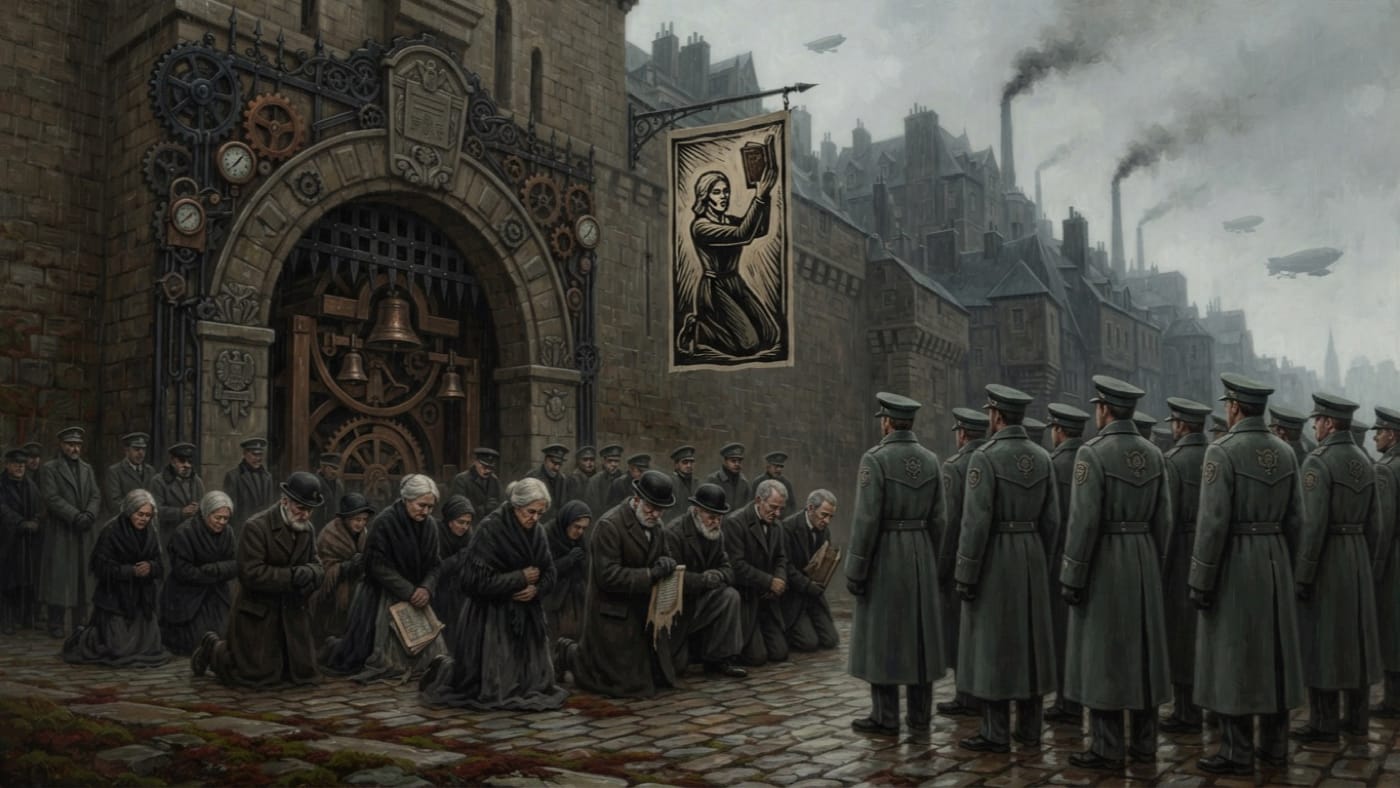
#On the Appointed Day
On the fourteenth day of Corvus the Church keeps two observances in a single square of the calendar. The faithful know the first, the Feast of Saint Margaux of the First Blood, because her face hangs in every parish hall west of the Line. The second is the Day of the Thirty-One Names, and the faithful attend it without being able to say a single one of the names.
The later Church calendar assigns this date. It did not inherit it. No surviving witness to the Massacre at Saint-Malo in A.S. 10 / 1720 CE wrote down a day and month that the Bureau of Records can produce under seal. Corvus is a month of the Church's own later naming, and no conversion into the months of the old reckoning has ever been approved. The dead are mourned on a day appointed for them. Whether it is the day they died, the Records do not say, and I will not say it for them.
Nobody has established when the observance began either. The tribunal of A.S. 14 dates Margaux's recognition and nothing more. The settlement of A.S. 90 numbered the years retrospectively, and no year it numbered carries a founding notice for this Day. What follows is a survey of the Day as it is kept in the present year, A.S. 201, and I have claimed no earlier history for it than the archive can bear.
#On the Thirty-One
Forty-three pilgrims set out from Dinan with the Reliquary of Saint Matthias, bound for the Chapel of the Tide on the marsh road beyond Saint-Malo. Forty-three is the ratified count. Some accounts give sixty, and the Bureau has heard them, filed them and left the figure where it was. At Saint-Malo, Republican Guards fell upon the procession, claiming the authority of secular law, and the Atheist Wars followed. Survivors said the sky cracked with thunder. The Bureau of Doctrine holds an opinion about that thunder, and the Bureau of Records holds the depositions. In this entry the depositions take precedence.
The later Martyrology of Saint-Malo sorts the forty-three into three columns: thirty-one certified dead, seven wounded witnesses and five consumed absences. The third column is an administrative designation. It names a category of entry in the register. It does not tell you what became of five people, and since the Records will say nothing further, I shall say nothing further either.
Father Gaël of Dinan led the procession and is counted among the thirty-one. So is Sister Margaux of the Blessed Thorn, sixty-three years old, small and grey, who died on her knees holding a psalter. So is a child of nine. The Bureau keeps the child's name in the Folio of the First Fallen and does not publish it.
The remaining twenty-eight were pilgrims of the coast road. They had parishes, trades and debts, and families who waited at home for news. Some of them had walked that road before. The Martyrology records each of them by name. This entry does not reproduce the register, because a register copied into a Codex is a register that begins to drift, and these dead have been revised enough.
The inherited chronology in this Codex's master lore enters the Thunderclap of Saint-Malo under A.S. 17.
The massacre took place in A.S. 10 / 1720 CE. That chronology entry is superseded. Any parish homily, devotional calendar or schoolroom primer that counts seventeen years from the wound to the Thunderclap has miscounted by seven, and the Bureau of Records invites its author to recount.
#On the Count Heard
The registry has recorded the observance at the Porte Saint-Vincent, the landward gate of Saint-Malo where the blood-stone draws its pilgrims. There the bell strikes thirty-one times, and forty-three seconds of silence follow.
You do not need a theologian for the arithmetic. The tolls match the certified dead. The silence matches the ratified procession. That leaves twelve, the seven who lived to give testimony and the five entered as absences, and those twelve are kept in silence because no bell is struck for them. I have found no decree that explains the count second by second. None is needed. Any child standing at the gate can do the subtraction, and I am told that many of them do it aloud, to their mothers' mortification.
I cannot certify that every parish in Brittany rings the same count. The registry records the gate's custom and no other, and I decline to extend it to churches I have not inspected. Nor can I tell you when the tolls began. The Office of Bells received its constitution in A.S. 52 and the Bureau of Bells ratified its Codex in A.S. 115. Both instruments govern ringing as it is now practised, and neither records the first time a bell at Saint-Malo struck thirty-one. A bell-master will tell you the custom is ancient. Ask him for the folio and he will remember an appointment elsewhere.
#On the Saint among the Names
Margaux is one of thirty-one. She shares the day's square with them. Hers is the only face the visitor at the gate brings with him, already printed on the inside of his skull.
The printing houses gave it to him first. Within a fortnight of the massacre, woodcut broadsheets of a kneeling, wimpled woman with a psalter raised against descending bayonets were circulating from Nantes eastward, and the Rhineland sheets of A.S. 12 carried them into every parish that owned a wall. The early tribunal at Strasbourg recognized her in A.S. 14 / 1724 CE, four years after her death, on seven survivor depositions and no authenticated miracle. The later Bureau ratified that recognition in its own time and under its own seal. That is a separate act, and it should not be confused with the first.
The title "of the First Blood" appears in that early recognition. Too many pilgrims read it as a statement about the order of the killing. The Martyrology denies that she fell first and denies just as plainly that she fell last. She was among the thirty-one. The title is an honorific conferred by a tribunal, and nobody timed the bayonets.
The reasons for her prominence are visible to anyone. She was old, she was kneeling and she was holding a book. An engraver could draw her and a grandmother could see herself in the drawing, and a collective memorial, which by nature has many dead and no single face, has always tended to take the face the printers supply. The Day carries the thirty-one. The feast carries the one. Every year the two processions file through the same gate and the pilgrims go home remembering only one woman, which is exactly how the broadsheets were designed to work.
The Bureau of Doctrine does not call this an injustice to the other thirty. It calls it the means by which the other thirty are remembered at all. I have read the argument many times. I have even drafted it twice myself, for a fee, and I have never managed to find the flaw in it.
#On the Custody of Mourning
The grief belongs to Saint-Malo and the files belong to Strasbourg, and a Breton widow at the Porte Saint-Vincent and a clerk in the archive-wing of the capital are both, in their separate ways, keeping the same day.
The Bureau of Records holds the Martyrology's three columns and the Folio of the First Fallen. It certifies who counts as dead, who as witness and who as absence. Doctrine supplies the authorized meaning of the massacre: Saint-Malo, so the Bureau teaches, proves that neutrality is heresy. Bells governs the calendar that fixes the date and the ringing that marks it. The Bureau of Rites standardizes how the liturgy is performed, so that a pilgrim from Mainz and a fisherman from Cancale kneel to the same rubric. At the gate itself, the Bureau of Pilgrimage, Tithes and the municipal wardens supervise the crowds, the coin and the stone, as the A.S. 201 registry records.
I admire the arrangement, and I say so without irony. A massacre left to the families fades within three generations into folklore, and a massacre left to the printers becomes a single woman with a psalter. A massacre entrusted to a Bureau keeps its count, its categories and its silence of exactly forty-three seconds. It also loses the voices of the people it counts. Thirty-one people died on the cobbles of Saint-Malo. The Church has made sure the number has not changed in two centuries, and the names, except for one child's, are on file for anyone with the correct writ.