
#On the Day That Is Not the Date
Every parish in the Theocracy keeps the Saint-Malo memorial on the fourteenth day of Corvus. Every parish is right to do so. And every schoolmaster who tells his class that the pilgrims fell on the fourteenth of Corvus is wrong. I have had three of them corrected in writing, and one twice. The Church calendar chose the day. The cobblestones did not. The surviving record of A.S. 10 gives us the year, the gate, the writ and the count. It will not give the day or the month. Corvus is itself a later Church month. No conversion to the old civil reckoning has been approved by anyone whose seal I respect.
So the Annual Remembrance of Saint-Malo is an office for a wound, kept on a day the wound never chose. Its first lesson costs nothing and teaches the most: memory belongs to whoever keeps the calendar.
Earlier editions of this Codex, including the Warden's own survey of the Atheist Wars, fixed the Remembrance on "the 15th day of the eighth month, A.S. reckoning," and reported fourteen dead.
Corrected. The Remembrance is kept on the fourteenth day of Corvus. Corvus has no approved equivalent in the old reckoning, and the fourteenth proves nothing about the day of the massacre or the day Sister Margaux died. The ratified dead number thirty-one. The clerk responsible for the eighth month has been sent to a department where months do not occur.
No founding ordinance survives, and I will not forge one to make the record tidy. The office built up slowly, as useful things do. A.S. 12 fixed the Thirty-One Names for dawn recitation. A.S. 14 regularised the route and yoked the Chapel of the Tide to the cycle. That was the year of the early tribunal that recognised Margaux as Saint Margaux of the First Blood, a pre-Concordat ecclesiastical act that the later Bureau ratified and did not originate. A.S. 38 gave the five consumed absences their place in the closing antiphon. A.S. 90 carried interpretive authority to Strasbourg under the Concordat, where it has been kept polished ever since.
#On the Count
Forty-three pilgrims walked out of Dinan toward Saint Clement's Chapel of the Tide. They carried the Reliquary of Saint Matthias under the banner of Saint Hermas. At the Porte Saint-Vincent, Republican Guards enforcing the Secular Gatherings Act stopped them and demanded the reliquary. Father Gaël of Dinan answered, "It is not yours." The ratified count, held by the Bureau of Records, is thirty-one dead, seven wounded witnesses and five consumed absences.
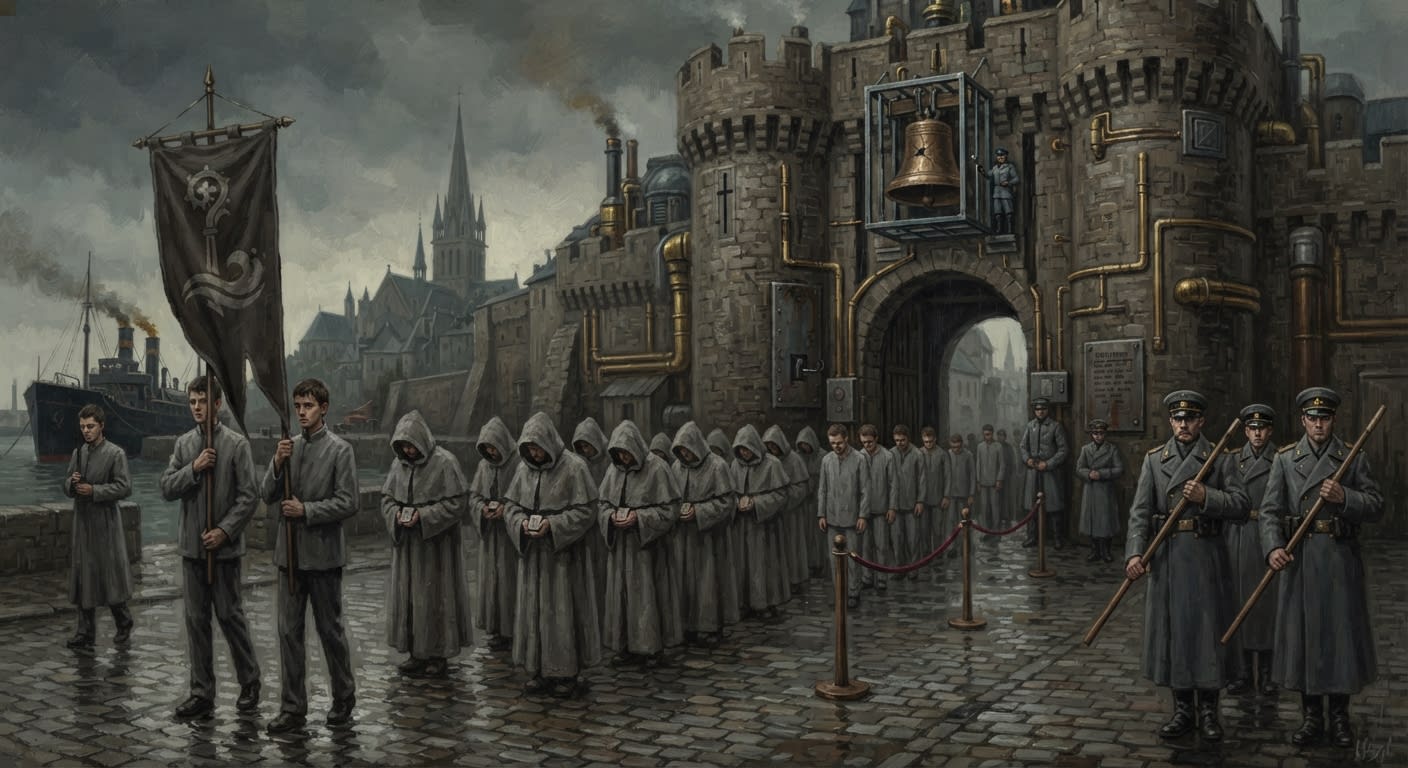
The Remembrance turns this count into sound. The Antiphon Bell is struck once for each certified dead, thirty-one tolls in all. Then comes forty-three seconds of silence, one second for each pilgrim who entered the gate. The five consumed get no toll. They get the whole of the silence.
Sentimental catechists call this mercy. Look at how it is built. A toll is a certificate: this one died, at this stone, and Records will swear to it. The five have no certificate, no body and no stone, and the Church will not guess at their names. It cannot count them anywhere, and it will not let them go uncounted. So it put them in the one place where nothing has to be proved. The silence is where the ledger keeps what it cannot enter.
It is a fasting day in every parish. The Thirty-One Names are recited at dawn in their Martyrology order, from Gaël first to the last certified name, without local variation. The Martyrology requires this. The Breton kitchens ignore it.
#On the Route
The rite starts where the pilgrims were meant to end.
On the eve, at the Chapel of the Tide, the Empty Arrival is kept for pilgrims who have not yet set out. Forty-three brass hooks on a whitewashed board each take a grey token stamped with wave, crozier and the number forty-three. The tokens carry no names, because the chapel keeps the number and leaves the names to the Martyrology. The priest breaks off the Antiphon of Safe Passage before its final line. The west door is left open until the tide reaches the step. Then a shell is struck once against the altar stone. No bell rings there. Saint Clement of Brittany supplies the destination that was denied, and the destination mourns first. A liturgist could not have arranged it better. As it happens, one did.
Before dawn on the fourteenth, Dinan departs. Families in grey cloaks carry travel bread, the successor Hermas banner (two thin boys chosen for height and solemnity), the road copy of the Matthias reliquary, and pockets of Grey-Clement tokens. The Names are read at the road gate under Bureau of Pilgrimage permit.
At Saint-Malo, the children go out first. Before dawn, under a warden's eye, they scrub the gate-run with seawater and ash. The ash is mixed to a Strasbourg recipe, and the seawater is free, which Tithes considers an oversight. After Prime, pilgrims pass through the Porte Saint-Vincent in groups of forty-three. Thirty-one kneel on marked stones. Seven stand behind them as witnesses. Five spaces stay empty behind a cord, and no child may step into them. The bell tolls thirty-one times. The silence runs. The warden strikes the inner post with his ashwood staff, and the next group of forty-three is let in.
In Strasbourg the office ends with a procession that is not stopped. The Procurator-General carries the primary Reliquary of Saint Matthias through the streets. This is the same reliquary the Rational Magistrate catalogued as Item 7 and kept in his basement for nine years, until the faithful of Saint-Malo took it back during the Retribution of the Tides. It now rests in the Basilica of the Ledgered Saints. No sergeant stands in the road. No writ is read. The crowd is kept orderly, which is itself a kind of writ, but it is ours. Each year the Synod completes on paved streets the journey the Republic halted at a gate. It is the Synod's standing reply, and the Synod repeats it annually in case anyone has forgotten the question.
#On the Objects
The primary reliquary is in Strasbourg. Brittany is allowed copies: a road copy for Dinan and a gate copy for Saint-Malo. The Bureau of Pilgrimage calls this distributed devotional access. The towns call it robbery conducted in Latin. Both phrases appear in the minutes.
The Hermas banner is a successor cloth. The original tore at the gate, and Hermas of Dinan fell under it. Margaux's psalter, catalogued as Relic 23-M, is shown in Strasbourg with its brass clasp closed. The clasp still works. Pilgrims find this unbearable, which is the purpose of the display. The Grey-Clement tokens are pressed in tin, blessed in batches and sold singly. Printed silence cards, which tell the illiterate when the silence starts and when it ends, are sold at three for a Crown under a Tithes stamp. The Antiphon Bell of each parish is inspected before Corvus for crack, tongue-wear and pitch.
Sabina of Ghent has no object in the rite and a great deal of use outside it. She tore her habit into bandages and bound eleven people. She died of fever three weeks later. She belongs to the witness annex and the Mercy tradition, and she appears in the Remembrance only as the linen folded over each parish's name-board. Mercy paid for the linen. Mercy wants that known.
#On the Lessons Recited
Catechism schools teach the Atheist Wars twice a year, with examinations. On the fourteenth of Corvus the three lessons are recited after the Names, in the form set by the Bureau of Doctrine.
First, Reason was allowed to triumph so that its failure would be public, total and beyond appeal. Second, the dead of Saint-Malo were not wasted. They were the first coin paid into the Synod's authority, and without their memory the Synod could not ask for the obedience it requires. Third, doubt is a breach in the wall as well as an error of the mind, and a people that questions its faith leaves the gate unguarded.
These are Doctrine's lessons. I set them down because I am ordered to, and I agree with them because I am paid to. Still, there is a fourth lesson the Remembrance teaches without reciting it. Grief can be governed. It can be fixed to a day, counted in tolls, timed by sand-glass, roped into spaces, taxed by the candle and sent to Strasbourg in a sealed cart. The mourners stay sincere throughout. That is what makes the arrangement work.
#On Local Memory and Strasbourg's Custody
Brittany keeps its own Remembrance, and Strasbourg allows this the way a physician allows a scar.
In Dinan the kitchens rise before the marshals. Families touch old cloak hems, fold the bread, and say the names in the order their grandmothers used, which is not the Martyrology's order. Some kitchens name the three candle-children aloud, including the one Records has sealed. Some remember Margaux walking slowly and asking whether anyone had brought salt, not kneeling and not wearing her Strasbourg face. In certain Saint-Malo houses a sixth chair is left empty, for reasons I have been told not to ask about.
Records circular to Breton parish clerks, undated copy: kitchen recitations exceeding thirty-one names to be noted but not corrected. Two households reported reciting ██████ ██████ after the Thirty-One. Clerks are forbidden to record the names heard. Reason given: ████████████████████████. Doctrine countersignature present; Records countersignature scraped away.
The Bureau's settlement is simple and nobody likes it. Local variants are tolerated if they stay indoors. Public recitation follows the Martyrology. Candles are licensed. Silence cards are stamped. Touching the stones requires a warden's nod. Grief pays its tithe to the Bureau of Tithes like any other traffic on a road. The Bretons call this theft. Strasbourg calls it custody. Both are right. The Remembrance goes on every fourteenth of Corvus, as punctual as the Creator's tides and better audited, and the Great Deceiver has never yet persuaded a Breton grandmother to skip it.
The five spaces stay roped. No one has ever been allowed to fill them. Doctrine says the reason is reverence. I say it is that an empty place teaches the lesson and a filled one would teach nothing.