
#On the Bell That Counts
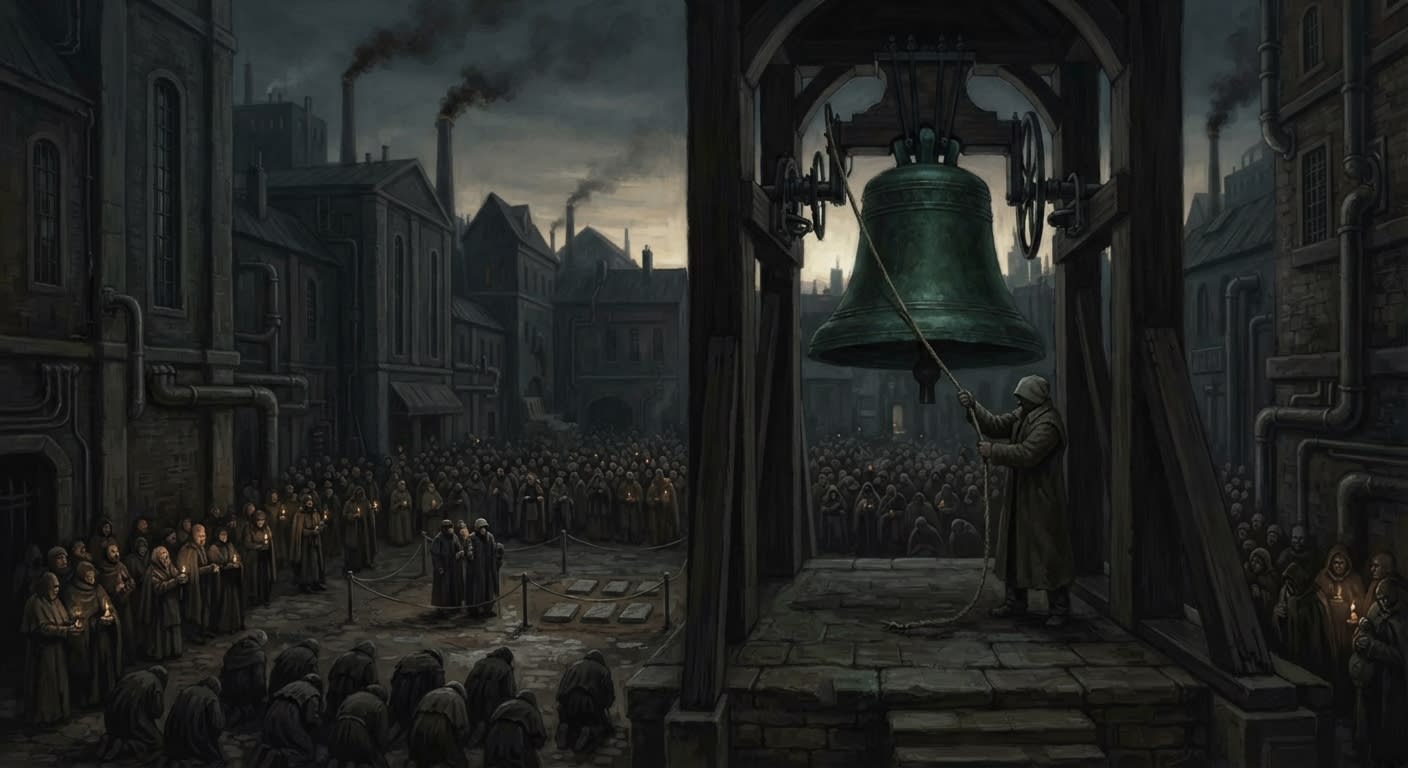
Every parish in the Theocracy owns an Antiphon Bell. Few of them ever cast one. The name belongs to an office, and the metal belongs to whoever holds the rope that morning: the tenor of a cathedral ring, the only bronze in a fishing chapel's bellcote, or a garrison bell borrowed back from the quartermaster for the day. On the fourteenth day of Corvus that bell is set apart for the Annual Remembrance of Saint-Malo. For thirty-one strokes it stops being the parish's property and becomes an instrument of the Martyrology.
The laity assume the bell sings the Antiphon. It cannot sing and never has. The Antiphon of Safe Passage is the road song that forty-three grey cloaks carried out of Dinan, and it was broken at the Porte Saint-Vincent before its last line. The bell takes the song's name the way a notary takes the name of a widow's estate, so the matter can be filed under the correct heading.
Doctrine divides the labour. The song gives the throat and pulls it back at the wound. The bell gives the count. The silence gives the absence. Mix the three and you have a funeral, and funerals belong to families. Keep them apart and you have an office, and offices belong to Strasbourg.
Earlier editions of this Codex, including the Warden's own account of the Massacre at Saint-Malo, stated that the silence after the tolls lasts "precisely the duration it takes to read the writ that killed them."
Corrected. The silence lasts forty-three seconds, one for each pilgrim who entered the gate. The writ of the Rational Magistrate is not read aloud during the office and never has been, and its reading time is not a liturgical measure. The clerk who timed it did so with the writ's own text, which means he had that text in his hands. Enquiries are proceeding.
#On the Thirty-One Tolls
The facts under the bell are simple. Forty-three pilgrims left Dinan for Saint Clement's Chapel of the Tide, carrying the Reliquary of Saint Matthias and singing as they went. At the gate of Saint-Malo, Republican Guards enforcing a genuine writ issued by the local Rational Magistrate stopped them and demanded the reliquary. Father Gaël of Dinan answered, "It is not yours." Records certifies thirty-one dead, seven wounded who survived to testify, and five consumed by the event.
The bell strikes thirty-one times, once for each certified death.
A toll is Records made audible. Each stroke says that one person died at this gate in A.S. 10 and that a clerk will swear to it. The bell does not know the names. Names are recited at dawn, in the order the Martyrology has kept since A.S. 12 fixed the Thirty-One. The bell knows the number, and it knows it better than any schoolmaster who has tried to round it for a hymn.
Sentimental catechists call the tolls consolation. They are wrong. A mother who wants consolation can buy a candle. The bell certifies, and certification is colder than comfort and lasts longer. Each stroke is a death given bronze and a seal, rung across a parish so that nobody inside its radius can later claim the death was never filed.
The sexton spaces his strokes by the mourning interval of the Bell Codex. He may not hurry toward the end, and he may not linger on the first stroke, which belongs to Gaël. Grief would like to do both. Grief does not hold the licence.
#On the Forty-Three Seconds
After the thirty-first stroke comes the silence: forty-three seconds, one for each pilgrim who went through the Porte Saint-Vincent. It covers the thirty-one dead a second time, the seven witnesses, and the five.
The five get no toll. A toll is a certificate, and the five have no certificate, no body and no stone. The Church will not guess at their names. It cannot count them in the bronze, and it refuses to leave them out of the count. So it puts them where nothing has to be proved. The silence is where the ledger keeps what it cannot enter. In A.S. 38 the five were written into the closing antiphon as well. No surviving ordinance says when the forty-three seconds themselves entered the office, and I will not write one to make the file look tidier.
Sextons time the silence with sand-glasses calibrated in Strasbourg. A sexton who counts by his own pulse is fined, because grief raises the pulse and his silence comes out short. A short silence cheats the five. Nobody else in the square has so little to lose.
#On Inspection, Custody and Profit
Every parish's Antiphon Bell is inspected before Corvus for cracks, wear on the tongue, and pitch. The practice is older than the inspectors. Sextons and parish custom kept these bells long before the Bureau of Bells was constituted in A.S. 52, and the current standard dates only from the ratification of the Bell Codex in A.S. 115. The Bureau did not invent the thirty-one strokes. It took them over, and it tells the story as if the strokes had been waiting for it.
A cracked bell may not toll the dead. The Bureau's reasoning is sound: a cracked certificate is a forgery. A worn tongue drifts in pitch, and a drifting pitch makes the thirty-first stroke sound unlike the first, which would imply an order of merit among the dead. Records will not tolerate that, and neither will I.
Thirty-one strokes is well over the three that an unlicensed peal may sound. The Antiphon Bell therefore rings under licence, and the licence names the count, the hour, the interval, the purpose and the emotional register. The emotional register is "grief, public, lawful."
The quarrel over custody never ends, and the rite works because of it. The Bureau of Doctrine owns what the tolls mean. Records owns the number. The Bureau of Pilgrimage owns the order of the route and the groups of forty-three at the gate: thirty-one kneeling on marked stones, seven standing behind them as witnesses, five spaces roped off and empty. The Bureau of Tithes owns the candles, the tin tokens, and the printed silence cards that tell the illiterate when the silence starts and ends, three for a Crown under a Tithes stamp. Bells owns the bronze and claims the silence. Every bureau has a hand on the rope, and none of them pulls it.
#On Misuse
The commonest offence is the thirty-second stroke. A sexton with a soft heart and a hard arm adds one more "for the five," or for a name his grandmother taught him. It is the gravest thing he could do to them. A stroke with no certificate behind it claims a death that Records has not entered, which makes it a forged death rung in public. It also takes the five out of the silence, the one place that holds them without proof, and pushes them into bronze they cannot answer for. The Bureau of Bells treats the thirty-second stroke as an unlicensed peal. Doctrine treats it as theology done without a permit. The sexton is usually moved to a post where the bells are rung by the hour.
Mistimed grief comes next. A crowd that sobs through the silence has not broken it, since the silence is for the living to keep and the living are allowed to fail at it. A sexton who starts the tolls before the Antiphon has broken off has done something worse. He has put the count ahead of the wound, as if the dead were entered before they fell. The Remembrance allows many kinds of sorrow. It allows exactly one order of events.
Local variants survive indoors. The kitchens of Dinan still recite in their grandmothers' order, and some Saint-Malo houses keep customs the clerks have been told not to ask about. Strasbourg allows all of this, provided it stays behind a door. The bell is public. It follows the Martyrology's count, it strikes over every kitchen in the parish, and no kitchen may strike back.
The Chapel of the Tide rings no bell at all. At the Empty Arrival on the eve of the fourteenth, the Antiphon is cut off before its promise, the west door stands open until the tide reaches the step, and a shell is struck once against the altar stone. Doctrine's reading is that the bell counts deaths at the gate, while the Chapel keeps an arrival that never took place, and nobody certifies an arrival that never happened. Saint Clement was waiting for pilgrims. He got a shell. Any pilgrim who brings a handbell to the Chapel has it confiscated at the door, blessed, and returned after the tide goes out.
In Strasbourg the office ends with the Reliquary of Saint Matthias carried through the streets in a procession that no one stops. The bells there ring the Remembrance's count and nothing more.