
#On the Silence That Begins the Audit
Every audit opens with a hush. The Bureau does its finest work in the hush.
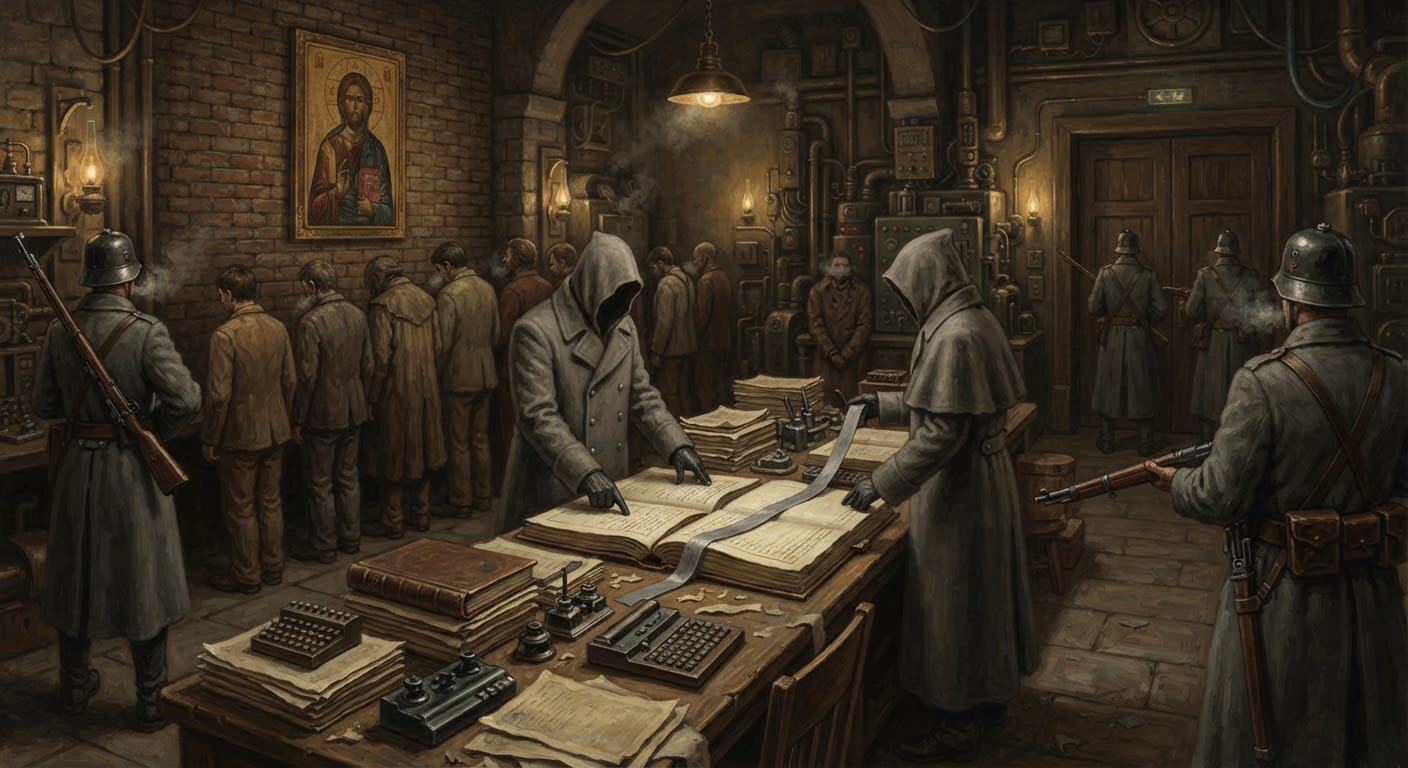
Audit Silence is the procedural doctrine that turns an Indiction writ from folded paper into law with a physical effect. The Bureau of Records imposes it on a room, a parish, a granary or a bastion ration office when its Indiction Shadows declare a ledger under reconciliation. Once the silence is pronounced, no one speaks unless summoned. No one moves except into the custody the writ has ordered. The bearer goes unnamed, the books are laid on the table, and everyone else becomes furniture with a pulse.
The doctrine has four working parts, and Records recites them as a catechism recites the sacraments: the silence clause, the access rule, the enclosure of witnesses and the protection of the bearer's name. The silence clause governs speech. The access rule opens every cabinet, strongroom, sacristy press and locked choir-stall named in the writ, and any the writ has neglected to name. Enclosure governs who may leave and what they may later say. Name protection governs the bearer, and it is the part that frightens people.
The procedure looks like this. The grey veil comes into the street and the writ is shown. The guard salutes before he has read it, the clerk hands over the keys, and the household saint is turned to face the wall. The saint is turned so that nothing in the room may testify, not even the painted.
#On Its Post-Concordat Origin
The Concordat of Strasbourg settled the Synod in A.S. 90. It did not settle the Synod's arithmetic. Benedict Veyrault had consolidated Records around A.S. 78, and the Great Ledger had been open since A.S. 80. Every parish book that fed it was full of accident, charity, fraud and grief, which in practice amount to the same four things. Field audits failed for a simple reason: the audited were allowed to talk. Tollmasters explained. Priests pleaded. Clerks corrected entries while the auditor was still unpacking his ink-case, and by supper the discrepancy had been found, understood and forgiven in three different hands.
In the post-Concordat harmonisation years, Records wanted an audit that could act before a local office could lie, delay or appeal. Audit Silence was the answer. It appears alongside the Indiction writ in those years, c. A.S. 90, and serves the Great Ledger Harmonisation Mandate that every standard writ cites as its authority. No ratification date has reached my desk. Records calls the doctrine "operative from the first Indiction", a phrase that dates nothing and admits less.
By A.S. 93, when the Strasbourg successor council formally recognised the office of Archon of Records, parish clerks were already dropping their pens at the phrase "under Silence" without being told to. Records counts that as a kind of ratification, and the fastest kind.
#On Article 9 and the Unnamed Bearer
The only Article of Audit Silence I am cleared to quote is the ninth, and only in part. As it was read to me at the Basilica of the Ledgered Saints, it allows the bearer of an Indiction writ to remain unnamed. The standard gloss adds that the writ acts and the bearer attends.
That gloss holds the whole theology of the office. A named officer can be bribed, befriended, cursed, remembered, followed home and found in the Great Ledger like anyone else. An unnamed officer is only the writ's way of getting from one room to the next. A complaint against him has no addressee. A widow who recognises his walk in the market has recognised nothing the file will accept. If he is killed, the writ passes to the next bearer, who arrives in the same grey and is, for every lawful purpose, the same man.
Records defends this on the grounds that audit must not become personal. Every other part of the doctrine is personal, and Records knows it.
Several seminary readers have cited "Article 9" of Audit Silence as the ground of retroactive guilt for undefined heresy.
Clarified. That is Article 9 of the Catechism of Obedience, a Doctrine instrument of A.S. 92. Article 9 of Audit Silence concerns the bearer's name and nothing else. The two Articles are unrelated and share only a numeral. They have been known to arrive at the same house on the same afternoon.
#On Witness Enclosure and Reconciliation
Enclosure begins with the body and ends with the memory. The doors are barred by men who came in from outside. Anyone present when the silence was pronounced stays present until the books agree, whether they are clerk, sexton, supplicant or a child sent to fetch the beadle. Food is provided. Latrine buckets are provided and entered on the inventory.
The memory is enclosed on the way out. Each witness signs, or marks, an acknowledgement that an audit took place, and that is the only description of the day they may lawfully give. Anything else they saw belongs to the file: the entries marked with grey ribbon, the name the bearer read aloud twice, the clerk who wept on the tithe roll. A witness who later tells his tavern what the ribbons meant has interpreted a Records proceeding without licence, and interpretation is the one liberty Audit Silence was written to abolish.
The standard writ gives the appeal in two words: after reconciliation. Records calls this procedural hygiene. In practice it is a trap. An appellant may complain once the books agree. If the books agree that the appellant has no standing, the complaint arrives from a person the file does not contain, and the clerk receiving it is entitled to wonder who left a letter on his desk.
The Audit Liaisons of Tithes hold that reconciliation is complete when the bearer says so. Records considers the maxim crude, because a bearer is a person and persons can be persuaded. Records holds that reconciliation is complete when the file says so. That is the same thing, better dressed.
#On Name Suspension
Suspension is the mildest of the powers the writ confers, and the most used. A name under provisional suspension stays in the Ledger with a grey ribbon laid across it. It is present and inoperative, the way a bell is present with its clapper tied. Payroll stops first. Rations follow, then the right to receive baptism or witness it, then the right to be buried in consecrated ground under one's own entry. Records calls the resulting condition pending personhood. Physicians tend to refuse the pending. Taverns refuse them as a matter of course.
Suspension is not Administrative Dissolution. Dissolution is the terminal instrument: Form 77-D, the Mortuary Black, and the null mark Ø that leaves a body present and illegible. Suspension is provisional, reversible in theory and reversed in about as many cases as theory can bear. Its danger is that it lasts until reconciliation, and nothing requires reconciliation to be brief.
The Natal Registration Writ complicates matters. Since Doctrine's A.S. 162 ruling gave that writ its quasi-sacramental standing, suspending a birth entry is something more than clerical. Records insists that a suspended birth has not been unmade and has only been asked to wait. The Records Scribes who carry out the ribbon-work have learned not to ask what the unborn wait in.
#On Hostile Files
The doctrine was built to silence liars. At Bastion-Brest it met worse.
INDICTION ABSTRACT: BASTION-BREST, A.S. 188 Subject: suspected Peripheral Erasure penetration of ration ledgers. Finding: entries altered before the ink dried; handwriting matched to clerk ████████, dead three weeks; ash-tracks ending at a locked file wall; one bearer returned with his mask marked from the inside in glyph script. Disposition: file retained; bearer retired; room bricked; ration deficit declared "anticipated."
Brest showed Records that the Tide's infiltrators could attack a file as well as a throat. The Veil-Stalkers and their kin, working the bridge-fortress against the Nameless Tide between A.S. 188 and 195, learned to stay where attention does not settle. A falsified ration book starves a company more quietly than any blade could. Records did not take this as a military lesson. It took it as an insult to its ink.
The Bureau's answer was more silence. In a room held under Audit Silence, a nib moving is loud. When every living hand is still and every clerk is enclosed and counted, a pen that moves anyway has confessed that something unlisted is in the room. Bearers posted to Brest are now trained to listen for scratching before they read a line, and to count the people present twice, once looking at them and once looking away.
Other Bureaus crowd the ground there, and they do not always agree. The Bridge Tribunal's powers under Standing Order 14-B to seize paper and halt crossings overlap uneasily with an Indiction bearer's power to enclose the same clerks. The Blank-Sheet Circle and its nameless transits give both authorities the same headache from opposite sides. When a Tribunal officer and an Indiction bearer order the same room silent, the room obeys both, and nobody at Brest has yet dared to ask which order ends first.
#On Present Use
As of A.S. 201, Audit Silence is pronounced wherever Records suspects the world of improvising: parish books, bastion ration offices, tithe courts, refugee registries, orphan rolls, death wagons and the private ledgers of guilds that believed themselves private. It travels from Strasbourg outward, grey-wrapped, and it has never needed an army.
What frightens people is not secrecy. Purity hides nothing, and Purity is feared for other reasons. Audit Silence performs everything in full view. The ledgers are opened in the centre of the room. The ribbons are laid where all can see them. The names are read aloud, suspended and set aside while the people who own those names stand three paces off, forbidden to speak, forbidden to leave, and forbidden ever afterward to say what it meant.