
#On the Authority Behind the Writ
A writ is a page that speaks with the authority of a larger page. The larger page never has to come into the room.
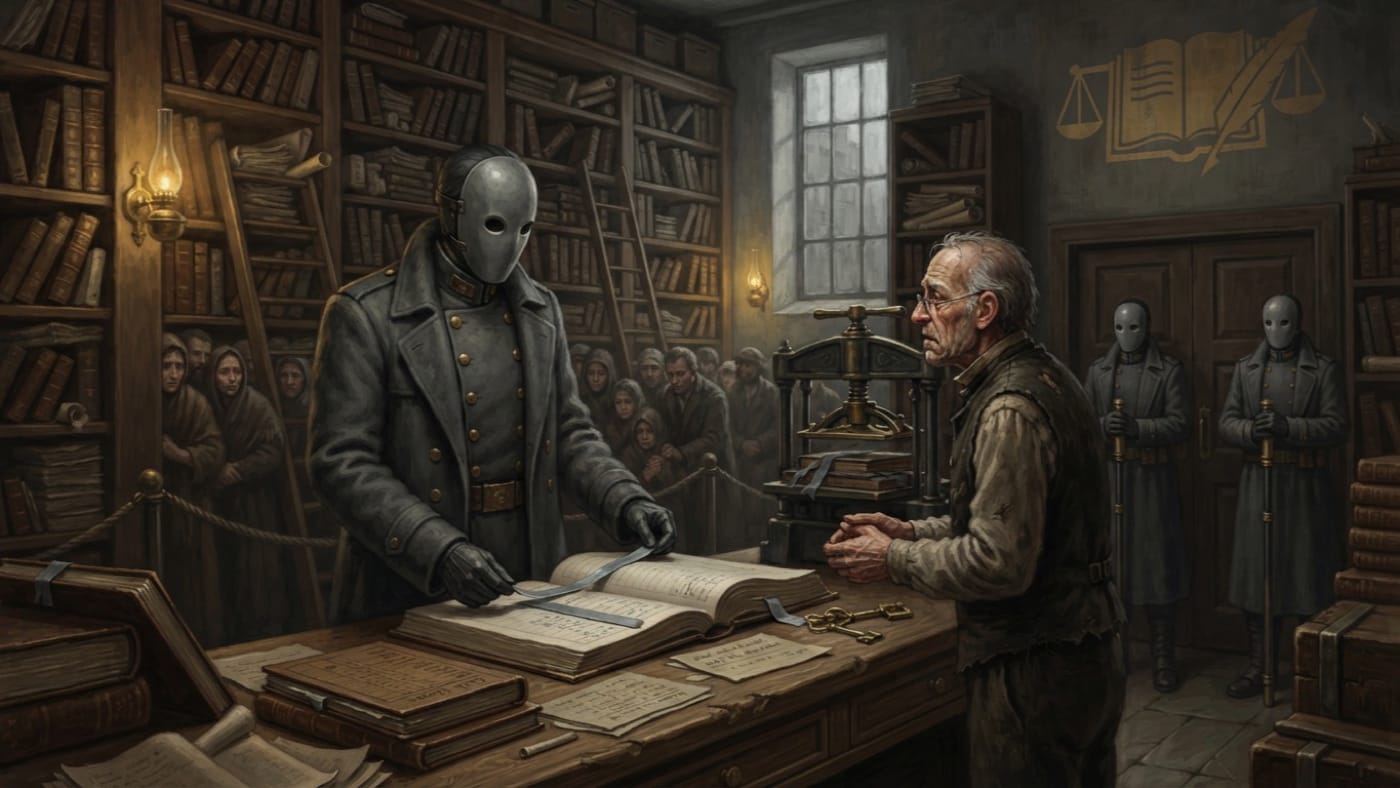
Every Indiction writ of the standard form names its authority in one line, and the line is always the same: Great Ledger Harmonisation Mandate. The parish clerk who reads it does not ask to see the Mandate. He hands over the keys to the book-press, sends the sexton to hold the bells, and stands where the grey-masked bearer points. By the time he has found his spectacles, the writ owns the room.
That moment holds the whole system in small. The Mandate is the standing authority. The writ is its local form, carrying five powers and two conditions into one particular parish. The operative of the Bureau of Records who carries it stays unnamed under Article 9 of Audit Silence. Audit Silence is a separate procedural instrument, and I will not hear it blamed on the Mandate by careless students. So there are three documents, one masked functionary, and at the end of the chain a parish that is about to be made to agree with itself.
I have not read the Mandate entire. I know of no one who claims to have read it without also claiming to have dined with archangels. In common use it survives as a name on a writ. The name has proved enough.
#On the Books That Would Not Agree
Records did not begin with the Synod. The Church kept parish books long before the Sundering of A.S. 45 brought its bells into public service. After that, registers of births, burials and ration shares multiplied in every town that survived to keep them. Around A.S. 78, Benedict Veyrault gathered those scattered registers into something like a single memory. He bound existing books under one hand, and the formal Synod was still twelve years in the future. When the Concordat of Strasbourg constituted it in A.S. 90, the new state inherited thousands of volumes and found, to its annoyance, that they contradicted one another.
Villages changed their names between censuses. Parish books burned, some of them by accident. Families kept dead cousins alive on the ration rolls. Guilds kept their ledgers in layers, with the honest one buried under its rivals. Ordinary audits went out and came back beaten. Some scribes were bribed and some were thrashed. Others came home wondering whether a book could be called a lie if everyone who signed it agreed.
The published account credits Veyrault with the answer: the Indiction writ, carried at first by senior notaries under armed escort. My record does not say whether he drafted the Mandate behind it, signed it, or simply put it to use. I decline to supply the signature myself. Records already has forgers enough.
The Lore Book glossary classifies the Indiction Shadows as "Covenant elite stealth cadres."
Corrected. The bearers of Mandate writs are Bureau of Records audit-operatives. The writ authorises documentary reconciliation. Readers looking for its regimental colours on a battlefield will find a ration office instead.
#On the Powers of Reconciliation
Harmonisation: the art of persuading two books to tell one story, provided the Bureau chooses the story.
The standard form lists five powers. They belong to the writ and are stated on the writ. Whether the Mandate lists them in that order, or at all, is a question for whoever holds the original, and that person has not written to me.
Seizure comes first, because nothing can be compared until it is on the table. The parish book, the tithe roll, the death and birth registers, the marriage annex, the confession index and the copy of the military levy are all carried in. Men who arrived from outside bar the doors from within.
Comparison follows, and here the doctrine shows its face. Records teaches that a soul stands before the Creator in the Great Ledger of Souls and before the Synod in the lesser books that feed it. Where those books contradict each other, the soul is to that extent unaccounted for. A discrepancy is therefore a claim of jurisdiction. When a bearer lays a grey ribbon across a page, the Bureau is declaring that page its business. Two ribbons on one name mean a family should start counting its bread.
Provisional suspension lifts a disputed name from the books until reconciliation. Lifted, mark you, not struck. On paper the difference is enormous. At the bread window it hardly exists.
Witness enclosure keeps the room shut on those whose testimony may be needed and shut against everyone else. Nobody speaks unless summoned. The bells stay silent. The parish waits outside its own church.
Archive entry puts the finding into the archive once the work is done, which means the Indiction itself becomes a record. Like any record, it may one day be compared.
Audit Silence sits over all five. Its Article 9 keeps the bearer nameless, so the parish has a writ to obey and no man to hate. It is a courtesy to the operative and an insult to everyone else, and the Bureau accepts the trade without complaint.
#On Standing After Reconciliation
The writ runs until reconciliation, and appeal lies after reconciliation. Read the two lines together slowly, the way the condemned read them.
While the writ runs, a citizen with a suspended name cannot appeal, because nothing has been decided yet. Once the books agree, appeal opens, and the appellant comes forward to be recognised. If the reconciled books have agreed that he has no standing, there is nobody to recognise. The appeal arrives from a person the archive has stopped counting. The procedure is complete and flawless, and it works like a sealed reliquary with its key soldered inside.
Recorded existence holds up a Synodal life. A Records Scribe at a bastion counter issues rations, residence, work, passage, inheritance and penal assignment, and every one of those issues assumes the name is in good order. A man without standing may still have a pulse. Records has never claimed jurisdiction over pulses. He cannot draw pay or buy beer, no physician will treat him, and he cannot be buried in consecrated ground under the name his mother gave him.
The writ calls suspension provisional, and Records means the word in its strict sense: the Bureau reserves the decision for later. Some names come back. Others reach reconciliation and are agreed out of existence by every book at once. The Mandate's defenders call this fidelity to the evidence. They say it from the safe side of the counter.
#On Three Harmonisations
At Mainz in A.S. 136, an Indiction pair entered the Bridge Toll Annex and found fourteen years of duplicate widow exemptions paid against deaths the books could not reconcile. The tollmaster called grief administratively complex. The writ made it simple. His name was suspended from the payroll first, then from the baptismal register, then from the burial roll. He lived nine more days in the condition Records calls pending personhood, and no physician would touch him. His wife was legally his widow the whole time. She inherited his chair before he had finished using it.
At Budapest in A.S. 159, the books of the South Granary on the west bank showed more flour going out than coming in, which is a miracle without an approved saint. The writ sealed the granary and every sack was weighed. Between the first and third floors the bearers found a second floor that appeared on no plan. In it were six clerks, three merchants and forty-two forged seals. Records corrected the granary. The Bureau of Purity took charge of the unlicensed chapel the smugglers had kept up there. The Bureau of Tithes dealt with the merchants until money fell out of them. The case shows the Mandate's practical value: a column of figures that would not balance led other Bureaus to crimes they could prosecute.
At Bastion-Brest on the Bug River, the Mandate met something it was not written for.
INDICTION REPORT — BASTION-BREST, A.S. 188 Subject: Peripheral Erasure penetration suspected within ration ledgers. Finding: entries altered before ink dried; handwriting matched clerk ████████, deceased three weeks prior; ash-tracks ended at locked file wall; one Indiction Shadow returned with face-mask marked from the inside by glyph script. Disposition: file retained; bearer retired; room bricked; ration deficit declared "anticipated."
Comparison assumes a forger whose hand can be compared. At Brest the hand belonged to a clerk who had been dead three weeks. I know of no amendment to the Mandate that followed. The report gives its disposition, and the disposition is all Records has ever offered on the matter.
#On Present Application
As of A.S. 201, the Mandate's writs are carried wherever Records suspects the world of improvising. That means parish books in the river provinces, bastion ration offices, tithe courts, refugee registries, cathedral orphan rolls and private guild ledgers whose owners believed their bookbinding was discreet. The archives at Strasbourg receive the findings. The Bureau of Doctrine supplies the theology that lets the findings be called mercy.
Nobody needs to see the Mandate for it to work. A clerk in a refugee registry has never laid eyes on it, and yet he knows exactly what a grey ribbon is worth. His supervisor knows the five powers, and the bearer knows to keep his name to himself. The refugee knows only that he was a name yesterday and is a question today. If reconciliation goes against him, he will be nothing the counter can serve.