
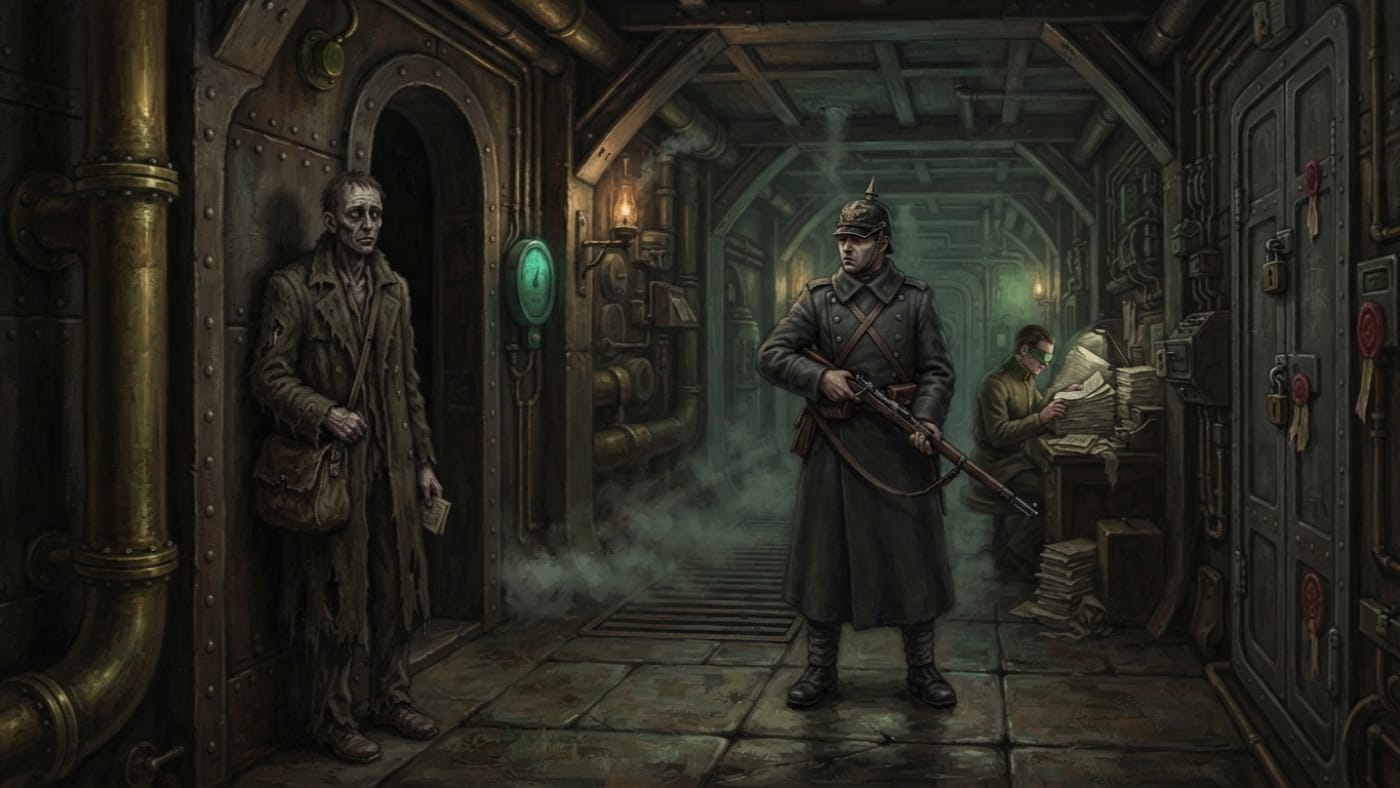
#I. On the Man the Eye Files Away
The eye is a junior clerk. It enters what it expects and initials the rest unread.
Peripheral Erasure is the commonest of the five concealment modes so far identified among the Veil-Stalkers, and the least theatrical. The bearer does not vanish. He stands in the corridor with his weight on the flagstones and his breath on the cold air, his ribs showing through a stolen coat, and the sentry at the door looks straight at him and records rubble. Or shadow. Or, in the phrase that recurs through the depositions with liturgical regularity, "something that belonged there." Light reaches the eye as it always has. The glyphs act on attention, and attention declines to countersign.
The name misleads. Readers have taken it to mean that the mode ruins the edges of a man's sight, or wipes his memory, or strikes entries from files. No report establishes any of these. "Erasure" is a clerk's metaphor for a soldier's failure, promoted above its rank.
Three conditions must be kept apart, and the Codex has not always kept them apart. The Stalker under Peripheral Erasure exists entirely and goes unregistered. The Stalker under Mirror-Fade, a separate mode bought at a far higher price, achieves genuine optical absence. The citizen erased by the Bureau of Records remains perfectly visible at his own table while his name, rations and burial right are suspended under seal. The first is the enemy's economy and the second its extravagance. The third is ours, and it alone carries a right of appeal, exercisable after reconciliation.
The bearers are mortal men, auxiliaries of the Shadow Court, starved and cut with glyphs that feed on what life they have left. Peripheral Erasure is one configuration of those glyphs. It has no order, no banner and no chapter house of its own. The Bureau of War lists its bearers as Modified Conscript, Concealment Variant, Category Gamma. The Bureau of Purity lists them as Sub-Demonic. That second heading records Purity's opinion of the bearer. It tells us nothing about his anatomy, which is human and hungry.
My own interest is administrative before it is military. A sentry who sleeps on post can be flogged. No article of the field code punishes a man who looked at the corridor correctly and recorded it wrongly. I have drafted such an article twice. I burned both drafts when I saw that they would convict the entire night watch.
#II. On the Price of Being Overlooked
The Creator made flesh to be spent slowly. The Great Deceiver found a faster rate.
Peripheral Erasure is reported to consume roughly 0.3 kilograms of the bearer's body mass for each day of concealment. That figure is an estimate. It is the lowest rate recorded among the five modes, which is why the mode suits long work in rear echelons, where a man must be overlooked for weeks rather than for one bloody hour. I decline to turn the figure into a lifespan. The bearer's starting weight is unknown, his hours under concealment are his own secret, and any scraps he steals go unrecorded. A clerk who hands me a number of days will be asked to produce the corpse he weighed.
What we know of inscription comes from the testimony of three captured Stalkers, taken between A.S. 180 and A.S. 196. That testimony covers Veil-Stalkers in general. The men describe starvation lasting days, restraint, hours of cutting by a figure they called a Scribe, whose nature remains uncertain, and ash packed into the wounds. None of the three described the particular configuration that produces Peripheral Erasure rather than one of its four siblings. Nobody on our side has ever watched this mode being cut into a man.
Earlier assessments described Veil-Stalker inscription as "voluntary."
ERRATUM (Bureau of Records, 3rd Revision, A.S. 199): Amended to "conscription under duress, Category 7-F." This office adopts the correction for Peripheral Erasure bearers without exception. Older cultist vocabulary appearing in earlier field notes is to be read as the enemy's description of its own victims, which is an unreliable class of witness.
#III. On Weeks Inside the Bridge
Bastion-Brest sits over the Bug on brass rib trusses and riveted iron, a bridge-fortress of the northern Line that is always damp and always counting. Mist comes up through the deck slats. The Casemate Galleries smell of brass polish and burned powder, and the intake offices smell of wet paper and vinegar. Ration chits pass from hand to hand all day, and so do toll writs and confession tokens. Fourteen thousand souls live there by ledger. For a Stalker who wishes to be taken for part of the furniture, there is a great deal of furniture.
Three confirmed Peripheral Erasure incidents occurred at Brest between A.S. 188 and A.S. 195. The account available to me does not split them into separate years, names or outcomes, and I will not write three tidy little biographies so that the reader feels better served. Taken together, they show the following. Each bearer lived inside the garrison for weeks. Each ate from the mess bins, slept in ammunition closets, and mapped supply routes. That last item worries War the most.
A man who maps supply routes is learning how a fortress feeds itself: which stair the bread comes up, which clerk signs for the powder, at what hour the convoy quartermaster leaves his keys on the table to relieve himself. Learning all that takes patience, and the slow-burning mode allows it. Shadow-Binding would trap him in the dark corners, and Mirror-Fade would have eaten him before he finished the first gallery.
#IV. On the Ration Ledger Under Audit
The Indiction Shadows article refers to Peripheral Erasure without explaining it. The report behind that reference is reproduced here as Records released it.
INDICTION REPORT — BASTION-BREST, A.S. 188 Subject: Peripheral Erasure penetration suspected within ration ledgers. Finding: entries altered before ink dried; handwriting matched clerk ████████, deceased three weeks prior; ash-tracks ended at locked file wall; one Indiction Shadow returned with face-mask marked from the inside by glyph script. Disposition: file retained; bearer retired; room bricked; ration deficit declared "anticipated."
The operative word is suspected. This report is not one of the three confirmed incidents, and the record does not say whether it overlaps with any of them. It also explains none of its own findings. It does not say who held the pen, by what route a trail of ash ended at a wall, or how script came to be on the inside of a mask. Junior readers ask me whether the dead clerk wrote the entries. The report says that the hand matched. It says nothing more, and neither do I.
The danger it describes needs no explanation, however. A knife in the dark costs a company one officer. A ration book altered in the dark can starve the whole company and leave the officers alive to sign the shortfall. An infiltrator who can stand unregarded beside a supply ledger while the ink is still wet can reach provisioning without killing anyone first.
Records responded in its own idiom. The Indiction Shadow who went into that room did so under writ, and he remains unnamed under Audit Silence. His tools were ribbon, seal and suspension. Concealment glyphs are no part of his office, and Records would sooner retire a man than let anyone suggest otherwise. In this case it retired him.
#V. On Detection and the Errors of Category
The floor catches more than the sentry. Under Standing Order 88-H, Brest lays blessed ash across galleries and thresholds before the night watch. A Stalker passing unseen still has feet, and the ash keeps the print. It does not keep the Stalker. The register records fourteen Veil-Stalker attempts from A.S. 190 onward: eleven intercepted before reaching their targets, three after. Those are figures for all Stalkers. None of them should be quoted as a Peripheral Erasure statistic. The register begins in A.S. 190. When the order was issued is not established. Wet ash, garrison traffic, uncovered stairs and forty panicked boots all spoil a reading, and Brest has all four in quantity.
Relics give exposure instead of traces. At the Ravelin of Sorrow in Bastion-Constantinople, a Stalker using this mode came up the pilgrim stair in A.S. 196 and reached the under-gallery before Ward Niche 5-F made his glyphs flare. A sentry died before the intruder collapsed. Reliquary Proximity Wards react within three metres. The Ravelin sets one ward to every eight metres of corridor, and a careful reader can do that arithmetic himself. Since A.S. 196 that position has had no confirmed penetration. The claim belongs to that position and to no other part of the city.
Bells deserve a short paragraph. Counter-rhythms are reported to break glyph concealment for about two seconds, and they are documented at bastions south of Przemyśl. Brest has no such installation on record. No success rate specific to this mode exists, and the A.S. 198 date at Shipka belongs to a revision of Standing Order 44-F, which tells us nothing about when the practice began. Directive 31-D pairs checkpoint guards to watch each other's faces. Its reported sixty-per-cent reduction applies to Desire-Cloak. Quartermasters who cite it against Peripheral Erasure are borrowing another variant's receipt.
The siblings are confused with this mode often enough that the Field Manual has had to separate them. Shadow-Binding needs existing shadow and cannot cross direct light. Fog-Walk spreads drowsiness over everyone near it. Desire-Cloak shows the observer whatever he longs to see. Mirror-Fade bends light and is reported to deaden sound. Peripheral Erasure shares none of their powers, limits or costs so far as any report establishes, and the Bureau of Alchemical Standards has refused to attribute it to any patron.
#VI. On the Present Assessment
As of A.S. 201, Peripheral Erasure remains in the Bureau of War's threat taxonomy as the commonest concealment mode and the slowest burning. Its origin is unknown and its first use unrecorded. No Sin-General has been proven its patron, and that includes whatever force accumulates on the far bank of the Bug. Its bearers are still conscripts, still starving, still spending themselves at an estimated three hundred grams a day in our ammunition closets. Brest still lays its ash, and the ration office is still bricked.