
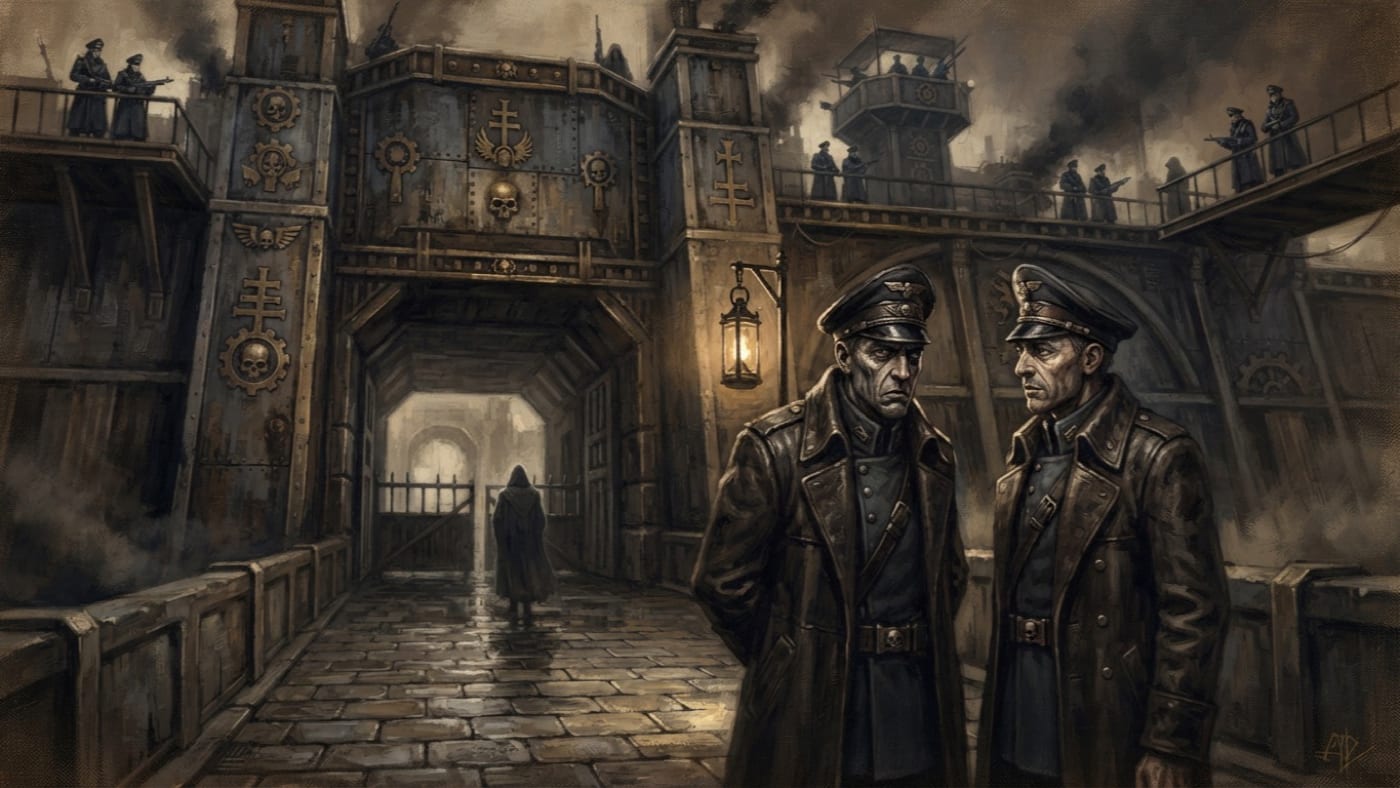
On Directive 31-D
Being an Explanation of the Bureau of Purity's Checkpoint Order Against the Desire-Cloak, under Which the Sentry Is Set to Watch the Sentry
#I. On the Instrument and Its Owner
Directive 31-D belongs to the Bureau of Purity. I say so first because the Bureau of War has been known to cite it as one of its own, and the Bureau of War already has enough paper of its own to apologise for. The directive governs checkpoints. As far as the record shown to me goes, its operative requirement fits on one line. All checkpoint personnel serve in pairs, and each watches the other's reactions instead of the person seeking passage.
Any quartermaster can double a guard. Two men staring at the same traveller is a familiar economy, and it is enough against most deceptions. Directive 31-D turns the second man around. For the purposes of the order, the traveller at the barrier is the least reliable witness at the post. The evidence is the sentry's own face.
I have not been shown the preamble, the date of issue, the name of whoever signed it, or any amendment. Its number is a number. Some have tried to read a year into it. I name no Bureau, and I invite them to say which calendar they used. What follows describes an order already in force along the Line, as it stands in the Veil-Stalker assessment sealed this year, A.S. 201. It reconstructs no clause the record does not carry.
#II. On the Face Admitted
The directive answers the Desire-Cloak, the Veil-Stalker variant attributed to Velkara. The Veil-Stalker is mortal. He is a conscript of the Shadow Court, cut with concealment glyphs that eat whatever life he has left. Four of his five modes act on the eye. They turn it aside, hide its quarry in shade, dull it, or bend light around the body. The Desire-Cloak leaves the eye alone and works on the wish behind it. The intruder stands at the barrier in plain view and appears as whatever the watcher most wants to see: a loved one, a comrade, a superior bearing orders.
The clerks have smudged the next point, so I set it down plainly. The Stalker's body does not change, and no flesh reshapes itself into a wife. The change happens in the watcher, who supplies both the face and the welcome. Afterwards he will swear on any relic you care to bring that he saw what he saw. He did see it. That is the difficulty.
The specimen case comes from the Velvet Choir investigations, and I give it only as the investigators gave it. Desire-Cloak Stalkers passed three checkpoints in succession. To the first guard the intruder appeared as a wife, to the second as a chaplain, and to the third as a supply clerk carrying tobacco rations. Each guard remembered admitting someone. None remembered the same face. The report reaches me with no date, no place, no names and no case number. I do not doubt that some folio carries all four. I have not been allowed to hold it, and I will not supply it from imagination.
Mark the tobacco. Anyone can name the longing in a wife at the gate. A clerk with tobacco is a humbler want, and for a man three weeks into a ration of nothing it was apparently enough. The Cloak needs no grand passion. It takes whatever want is to hand.
#III. On the Paired Watch
The reasoning is that of the confessional screen. The penitent cannot see the priest and does not need to, because the priest listens to the voice and to what the voice gives away. The checkpoint works the same way. If the Cloak lives in the watcher's wanting, the wanting will show somewhere, and it shows on the watcher's face. The assessment that accompanies Field Manual 19-C gives the reason in one sentence: the Cloak works through the watcher's longing, and the partner's expression gives it away.
The record does not say what the betrayal looks like. I have read no list of sanctioned tells and no catalogue of forbidden softenings about the mouth. I have found no challenge phrase and no rule for choosing, spacing or relieving partners. A reader will picture the look of a man whose wife is walking up a road she has no business on, or a private who sees his captain and straightens. A watching partner would look for recognition and for the readiness to admit that comes with it. Whether Purity has written this down I cannot say. I suspect it trusts the soldier to know a lovesick face when he sees one. Soldiers are experts.
The order rests on a claim about attention, and the claim is sound. A traveller at the barrier presents an identity. A colleague at the barrier presents a response. The Cloak can counterfeit the identity at no cost to anyone but the Stalker, and his glyphs are eating him anyway. The response is harder to forge because it belongs to the colleague, and the colleague is not the one being deceived by that face at that moment.
The directive guarantees none of this. Two men can want things at once. If the Cloak can show three faces to three guards at three gates, I know of no doctrine that stops it showing two faces at one. The record does not claim that a pair is proof against simultaneous deception, and neither do I. The directive is a stricter seal on the folio. Nobody who has handled seals thinks them unbreakable.
#IV. On the Reported Success and the Garrison's Trust
The parent assessment reports that Directive 31-D has cut Desire-Cloak penetrations by an estimated sixty per cent. The figure covers that variant alone. Peripheral Erasure gets past a paired watch as easily as a single sentry, since no face changes for a man nobody notices. The estimate comes with no sample, no baseline period, no trial ground and no method I can examine. I record it as an estimate, because that is what Purity called it, and I commend Purity for the restraint.
The same sentence says garrison morale fell by about the same margin. That half is mine. I wrote it in the Veil-Stalker assessment, and I stand by it as judgment. No Bureau measured it. Strasbourg keeps no register for morale. If it did, the Bureau of Tithes would invoice for it.
Take the order as a soldier receives it. He is told to stand beside a man he has shared bread with and to watch that man's face for signs of the enemy. His partner gets the same instruction about him. If his face softens at a woman's shape on the road, the man beside him is under orders to notice. The enemy could not have devised a better way to teach a garrison that its affections are evidence.
They are evidence of nothing shameful. I must be exact here, since Purity sometimes is not. A sentry who misses his wife commits no sin by missing her. The sin belongs to the Cloak that wears her. The directive reads the face only because the Cloak has borrowed what was in it. A garrison that forgets this starts to treat loneliness as a confession, and the Confession of Desire has already taught some of them that habit.
Bastion-Sibiu stands in the record as the warning. I can date nothing about this directive against it, and I draw no line from one to the other. In A.S. 189 a single confirmed Veil-Stalker killed one man there. The garrison had learned to fear unfamiliar faces, and it executed three of its own soldiers whose only offence was being strangers. The Purity inquiry counted one dead by the enemy's hand and three by the garrison's. Sibiu had no paired watch to blame. Ordinary fear was enough.
#V. On the Present Application and Its Limits
The Synod has four answers to concealment, and Directive 31-D is one of them. Ash-dusting records where a body walked, and its own entry admits it cannot vouch for Mirror-Fade. Bell-pulse counter-rhythms make concealment falter for a second or two. Reliquary Proximity Wards make glyphs flare within three metres, at a price the Bureau of Tithes recites with relish. Those three work on the Stalker's body or on his inscriptions. The paired watch is the only one of the four that works on our own men. That makes it the cheapest in coin and the most expensive in men.
At Bastion-Constantinople, the Ravelin of Sorrow has had no confirmed penetration since A.S. 196. That figure belongs to the relics in its walls. Nobody has credited it to 31-D, and I will not be the first.
The man inside the Cloak deserves a line before I close, because some readers prefer him a volunteer. The Bureau of Records has already ruled on that point. Its ruling amends the recruitment assessments. It does not amend this directive.
ERRATUM (Bureau of Records, 3rd Revision, A.S. 199): Previous assessments describing Veil-Stalker inscription as "voluntary" are amended. The process is correctly classified as "conscription under duress, Category 7-F."
Directive 31-D addresses one Stalker variant at one kind of post. The Velvet Choir is a larger problem, and Purity's own Annual Review for A.S. 200 concedes that it cannot determine the Choir's membership in Constantinople. A Choir operative at the barrier carries good papers and a faint perfume. The A.S. 199 inter-Bureau advisory holds that her diminished Art compels no one. It changes the emotional setting of a choice and leaves the will intact. Directive 31-D does not reach that, and I know of no one at Purity who claims it does. A partner watching for sudden longing will see nothing sudden in a friendship three years old.
The directive remains in force. Its date of issue has not been produced, and its signatory has not been named. The sentries still stand in pairs, each watching the other, and on the strength of sixty per cent the Bureau of Purity calls the arrangement effective. I have filed my concurrence and my objection on the same folio. Of all the pairs on the Line, they are the only one that has never quarrelled.