
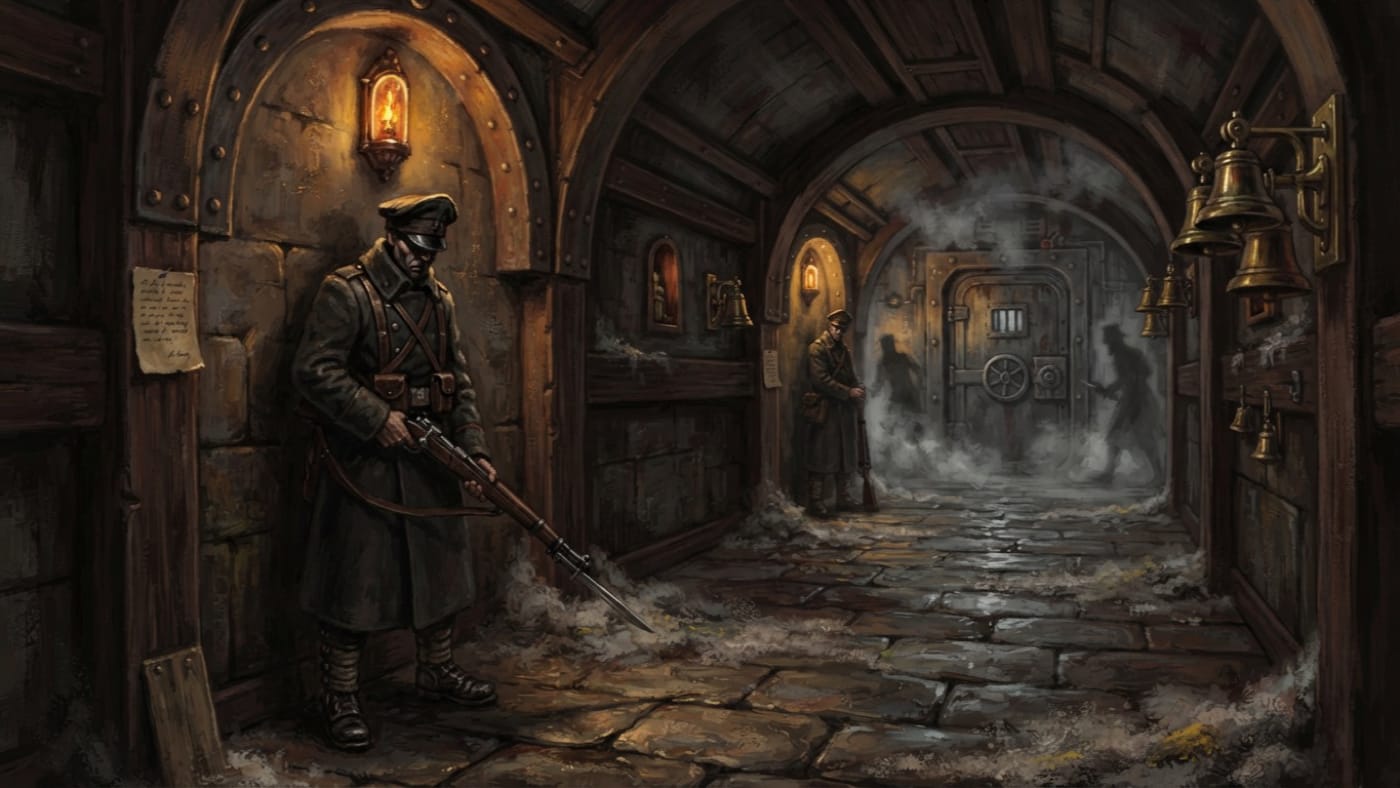
Bureau of War Field Manual 19-C
Concerning an Instructional Document of the Bureau of War in Its Seventh Revision: What Is Attested of It, What Stands Beside It, and the Distance Between the Two
#I. On the Document Itself
The Bureau of War issues manuals the way a cathedral chapter issues indulgences. It issues many, it seals them all, and it trusts that the recipient will not read past the first folio. Field Manual 19-C is one of these. It deals with the enemy a sentry cannot see, meaning the Veil-Stalkers of the Shadow Court, and it is now in its Seventh Revision. The Ledger holds nothing I am permitted to cite about the six revisions before it. On its first issue, its compiler, its signatory and its page count, I know exactly as much as the reader does, though I know it from a better chair.
One line of it reaches the survey of A.S. 201. It is a marginal observation, written in a hand that no Bureau has claimed:
"The enemy's truest weapon is the one you cannot see. The enemy's cruelest weapon is the one you could see, once, before the glyphs ate its face."
A field manual is meant to tell a man what to do. The only line of this one that anyone quotes tells him what to dread. Every archivist of the Church knows the habit of margins outliving their text. The Bureau of War would prefer that I not mention it.
#II. On the Enemy It Names
The Veil-Stalker is a mortal man. The older descriptive registers call him a cultist: starved, cut with glyphs, his concealment fed by whatever lifeforce he has left. The Bureau of Records has since amended the circumstances of his recruitment, as the erratum below records. He is used for reconnaissance, for infiltration and for the selective knife. He goes for officers, couriers and Bellwardens. Each one he removes costs the Line an hour it had already spent.
The Bureau of War files him as Modified Conscript, Concealment Variant, Category Gamma. The Bureau of Purity files him as Heretical Manifestation, Sub-Demonic, a classification that has been pending since A.S. 162. The quarrel has a practical edge. One searches for a conscript with dust and a bell. One searches for a manifestation with relics and a writ. A sentry trained under one heading and inspected under the other will be faulted by both.
Instruction must also tell the five modes apart, because what exposes one leaves another untouched. Peripheral Erasure turns the eye aside. Shadow-Binding lives in existing shade and cannot cross direct light; Bastion-Irongate first documented it in A.S. 171. Fog-Walk, attributed to Syrion, dulls the attention of everyone nearby, so the sentry notices the intruder and does not care. Velkara's Desire-Cloak shows each watcher whatever that watcher wishes to let through. Mirror-Fade was measured at Bastion-Przemyśl in A.S. 194. It produces optical absence and muffled sound inside an envelope reported at about forty centimetres beyond the body. A rifle is longer than forty centimetres.
The survey cites a Bureau of War field manual, without saying which, that calls the floating barrel "a deficiency in the enemy's methodology." I quote it as a specimen of the Bureau's temperament. I do not offer it as a clause of 19-C. Anyone who cites me as having done so will receive a correction in red ink.
ERRATUM (Bureau of Records, 3rd Revision, A.S. 199): Previous assessments describing Veil-Stalker inscription as "voluntary" are amended. The process is correctly classified as "conscription under duress, Category 7-F."
#III. On the Practice Around It
Four practices against the Veil-Stalker are reported along the Sagittal Line. I have not been shown any of them as a chapter of 19-C. They are the field's answer to the problem the manual names. I set them beside it the way a sacristan sets candlesticks beside the book: close at hand, and listed in a separate inventory.
Ash comes first because it costs least. Under Standing Order 88-H, the garrison of Bastion-Brest spreads blessed ash across floors, thresholds and sentry walks before the night watch. The survey reports fourteen detections since A.S. 190. Eleven came before the intended attack and three came after it. Ash records where a man has walked. Mirror-Fade bearers are reported to leave no mark in soft ground, and the record does not say whether ash shows them. I will not say it for the record.
Bells come second. A sharp pulse outside the expected rhythm makes concealment falter for a second or two, by the reports. At Bastion-Shipka, in the Balkan pass and the marsh corridor below it, dedicated Bellwarden teams pulse every seventeen minutes through the night. A separate instrument, Standing Order 44-F, revised A.S. 198, governs the sentry instead of the corridor. No man may stand longer than ninety minutes without percussive stimulus, and the stimulus is three sharp peals at irregular spacing. The two schedules work at different scales and serve different ends. Anyone who tells you they make a single bell code has never stood a watch at Shipka.
Relics come third, and they cost the most. Reliquary Proximity Wards are sealed into niches in the trench wall, and they make concealment glyphs flare when the bearer passes within three metres. At the Ravelin of Sorrow, Bastion-Constantinople, the density is reported at one relic per eight metres of corridor. The Bureau of Relics supplies them quarterly, and the Bureau of Tithes bills for them. The Ravelin has had no confirmed penetration since A.S. 196. That figure belongs to the Ravelin alone and says nothing about the city behind it.
Suspicion comes last. Directive 31-D is a Purity instrument. It puts checkpoint personnel in pairs and has each man watch his partner's face instead of the traveller's, since the Desire-Cloak works through the watcher's longing and the partner's expression gives it away. Penetrations are reported to have dropped. The directive is also a standing order that every man distrust the man beside him, given to an army that sleeps in rows.
#IV. On the Failures of the Watch
Any instructional document must sooner or later face the cases where instruction was followed and the man died anyway. I cannot say whether 19-C does. The record around it supplies such cases in plenty.
The ash at Brest caught three intruders only after the killing. A bell exposes for two seconds, and then the corridor goes back to being a corridor, watched by a sentry who has not slept properly in a month. The relics are finite. The Bureau of Relics counts them, and the Bureau of Tithes counts them again on an invoice. Paired watchers tire of watching each other, and by the third week they are watching the clock. Rotation at Constantinople defeats the Stalker's intelligence, but it destroys the garrison's familiarity in the same order. A captain who does not know his sergeants has been half beaten before the enemy draws a knife.
The case most worth a staff officer's attention is Bastion-Sibiu, A.S. 189. A single confirmed Veil-Stalker killed one man. The garrison had grown afraid of faces it did not know, and it then executed three of its own soldiers for no fault but unfamiliarity. The Purity inquiry put the count plainly: one dead by the enemy's hand, three by the garrison's. I have not been shown the page of 19-C that answers it. I have asked twice.
Every one of these procedures spends vigilance, and the sergeants pay for it. A manual can order a sentry to stay alert for ninety minutes. It cannot order him to stay sane for the length of a war. Voss said as much under oath. It would be a poor economy for the Bureau to make her say it again.
#V. On the Present Assessment
The Bureau of War thinks highly of 19-C. A Seventh Revision shows that somebody has read it closely enough to amend it six times, which is more than most instruments in the Bureau's keeping can claim. Its confidence rests on the enemy's limits: the shade the Shadow-Binder needs, the forty centimetres of Mirror-Fade, the starving body that burns down beneath its own glyphs. War has a habit of filing an enemy's limitation as its own success. The barrel that hung in the air at Przemyśl caught one man. The Bureau's phrase for it has caught a great many readers.
Against that confidence, the record sets ash that arrives late, bells that last two seconds, rationed bones, watchers who distrust each other, captains rotated away from their men, a sergeant's deposition, and three soldiers shot at Sibiu for being strangers. The Veil-Stalker has read none of it. He is busy dying at the rate his glyphs allow, and he takes one officer a week with him.