
#On the Chapterhouse Above the Mills
"Tolls are mercy; stairs are discipline." — Propaganda line, Rheinscarp
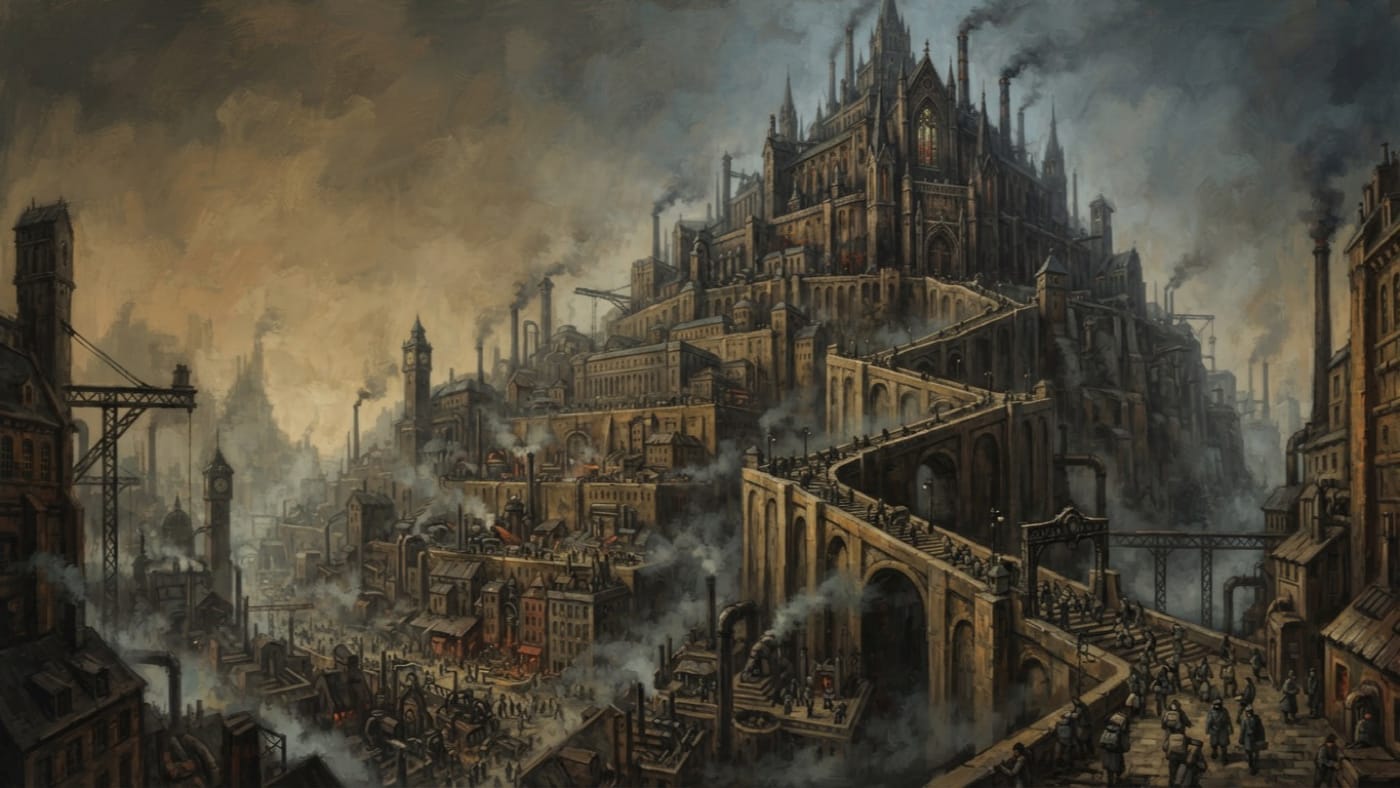
The Synod Chapterhouse of Rheinscarp stands at the summit of the High Step Precinct on the ninth terrace, above all of the city's labour. In correspondence I use its institutional name. The mill-hands of the fourth terrace call it the Ration-Cathedral. They don't say it fondly. They say it the way a debtor names his creditor's house: accurately, quietly, and with one eye on the window.
The nickname describes a jurisdiction, and it should not be read as an inventory. The survey records no dedication to a saint, no architect, and no seated superior whose portrait the reader might admire. I will not furnish the building with a granary to make a mill-hand's joke work. The Chapterhouse holds authority over the system that allots rations. The flour is ground four terraces down in the Mill-Crown dust, by people who will never be asked their opinion of the arrangement. If they were asked, most would answer with the far end of their breeches.
Between the summit and the mills lie the Ledger Cloister on the fifth terrace, the Widowlight Quarter on the sixth, the Ash Exchange on the seventh and the Cantor Foundries on the eighth. Each does its work and sends its sums upward. The air at the top is clean and the stone is polished. The fog that climbs the Steps at dawn reaches the summit last, tired, and rather better behaved.
#On the Local Consecration
"The river was free until they taught it to count." — Counter-narrative, Rheinscarp
Rheinscarp was mills and lockworks before it was holy. They were Rationalist works on the Rhine, older than the Sundering of A.S. 45, with no recorded founding year and no theological ambition of any kind. The Church did not raise the cliff. It inherited it.
The Silt Year of A.S. 78 (1788 CE) sent the city upward. Spring floods drowned the lower terraces and four thousand people with them. The survivors climbed, and a river-warden the record preserves only as "Warden K." put a toll on the climbing. The summit then became the safest place in Rheinscarp, then the most expensive, then the most authoritative. That is the usual order of such promotions.
The constitutional settlement came from elsewhere. The Concordat of Strasbourg established the formal Synod in A.S. 90 (1800 CE). By then both founders of the Church were in their graves, and neither commissioned, consecrated or so much as looked at a stone of this building. Rheinscarp's own settlement followed in A.S. 92 (1802 CE), the year by which the Chapterhouse had been consecrated at the summit. The Bureau of Tithes seated its liaison and the Bureau of Records installed its annex. The Tribunal of Stairs received the charter that turned every terrace crossing into a registration.
The Ledger does not give the day of consecration, the officiant or the years of building, and I decline to supply them. A consecration date is a seal, and a seal is not freehand work.
"By A.S. 92, when the first Bureaus received their formal constitutions under the Concordat, Rheinscarp had already built the architecture of its own tyranny." — Codex entry on Rheinscarp.
The Concordat and the formal Synod date to A.S. 90. The Rheinscarp consecration, liaison, annex and charter of A.S. 92 were a local settlement made under that Concordat. Bureau organs existed before either date, and they did not all begin together, in Rheinscarp or anywhere else. The rest of the sentence stands.
#On Holy Authority and Its Officers
"NO STEP UNSTAMPED." — Local motto, Rheinscarp
Under the city's constitution the Chapterhouse is supreme. The Tribunal of Stairs judges beneath it. The Records annex registers beneath it. The Tithes liaison takes part in local administration beneath it, which in practice means beside it with a ledger open. In theory, every stamp in Rheinscarp is applied under holy authority.
Theory sits a long way above the stair.
Daily survival is run by three powers who keep summit offices, and the Chapterhouse is none of them. Praetor-Registrar Ysabeau Kelm holds names and absence through the Records annex. Her working archive is four terraces down in the Ledger Cloister, where the paper is kept and the dust is honest. Cantor-Marshal Hrodric Venn holds the bell-hours, the time-credits and the convoy logistics that supply the Sagittal Line. Miss one of his windows and your ration priority collapses on schedule. Broker-Saintsman "Uncle" Damas Rohe holds the mortuary finance of the Ash Exchange of Saint Pelagia, and with it the assurance that every citizen becomes collateral in the end.
The Codex has already withdrawn the phrase "tripartite balance," and I will not let it back in. Kelm and Venn are officers. Rohe is a financier, and his title is a trade designation; no register I have seen records an ordination. All three are subordinate. Nobody has tested that subordination in recent memory.
The standing survey of Rheinscarp records that the Chapterhouse has issued no independent decree since A.S. 187 (1897 CE). That is fourteen years. A careless reader might decide the seat is empty, or the building sold, or that someone in the cellar drafts decrees and signs them under another name. The survey says none of this, and I say none of it either. It records only that the supremacy continues and the independent decrees do not. The Chapterhouse ratifies, hallows, and is cited. Whether it also wakes in the mornings is a matter for its own clergy, who have not written to me.
#On Reaching the Authority
"Stairs don't care who you were." — Proverb, Rheinscarp
In Rheinscarp, authority sits at the top of a staircase, and the authority's subordinates keep the staircase. That is the whole of the problem and most of the comedy.
Every terrace boundary demands coin, an authorized Stair Verse and a stamp. A clipped brass stair-token is good for one crossing. Bulk cargo must go up the Hundred Steps, the principal legal ascent. Licensed lifts and chain-bridges carry other traffic at the bell's rates and the provost's moods. If a verse is misspoken at any window, the speaker can be entered in the Ledger as absent. Confession repairs the entry, and confession is billed.
Anyone who wants to bring a grievance before holy authority has to clear every one of those landings first. At each one they need a name the Records clerks will recognize, a verse the provost will accept and coin that has survived the landings below. The keepers of that road are the Tribunal's provosts and the Records clerks, the same offices the constitution places beneath the Chapterhouse. It is a short road for them and a long one for everyone else.
The survey lists no admission tariff peculiar to the Chapterhouse and no petition form, and I have found no rule barring the poor from its doors. The stairs do that work unassisted, and they are thorough.
#On Hunger Before the Tribunal
"A clean name is warmer than a coat." — Proverb, Rheinscarp
In A.S. 198 (1908 CE) two terraces received one grain shipment on paper: the Mill-Crown Terraces and the Widowlight Quarter. The stamps were authentic and so were the entries. The grain was real too, and it arrived once. Forty-one people died in the double-entry famine. The documents that killed them would pass any audit in the Church. They did.
The famine exposed the absence quota shared by the mills and Records. Each quarter some portion of the living must be corrected out of the count so that the rations balance in ink. The official percentage has not been disclosed. The street says one in forty, and the street is not a certifying body. The survey names no author for the arithmetic, and I name none. The Chapterhouse is simply the holy authority under which the arithmetic is done. The mill-hands consider this a fine distinction and are welcome to eat it.
The quarrel now before the summit grew out of the famine. The hunger-waiver advocates of the Bureau of Mercy hold that the starving should be fed whatever their stamps say. The Tribunal–Tithes axis holds that toll sanctity is doctrine and that hunger, however sincere, is not a doctrinal argument. In A.S. 199 the Ash Exchange was found trading claims on the future cremains of people still alive. The Mercy party gained a fresh exhibit, the brokers gained a fresh market, and nothing was settled.
Both parties appeal to holy authority. By the survey's count, holy authority has not decreed on its own motion since A.S. 187. The waivers are still contested and the tolls are still sacred. The Chapterhouse is still supreme, consecrated and polished, and it still stands above the flour.