
On the Raised Books
"All gifts require witness."
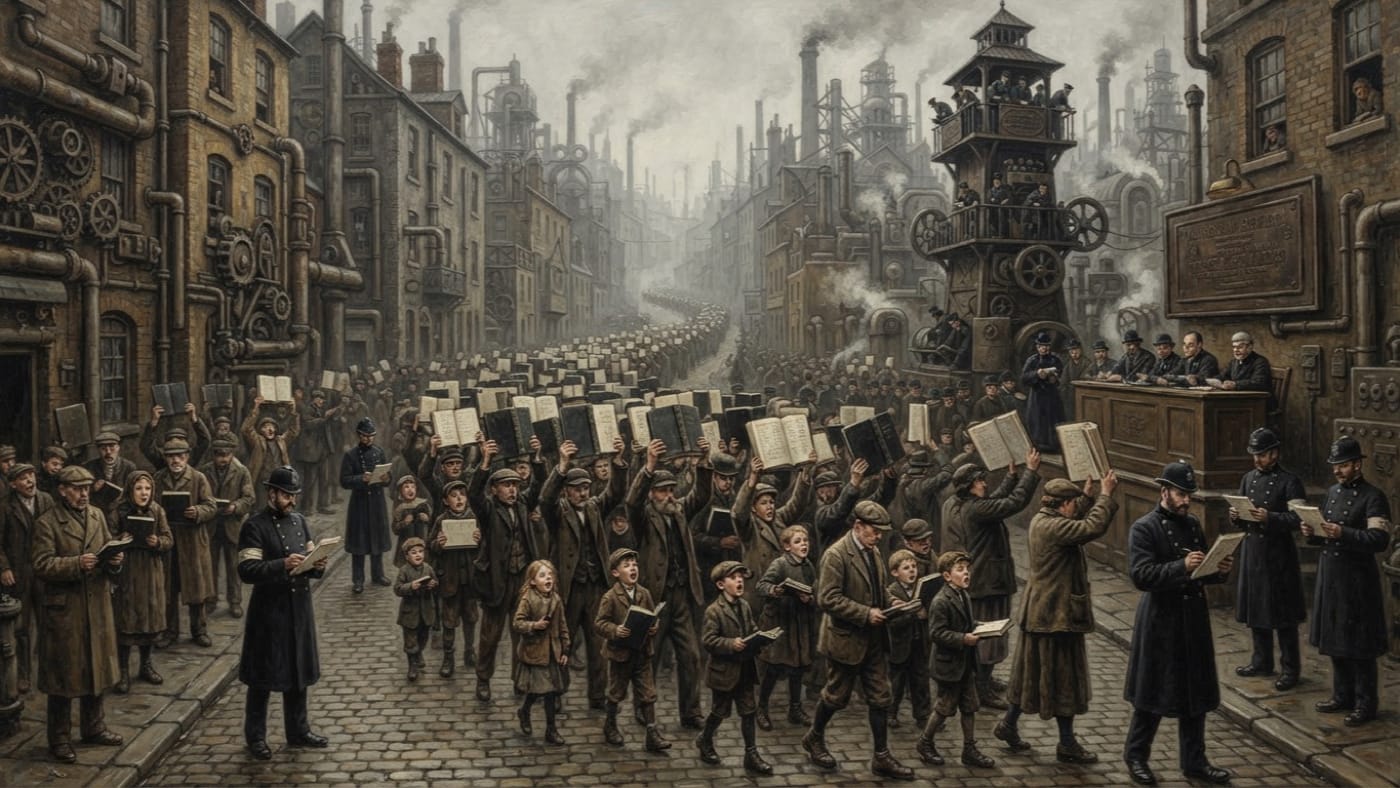
Four times a year the shutters come down across a ward, and the ward walks. The baker, the chandler, the cooper and the widow who sells thread by the arm's length all close their shops, take the Book of Receipts from under the counter, and carry it into the street. They hold it open above the shoulder, where Heaven and the neighbours may read it together. Auditors walk the column chanting psalms. Clerks walk behind them and read the entries line by line: Two loaves purchased, duly tithed. One sheep butchered, salt accounted. By the time the column reaches the plaza, a quarter's ordinary spending has become a hymn.
This is the Procession of Receipts. It is catalogued among the Inspection Liturgies and entered in the sanctioned calendar of the Bureau of Festivals. Attendance is mandatory in every Heartland city above ten thousand registered souls. Smaller towns may march if they please, and most of them please, because a parish that keeps its books indoors invites the question of what is in them.
The calendar's summary speaks of shopkeepers. The street knows better. The merchant's ledger goes up first because it is heaviest. Then the household books go up, with every family behind its own: mother, father, lodger, apprentice and child. A carpenter's purchase of nails is lifted as high as a reliquary, and with the same expression.
#On the Account Spoken Aloud
The clerk reads and the household answers. When a family's book passes the auditor's station, the family must speak its balance: what came in, what went out, what was rendered to the Bureau of Tithes, and what is still owed. The father may speak it. Often the father is made to stand and listen while his child speaks it for him.
Children recite their parents' debts in the cadence of psalms. They learn the figures the way they learn the Responsories, by repetition and under correction, until the number is in the mouth before the mind has considered it. A boy of seven can give his family's arrears to the farthing without knowing what a farthing buys. That is held to be the better order. Comprehension can come later. The cadence must come first.
The correction is the second liturgy. If a household leaves out a coin, rounds a debt down, or forgets a candle bought on credit, its neighbours correct it aloud, in the street, in the middle of the chant. They correct with relish. Doctrine says that to forget a coin is to forget the Creed, and a neighbour who lets the omission pass has made himself party to it. A ward that marches well is a ward in which everyone knows what everyone owes, and says so before the auditor has to ask.
The theology comes from the Bureau of Doctrine by way of Concordat Integralism. Records now classify it as an orthopraxy, having withdrawn "ideology". It holds that every civic act is sacramental. To eat is a liturgy in miniature, and so is to sign one's name. So is the purchase of two loaves and the tithing of them, and the record of that purchase must be carried as the faithful carry relics. The Integralists go further. They teach that decree saturates reality, and that what is written and sung in right order becomes true. I record the teaching. I also record its applications.
In Strasbourg, by an account repeated to me in three Bureaus and filed by none, an entire parish was once declared solvent because its ledgers were sung at perfect pitch. Were the books balanced? The declaration said they were. The account does not say what became of the creditors. Harmony is truth, the Integralists teach. Arithmetic was not called to give evidence.
#On Attendance and Reconciliation
"Joy leaves a trace."
Two Bureaus sponsor the Procession, and each counts something different. Festivals counts bodies: who marched, who watched, and who stood at the curb with an expression the Attendance Auditors could score. Tithes counts money: what the ledgers declared, what the chanting exposed, and what was paid in the following weeks by citizens who had heard their own arrears sung back to them in the street. The two figures rise and fall together. It is the only matter on which the two Bureaus have ever agreed.
Between them stands the apparatus. A large Procession is run by a Receipt-Procession Pageant Captain. The formal title is Processional Comptroller; the street says Joy-Taxer. The office works through route, ribbon, curb tally, exceptions and reconciliation. The route is chalked on the curbs the morning before. Ribbons are punched and issued at the ward gates. Since the Receipt Reform the wrist-ribbon has replaced the paper slip, being harder to forge and easier to see across a street.
At curbside stations along the route, faces are matched against parish rolls and ration stamps are inspected. The absent are noted by the shape of the gap they leave. Every pause in the column is timed so the tally can keep pace, whether it is for a psalm, a blessing, or a float turning a corner in those wards that use floats. When the last book is lowered, the Captain's office sits through the night reconciling the count to the rolls until the story agrees with the totals. Then it seals the list of anomalies in red wax.
The anomaly list goes downstream: to ration offices, to labour conscription boards, and to the inspectors of the Bureau of Purity. Officially none of this is a census, and no census charter exists. There is only a festival, and a festival is permitted to know who attended it.
Two other offices keep the column moving and audible. The Procession Marshal owns the movement: the whistles, the spacing, and the passage of eight hundred souls through a lane built for two carts. The Festival Chorus-Master owns the sound. The approved psalms, the rehearsed responses and the length of each antiphon are licensed through the Bureau of Orison and Song and timed against the Bureau of Bells. Three offices keep three ledgers on one column, and the citizens in it see only the auditor.
#On the Children in the Column
The Bureau of Conscription sends no officer to the Procession. It has no need to.
The Procession teaches through the body. A child who has walked behind the household book every quarter since he was old enough to carry it has learned several things. He walks at the pace a whistle sets. He halts when the antiphon halts and answers when his family's name is called. He stands still while a stranger reads his family's failures to the street. He has learned that correction comes from the man beside him, and that the proper answer to correction is to repeat the corrected figure, louder.
The doctrine of the Civic Cut counts the Procession among its principal instruments, beside the Quiet Spoon and the festival catechisms. The Civic Cut is the grinding by which a citizen is tuned to bell, ration and catechism before the levy ever reaches his door. A line of ledgers is already a queue. Under the Civic Cut that queue faces east, toward the Sagittal Line, though the ward it marches through may be three hundred miles behind it.
One might call it indoctrination; I call it tuning.
Per Stamped Errata, Bureau of Records, Fifth Revision: all references to "indoctrination" are excised and replaced with "harmonization". The children of the Procession are harmonized. I preferred "tuning". Records did not ask me.
When the mustering yard calls him, the boy has rehearsed the queue for years. He knows how to stand in a column while a clerk at a table checks his name against a roll. He has done it in his own street, with his mother's debt to the chandler in his mouth.
The information is worth as much as the drill. Suppose a household's book shows boots bought for a son of fourteen, and its neighbours correct it, loudly, for leaving out the bread ration of a second son. That household has told the Procession something the parish roll may not have known. The anomaly list seizes nobody. It travels, sealed, to the offices that do.
#On Local Accounts and Present Practice
Each city marches in its own manner and within the same rubric. In Rheinscarp the terraces march their Books by Step, each terrace on its own stair, under the town's motto of commerce as hymn. The local word for chanting a debt is receipt-hymn. The city's Receipt-Chanters can recite a family's debts from memory and are said to enjoy it. A citizen of Rheinscarp who misses his figure on a stair has been heard by the whole terrace above him and the whole terrace below. Geography does the auditor's work.
The rite belongs to the Heartlands under the Synod. The independent crowns of Britain and the Netherlands keep their own books, and whether they sing them is their own affair.
One account from Mainz is told so often in the Bureaus that I enter it here, still attributed and still unexplained. A Procession there once stopped in the middle of the chant when a Judge walked through the column with his ledger closed. Every shopkeeper whose book he passed was found bankrupt the next morning, though no coin had moved. Some swore they heard scratching in their ledgers that night. No Bureau has claimed the incident, and none has offered to reconcile it.
The ordinary Procession ends with less ceremony. The books come down and are closed. The shutters go back up. Households walk home, and the children mutter the corrected figures to themselves on the way, because they will be asked again next quarter. In a room off the route, the Captain's clerks work by lamplight until the count is clean, then press the red wax onto the list.