
#On the Yards and Their Work
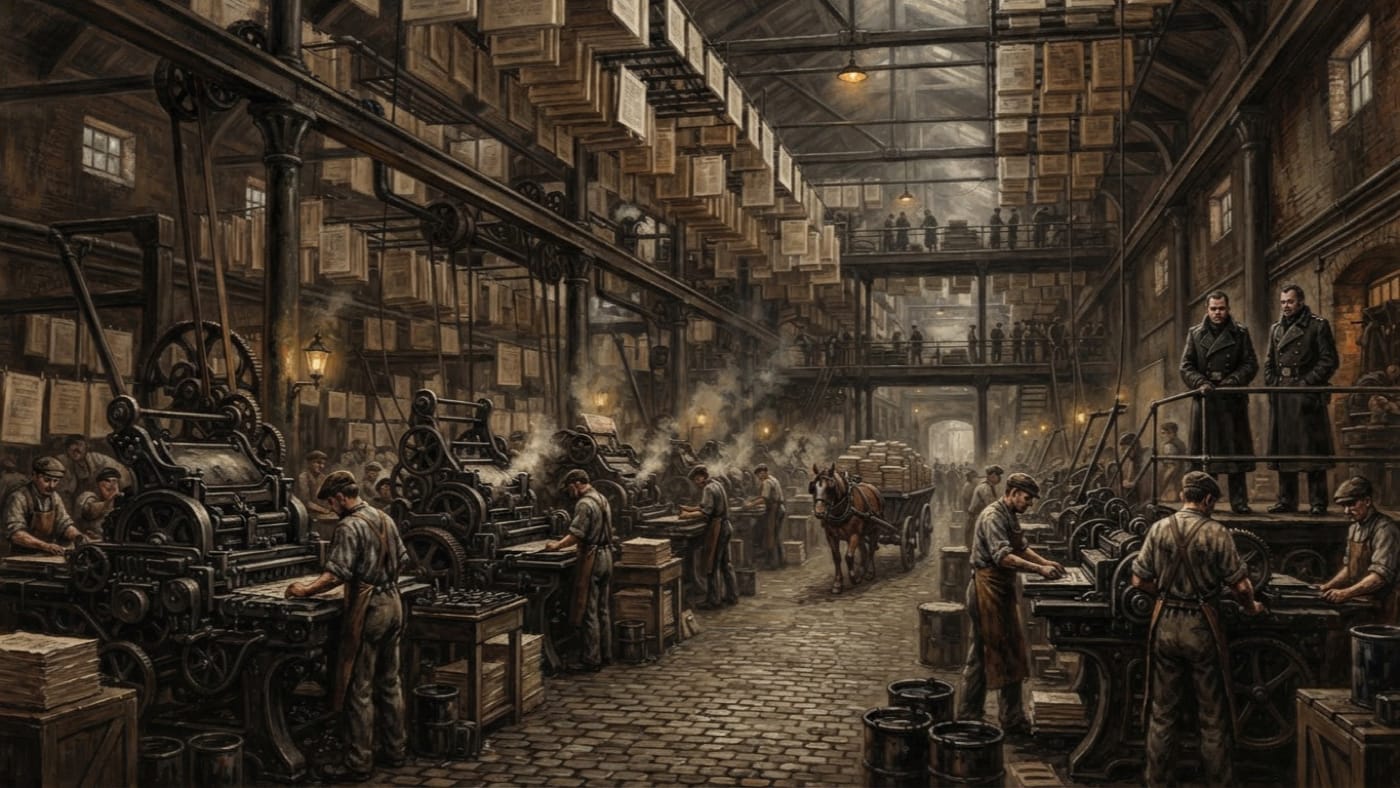
The Press Yards are the quarter of Ulm where the city's words are made lawful. They smell of lampblack, wet pulp and glue. The city entry adds suspicion to that list. I wrote that entry, and the suspicion stays. Carters drive the lanes through the Yards with the sanctioned stock on which Ulm prints the Index Damnatus. Behind the carts, under rafters hung with drying sheets, the presses run at the volume the Church has sanctioned, and the supervisors make sure they run no faster.
The products are few and plain. The Yards print copies of the Index, catechisms, denunciation forms, and instructional broadsheets that warn students against becoming the kind of men these presses once made famous. A city that taught Europe to read without permission now prints the forms on which Europe reports its readers.
The Ledger gives me no boundary for the quarter, no street plan, no acreage and no bearing from the cathedral. From most lanes in Ulm a man can see the spire, and a pressman needs no more orientation than that. He knows where the Church is. He works for it.
#On the Presses Before Correction
Ulm had printers before it had a crime worth printing. The crime arrived in A.S. −55, 1655 by the old reckoning, when twelve professors and academic dignitaries signed the Concordats of Ulm. The compact had three articles, a preamble and a seal. It also needed copies. The city's printing houses supplied them to any university willing to add its name, and the presses carried the correspondence of a learned continent that had decided the Church was an obstacle to scholarship.
The 1700 congress at Ulm, which drew delegates from thirty-one institutions, was a later gathering. It was not the signing. Engravers like to merge the two because one room is cheaper to draw than two, and I do not allow it.
After De Vera Luce came out of Amsterdam in A.S. 0, Ulm stopped being the source of the Rationalist movement and became one of its relay stations. Its presses hammered and its lecture halls filled. Sealed packets left the city under university marks, and cellar printers worked past curfew, since arrogance keeps poor hours and pays for its own candles.
Nothing on file says the quarter was already called the Press Yards in 1655. Nothing ties any standing building or surviving press to a signatory's printer. Guides in Ulm who point at a particular frame and call it the one that set the compact are guilty of a small fraud, and the Bureau of Silence has not yet found it worth the paperwork.
The city entry for Ulm states that its presses "produce approved paper at sanctioned volume."
Corrected. Presses do not produce paper. Ulm's paper comes from the Paper Mines outside the city, and the presses of the Yards print on it. The Hieromnemon wrote the original line in a fit of compression and regrets it as a matter of procedure. The paper also regrets it, though no Bureau will put that in a file.
#On Approved Words
The Bureau of Silence seized the old printing houses and turned them to approved use. I give no year for the seizure. The files give the sequence: the Sundering of A.S. 45, the Church's public emergence and its uneven taking of the cities, and the constitutional order made formal at the Concordat of Strasbourg in A.S. 90. They do not say which season the doors of the Yards were sealed, who held the keys, or when the presses began turning again. I leave those blanks where Silence left them.
The offices divide the work, and each guards its share. Silence supervises the printing houses and governs the physical word wherever it appears. The Bureau of Doctrine determines what is heresy. The Bureau of Purity keeps the Index. The Bureau of Records keeps the archives. A pamphlet can be condemned by one office, catalogued by another, filed by a third and pulped by a fourth, and each of them will claim the decisive part.
The master Index is chained in Strasbourg, and Ulm does not have it. Provincial copies are abridged, and the Yards print copies. Nothing before me says the Yards have ever set a whole Register in type, and a compositor who claimed to have read one would be confessing to more than he realised.
This is the bind the Church cannot get out of. It cannot print without readers. A compositor has to read in order to set type, and a proofreader has to read better than the man who wrote the text. Correcting a denunciation form takes a man who understands its grammar well enough to see how a clever penitent might fill it in against the wrong neighbour. Each skill the Church punishes in a free scholar, it pays for in a licensed pressman. The difference is the licence, and Silence holds all the licences.
#On the Stock and the Hands
The Yards print on Ulm stock. The Paper Mines lie outside the city, under Doctrine's jurisdiction and in Silence's production custody, and they send out archival paper, sermon stock, penitential forms, emergency writ sheets and redaction-grade vellum. The city's presses and its colleges both use sanctioned stock. The Ledger does not say which road the finished paper takes into Ulm. The Mine Road entry already refused to put condemned convoys and loaded paper carts on the same stretch of stone, and I uphold that refusal. Whatever road the stock comes in on, it arrives, and the carters take it through the Yards.
Keep the hands separate, because the Bureau keeps them separate and so must I. The men at the Yards' presses are licensed urban workers. They go home at night with names, wages and black under their fingernails. The relatives in the Nameless Hostels keep their names while they wait for derivative disposition. The labourers in the galleries lose theirs at the intake clerk's table, where the surname is suspended, the given name sealed and a number assigned, and their work is recorded under Anonymous Productive Penance. These are three different conditions governed by three procedures.
They are also close enough to touch. The Mines take authors, copyists, binders and printers. A pressman in the Yards only has to set the wrong sheet, keep a spoiled proof, or teach his daughter her letters from a page the Index has since claimed, and he can move from the first condition to the third. At the clerk's table literacy raises the quota. The skill that earns him wages in the Yards is the same skill the Mines count against him.
The Old Faculty Rows train the clerks, copyists and registrars that this arrangement depends on. The Yards print what those graduates will read, and some of it is forms. A denunciation form printed in the Yards is filled in by a lawful reader. A tribunal acts on it, and a convoy walks. Later, by a route the Ledger leaves undocumented, more stock comes in under a carter's tarpaulin.
#On What Remains in the Sheet
Some Ulm stock is warm. Some of it rejects names. Some of it shows a watermark no plate-master authorised when it is held to a candle. These are reported properties of some batches. They do not describe all Ulm paper, and nothing on file records an outbreak in the Yards. The test is in the city's own record. A clerk writes a dead man's name in the lower left corner. If the name stays, the sheet is cleared. If it fades, the sheet goes to Records. If the sheet answers, the clerk goes to Mercy.
There is also an older account. A healing attributed to Saint Aldebrand was reported from Gallery Three of the Mines in A.S. 156. Records classified it as occupational recovery. According to the reports, one recovered labourer's name later appeared faintly in the watermark of penitential forms printed between A.S. 157 and 159. Records attributes this to fibre contamination. The record does not say which press printed those forms, whose name it was, or why the others stayed lost. I do not supply any of it.
#On Present Production
In A.S. 201 the Yards are at work. The presses run under supervision at sanctioned volume. The Index copies go out abridged, as provincial copies always do. The catechisms reach the parishes and the denunciation forms reach the desks. The broadsheets go up wherever students gather. On the anniversary of the signing those students walk barefoot from the university court to the cathedral and recite the Litany of Twelve Errors over a blank page of Ulm stock. The Yards do not print that page, because nothing is printed on it.
At the end of a shift the carters take their empty wagons back down the lanes. The pressmen scrub their hands with lye, and the lampblack stays in the cracks of their knuckles. On the rafters above the cold presses, the day's catechisms hang drying in ranks, waiting to be counted.
Notes for the orchestrator
- Erratum: I didn't reuse the old "educational reform misused by extremists" correction, because the Ulm and Old Faculty Rows articles both already use it. Instead the erratum corrects a real line in the Ulm parent article: "The presses produce approved paper at sanctioned volume." Presses print on paper; the Mines make it. Swap it back if you'd rather keep the planned one.
- Nemea: It isn't linked because there's no local
nemeacodex file. The stamp says "supplied from Nemea." It doesn't say whether redaction ink is or isn't made in the Yards. - Links: I used 19 cross-links, above the 10–16 target but within the brief's 10–30. All of them have local deployed files. Live public routes still need checking at submission.
- Length: The prose is about 1,750 words including margins and stamps. These notes are not part of the article.