
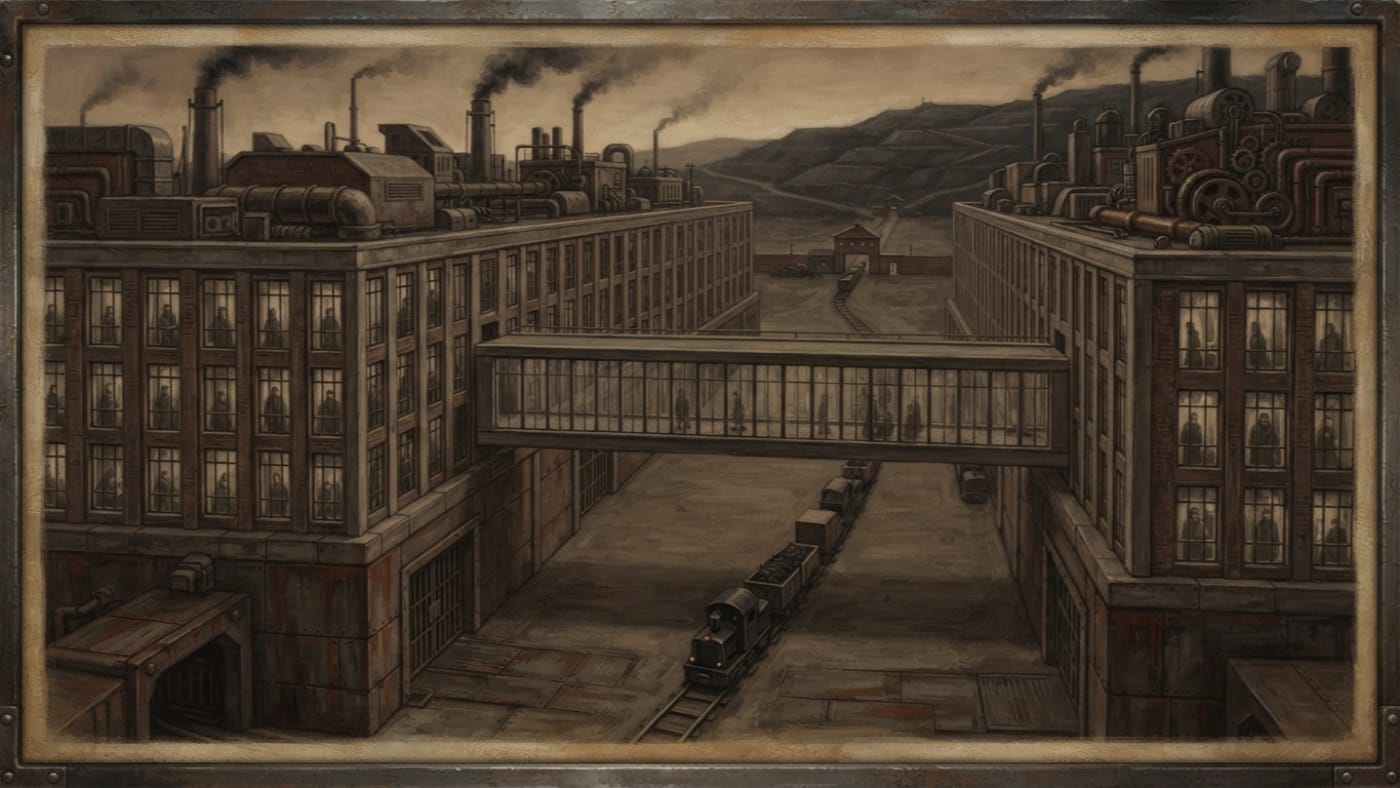
#On the Lodging by the Road
The Nameless Hostels stand along the Mine Road, which leaves Ulm south-east through checkpoint gates and runs out past the city proper toward the galleries of the Paper Mines. They house relatives awaiting derivative disposition. As far as I hold it, that clause is the hostels' whole charter, and every word in it was chosen by someone with a seal.
Relatives means the household of a person already condemned. Awaiting means the matter is still open. Derivative means the guilt reached them through someone else, the way rent reaches a lodger through a landlord. Disposition means a decision will be made, and the people under the hostel roofs will not be the ones making it.
A traveller from a softer province might hear hospitality in the word hostel. The word means lodging and nothing more. A bed by the road is an administrative condition, and it makes nobody who sleeps in it innocent. The Church lodges a great many people pending review, some of them in cells. The hostels are the cheaper kind of lodging, for people whose case needs a roof and does not yet need a number.
The Ledger names no proprietor, no superintendent and no keeper of keys. The Mines lie under Doctrine's jurisdiction and Silence's production custody, and Records keeps the paper. No instrument on my desk extends any of these arrangements to the hostels, so I do not extend them either. A roof with no named owner is a familiar thing in the Church. It means the roof belongs to the procedure.
#On Windows and the Forbidden Curtain
Two rules govern the architecture, and the record gives me only these two. The windows face inward. Curtains are forbidden.
An inward window looks onto the building itself. A resident at the glass sees more glass, with other residents standing behind it. Nobody sees the road, the gates or the hill with the galleries beneath it. The family is spared the sight of where it is going, and the road is spared the sight of the family. Ulm likes both arrangements.
The curtain ban has a stated reason, and I give it as the Bureau gives it: hidden cloth encourages private thought. A curtain is a screen. Behind a screen a person may weep, pray, quarrel with a spouse, or form a sentence in the head that has not yet passed inspection. Doctrine has no quarrel with weeping. It has a professional interest in where the weeping is done.
I accept the theory. I would only point out that it costs nothing. A curtain has to be bought, hemmed, hung and laundered. A prohibition is written once. The Bureau has found a rule of conscience that also saves on linen, and it would be ungrateful of me to ask which benefit it noticed first.
The Bureau's theory holds that what the windows show one another is household life with nothing covering it: a mother at her mending, a boy at his bread, a girl with nothing to read. These are the same acts that brought them to the road. The building shows the evidence back to the accused.
#On the Household as Evidence
The Bureau of Doctrine, in a fit of inheritance logic I have always admired, determined that certain intellectual crimes pass along through household benefit. The examples it sets down are domestic and exact.
A professor's son who ate bread bought with a heretical salary has consumed derivative error. A wife who mended the coat her husband wore to deliver a forbidden lecture has materially supported the lecture. A daughter who learned her letters from condemned books has received contraband literacy.
Read them slowly. The son need not agree with his father. The wife need not understand the lecture. The daughter need not remember a single proposition from the books. Belief does not enter into it. The son ate, the wife sewed and the daughter read. Doctrine attaches its classification to the benefit received, and a household exists to share benefit around. In the Bureau's accounting, every loaf on a scholar's table was an instalment of his offence, paid out to his dependants.
That is why the hostels exist. A scholar's crime, measured this way, does not stop at his door. It runs down the hall into the kitchen and the sewing basket, and from there it has to be assessed one person at a time. Assessment takes time, and time requires a bed.
The Bureau calls the joint treatment of families mercy toward kinship bonds. The sentence does not split a family. The family is examined together and housed together while the examination runs. The record does not say, for every case, whether it is then sent on together, and I will not say it on the record's behalf.
A parish primer still in circulation describes the hostels of the Mine Road as the place where dependants are "lodged apart pending review," and its readers have taken apart to mean spared.
Corrected. The Codex struck this reading from its entry on Anonymous Productive Penance and upholds the correction here. Lodging pending review gives no exemption from derivative punishment. The hostels hold relatives awaiting disposition. Disposition is usually intake.
#On Waiting with a Name
The hostels' name is a prophecy, and I would fail my office if I let it pass as a description. The residents have not been numbered, and they keep their names while they wait. A woman at an inward window is still the scholar's wife. She still has her surname, and her given name too, if anyone cares to use it.
Ulm's civic shorthand says that condemned families lose their names. In time that is usually true. It happens further down the road, at one particular table, and neither the hostel nor any gate on the way is that table. Citizens who say otherwise are improving a story at the procedure's expense.
The residents wait with no published calendar. The record gives no average stay, no deadline, and no figure for how many are sent on to the galleries against how many are dealt with otherwise. The Mines receive convoys twice weekly. That figure comes from the receiving end and cannot be read backwards into a hostel timetable. Disposition is usually intake. I keep the word usually because it is the Bureau's word, and the Bureau chooses its words precisely when it wants to leave itself room.
When intake comes, it happens at the Mines' intake clerk's table. There the surname is suspended and held so that kin can be cross-referenced. The given name is sealed. A number is assigned, and from then on the labour is recorded under Anonymous Productive Penance. The clerk enters category, fitness for labour, class of doctrinal contamination, and literacy. Literacy increases quota. The daughter who learned her letters from condemned books will find them counted a second time.
On the road the residents are kin: wife, son and daughter, the words a parish register would use. At the table they become categories. The Mines' own process reports list family unit under derivative penalty among their inputs. Between these two vocabularies stands the hostel, where a person is still called by a family relation and already filed under a classification. It is the last building in Ulm where both words apply.
#On the Hostels in a Corrected City
Ulm needs these buildings because Ulm needs paper. Its supervised colleges need examination sheets. Its approved presses print the Index Damnatus and the catechisms. Its cathedral precinct uses up sermon stock. The offices of the Church draw archival paper, penitential forms and redaction material from the galleries at the end of the road. Doctrine supplies the verdicts. The Bureau of Silence takes the labour into production custody, and the Bureau of Records receives the documents. A hostel full of relatives is a store-room in front of a mill, and Ulm, a printing town, runs its mills well.
The city corrected itself after the Concordats of Ulm, signed in A.S. −55, 1655 by the old reckoning. It never stopped teaching. It teaches under watch, in chartered halls, from audited syllabi. Learning received lawfully is the foundation of the corrected city. Learning received unlawfully is a charge against a schoolgirl. The difference lies in who paid for the book. The colleges and the hostels are two ends of one policy on literacy. One end has lecterns. The other has inward windows.
The arrangement has no cruelty in it that a ledger would recognise. The Mines need hands, Doctrine needs its households assessed, and the road needs somewhere to keep people between the verdict and the table. The hostels supply that place, and their only stated rules are about glass and cloth.
#On the Present Condition
The present survey of the Mine Road, for A.S. 201, finds the Nameless Hostels occupied. Their windows face inward, and curtains are still forbidden. Their residents await derivative disposition. They keep their names while they wait and have not been numbered. No instrument before me gives a founding date, a builder or a first occupant, and I enter none here.
The hostels have no shrine. If they keep a register of departures, nobody has shown it to me. They hold what the road brings them, and they hand it on when it is called for.