
#On the Street in the Plans
Piac Street was a street of Debrecen before the Sundering. That is nearly the whole of its civic biography as the Bureau of Records keeps it, and I have asked twice in writing. Its length is not on file. Neither is its width. Nobody can tell me who lived along it, what they sold, which bells rang over it, or whether its gutters ran clean. The clerks shrug in the trained manner of men who are paid to shrug and have taken pains to do it well. What survives is a line on the pre-Sundering civic plans, drawn by some municipal draughtsman who expected his work to settle disputes about drains and frontages.
It settled something else.
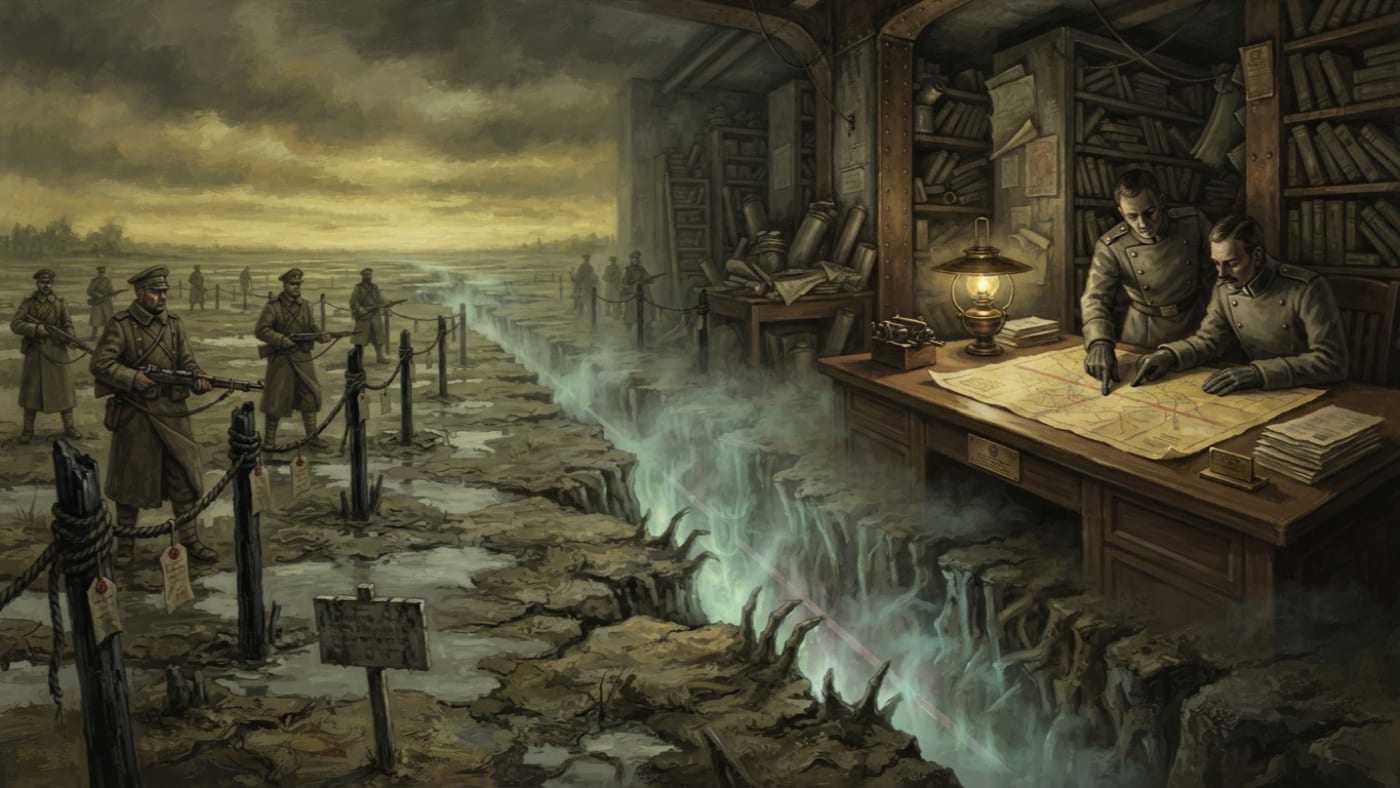
The street now exists in the archive mainly as a match between a line on paper and a crack in the ground. In A.S. 172 the ground of the Blightmarsh split along a line. That line was later laid against the old plans and found to agree with Piac Street. That gives us a recorded alignment, which is a different instrument from a road a man can walk down. The Bureau learned the difference at a price it still disputes in committee.
Nobody has proved that a buried road lies intact beneath the mud. Nobody has recovered its paving or confirmed a surviving house front. The street is known by its outline and by what that outline did to the men standing on it.
#On the City's Consumption
Kargath took Debrecen on the night of the Sundering, 1 November A.S. 45. The account of the Mire Collapse of Debrecen gives forty-two thousand souls and a forty-mile provision radius devoured before dawn. Those are figures for the whole city, and I record them here only as that account states them. Piac Street's share of the forty-two thousand is unknown. I will not guess at it.
The Hungarian plain that had fed empires turned to grey mud, grey water and a grey sky. The soil was eaten along with the granaries. Things moved under it afterwards, and mouths opened in it, and patrols learned to treat a smooth stretch of marsh the way a confessor treats a smiling penitent.
For one hundred and twenty-seven years Debrecen was a name in sermons, a gap in the grain returns, and a curse among old campaigners who would not trust a loaf baked east of the Danube. During that time nobody needed to consult Piac Street. Nobody could survey it either. It lay in a drawer of civic plans, drawn correctly and of no use to anyone, which is the condition the Bureau prefers for most of its holdings.
#On the First Fissure
The forward observation regiment had been posted to the marsh over the dead city to observe, to measure the boundary, and to support the engineers attached to it. Its last complete report lists sub-surface strain, vertical bubbling, faint choral return, and a smell of bread. These describe the field as a whole. No report places any of them under Piac Street, and I will not move them there to tidy the narrative.
At the third hour after Sext, the surface split.
The first fissure ran north to south. The men standing beside it did not call it Piac Street. They had no reason to know the name and no leisure to learn it. They called it whatever soldiers call the ground when it leaves without permission, and their vocabulary is not recorded. The name came later, at a table, when someone with clean hands set the field sketches against the pre-Sundering civic plans and saw the line agree.
A second fissure opened at an angle that matched the old market approach. Then side lanes opened across the wider grid, then courtyards, then wells. I have seen it suggested that all of these belonged to Piac Street, as if one thoroughfare had exploded into a district. The record does not say so. The first fissure is the street. Everything after it is Debrecen in general, which is worse.
A cartographer was recovered from the edge of the opening and survived for nineteen hours. Under sedation in a field hospital he drew the pattern from memory. He wept over the drawing because, he said, it was beautiful, and he apologised for that judgement twice. His sketch is the reason the Bureau could compare anything with anything. He is otherwise absent from the files, and I will leave him his privacy. He earned it more honestly than most men earn a pension.
Mouths rose from the fissures. The Church still has not agreed on what to call them. They have been filed as Maw-Born, sub-surface variant, Category Unassigned. They have also been called Charnel Mouths, Drava Throats and Street-Jaws, depending on the clerk, the regiment and how much the witness had drunk. These are names for reports. No one has shown that they are separate kinds of creature. Three men described one opening whose teeth were set like cobblestones, and then their testimony stopped holding together. The Bureau of Doctrine has rightly refused to treat this as a description of the street's paving. A frightened man looking into a throat sees whatever his memory supplies, and these men had been staring at a road.
#On the Engineers' Closure
The regiment had Litany-Engineers with it, and they did the only practical thing left. They consecrated a trench while the ground was failing. The Bureau of Engineering records one mile of trench consecrated. That figure is the length of the trench. It is not the length of Piac Street, and anyone who uses it to measure the street will find his citation struck.
They laid fuses end to end. When the ink washed out, they cut their palms and wrote the psalms into the mud in blood. The mud pulled at their boots the whole time, and engineers record that sort of thing as a load problem. The charge went off at Vespers. The mire fell inward on itself, and the mouths stopped coming up.
Precision matters here. Stopping the emergence did not give anything back. The collapse closed the mouths. It did not return Debrecen to the surface, Piac Street to the plans, or the regiment to its muster rolls. Fire rose through the muck on three nights afterwards. Below it, through packed earth, men heard singing off the beat, which they called the Choir Beneath. The engineering detachment returned zero.
The official loss for the whole incident is eight hundred nominal effectives, consumed in six hours. The figure belongs to the incident. No ledger divides it by street, and I will not lay eight hundred men along one fissure because it would make a neater grave.
An older chronicle entry places the Mire Collapse of Debrecen in A.S. 488.
Corrected to A.S. 172. The year 488 has not occurred. The Bureau of Records regrets having dated a catastrophe in advance and has asked that the error not be repeated near the Bureau of Doctrine, which takes prophecy as a jurisdictional matter.
#On the Restricted Map and Present Ground
The Bureau of War declared the site a permanent exclusion zone. The fissures are still there. They fill with mud, flatten, and come back after rain. I have read a petition asking that Piac Street be named the first to reopen each time. The petition was well bound and had no evidence in it. The record says the fissures come back. It does not say they come back in order, or that any of them follows the old civic line every time.
Survey teams sent close enough to check whether the ground has closed report a smell of bread, street noise and market bells from below. One heard a child calling prices in pre-Sundering Hungarian. The Choir Beneath can still be heard across the zone. These reports come from the zone as a whole. I will not set the child on a doorstep of Piac Street. Nobody has found a doorstep.
The perimeter is marked with black stakes and triple seals. Patrols must stay beyond listening distance, which shifts with the weather, with whether the men are fasting, and with whatever else has never been written into the standing orders. A man who hears the Choir is rotated west for examination. A man who hums along with it is quarantined. A man who answers it is struck from the duty sheets.
The Bureau of Doctrine teaches that the mud of Kargath's dominion keeps what it has eaten. That is Doctrine's wording, and I repeat it as Doctrine's. Whether the city is still down there as stone and timber, or has become something that only keeps the city's shape, or is being made again by some power of the Enemy that nobody has catalogued, has not been settled. The Bureau has not decided whether a street that reopens along its old course is a survival, a theft or a forgery. It has decided that nobody may stand on it while the matter is open.
That leaves the plans. The civic sheets that once settled disputes over drains are now treated as hazard references. Field officers have used them to predict where the ground will open next, and some of those officers are no longer available to explain their methods. The Bureau of Records has therefore withdrawn the Debrecen plans from general issue. Piac Street, the best-documented hostile line in the eastern marsh, can now be consulted only under seal, under supervision, and well away from the mud.