
#On the Name
Maw-Born, sub-surface variant, Category Unassigned.
That is the classification. It is the only one written down by a hand steady enough to sign it. Everything else comes from what soldiers, cartographers and the briefly recovered said while the Bureau of Records held its pen over the ledger and waited for someone to die or become consistent. The depositions from the Mire Collapse of Debrecen use Drava Throats, Charnel Mouths and Street-Jaws for the same horror. They sound like three choir-stalls singing one psalm in three keys, and no office has yet ruled which stall is flat.
I use Drava Throats because the heading was assigned to me and I am obedient. Obedience is not etymology. The name proves nothing about the river. It does not show that the mouths came up the Drava, that they keep house in its channels, or that a boatman anywhere on its course has more to fear than the ordinary Blightmarsh. No deposition I have read says who used the name first. Eastern names are minted the way coin is clipped: quickly, and by whoever holds the knife.
#On the Apertures
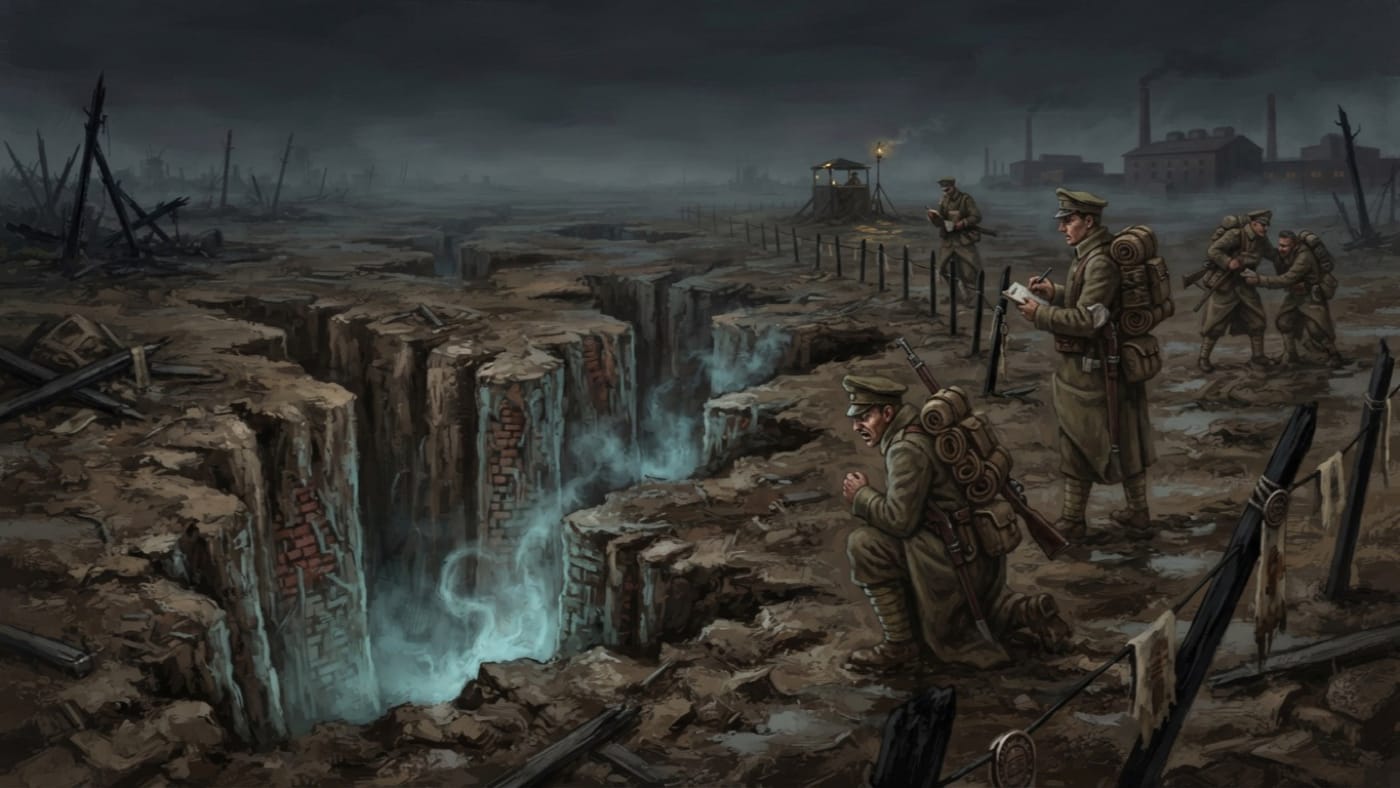
The Throats open upward. First the ground splits. Then the mouth stands vertical in the mud, much as a well stands in a courtyard, except that a well does not close. Witnesses gave sizes in the only measures a frightened soldier carries with him. Some mouths were the size of wells. Some were the size of gun-carriages. The depositions do not agree about anything between those two figures, and I will not average them to make a tidier column.
One aperture had teeth arranged like cobblestones. Three men reported it. All three lost deposition coherence before the examiners could ask them about spacing, wear or colour, which is what happens to men who have looked into a street with its mouth open. That detail belongs to that one report. It does not license an engraver to pave every Throat in the Codex.
The general Kargath lore describes the Maw-Born as demons that are mostly mouth, ranging from the size of a man to the size of a building. Some have legs, some drag themselves, and some have been rooted so long that the ground around them is eaten to bedrock. The Debrecen reports sit inside that description as a single entry sits inside a register, but they do not fill it. No one at Debrecen reported a limb, a torso, a gullet leading anywhere in particular, or any way of travelling beyond opening and closing. I have read pamphlets that supply all four. The pamphleteers were not there. Neither was I. The difference is that I have read the depositions.
The older Blightmarsh surveys speak of vast shapes moving under the surface and mouths opening in the mud to swallow whatever passes. Debrecen is the occasion on which a regiment stood on that surface with a field packet and a pencil while it happened.
#On the Streets Beneath
Debrecen was consumed on the night of the Sundering, 1 November A.S. 45. Its streets returned in A.S. 172, one hundred and twenty-seven years later, under a forward observation regiment posted for observation, boundary measurement and engineer support. No document I have seen gives the day or the month. The year will have to do. It did not have to do for the regiment.
The regiment's last complete report records sub-surface strain, vertical bubbling, faint choral return, and a smell of bread from the eastern fissures. Those four entries describe this regiment on this ground. They are not a catechism. A sergeant who recites them to recruits as a guaranteed sequence of warnings will one day bury recruits who waited for the fourth sign. Adjacent withdrawal advisories under Standing Order 119-F should have applied to that ground. The relevant material was not in the regiment's packet. The order's fourth revision, which classed smell as contact, came in A.S. 199, twenty-seven years too late to be blamed on anyone in the trench, and I will not let a later clerk's diligence be read backward into an earlier clerk's omission.
Then the mud split along a north–south line that was afterwards matched to Piac Street on the pre-Sundering civic plans. A second fissure followed the old market approach. Lanes opened after it, then courtyards and wells. The mouths came out of a street-plan. It would be difficult to file a more insulting sentence.
Earlier memorial pamphlets stated that the regiment advanced under direct Maw-Born assault.
Withdrawn. The terrain opened first, and the assault followed the opening. The pamphlets made the regiment braver and the ground more honest than either deserved.
The official account says eight hundred nominal effectives were consumed in six hours. Nominal is doing liturgical labour in that phrase. The arithmetic leaves out people the account itself knows were present, and it says nothing of the witnesses who were recovered for a few hours before they failed. No one has divided the eight hundred by the number of mouths, because no one counted the mouths. Anyone who offers me a rate of consumption per Throat will receive his figures back in the next post, unopened and lightly scorched.
The Bureau of Doctrine holds that the Marsh remembers what it eats. Whether Debrecen lies under the mud intact, in pieces, or only as a plan that the mud has memorised, the Ledger does not say. I will not say it for the Ledger. I do not know whether Kargath commanded this opening, watched it, or was told about it afterwards over dinner.
#On the Interrupted Emergence
The Litany-Engineers attached to the regiment did what the Bureau of Engineering trains its men for and then pretends they never do. They consecrated one mile of trench. When ink would not hold, they cut their hands and inscribed the psalms into the mud in their own blood. They laid fuses end to end along the line. The charge went at Vespers, and the mire collapsed inward.
The documented result is four words long: enemy emergence interrupted. None of the engineer detachment returned. I have heard chaplains praise saints for less, and I have signed the canonisation folios that made them. The engineers have a citation.
The word is interrupted. It does not mean exterminated or sealed, and it gives no proof that the Throats shrink from blood, psalm, powder, consecrated iron, fire or salt. One costly measure worked once, at one place, at the price of every man who carried it out. Any quartermaster who reads this paragraph and requisitions a cartload of salt for the Debrecen perimeter will be invoiced for the cart.
Fire rose from beneath the muck on three nights afterwards. After the fire came singing, muffled and off-tempo, through the packed mud. The survivors called it the Choir Beneath. Doctrine has offered interpretations. The Bureau once called it an acoustic after-effect. Neither office has said who is singing. I will not stand in front of the mud and guess.
#On the Exclusion
The Bureau of War holds the site as a permanent exclusion zone. According to the A.S. 201 account, the fissures fill with mud, flatten, and return after rain. A reopened fissure is a reopened fissure. It does not prove that the same mouth has returned to the same address, and anyone who claims it does should first show me the dead Throat's identity papers.
Survey teams sent close enough to check closure have reported the bread smell again, street noise, and market bells from below. One team heard a child calling prices in pre-Sundering Hungarian. Another heard a voice like a sergeant of the lost regiment. The Ledger records what the teams heard. It does not record survivors underneath, recovered souls, or Throats that have learned to imitate the dead. Imagination is not admissible as evidence.
The boundary is marked with black stakes and triple seals. Patrols are ordered to stay beyond listening distance. That distance changes, so the order is impossible to obey exactly and very easy to prosecute. Men who hear the Choir are rotated west. Men who hum with it are quarantined. Men who answer it are struck from the duty sheets.
The Ledger records no specimen, no corpse and no tooth. It holds four words from the engineers, eight hundred nominal effectives, and a street name no one has used since the Sundering.