
#On the Name
Soldiers called them Charnel Mouths, and soldiers are usually right about anything that wants to eat them. The name is a field designation. It has never been ratified, and no species roll held by the Bureau of Records carries it. What rose through the marsh fissures during the Mire Collapse of Debrecen in A.S. 172 opened upward from the mud and swallowed men. Since then it has been filed under four names. Nobody has asked which of them it answers to.
The practical rule comes before the argument over names. The thing comes up from below, after the ground has opened. A man standing over it leaves the regimental strength before the clerk has finished writing the line.
The other names are these. Drava Throats is favoured by men who regard the river as the enemy's plumbing. Street-Jaws is favoured by cartographers, who cannot forgive the things for keeping to the old roads. The provisional technical wording is Maw-Born, sub-surface variant, Category Unassigned. That phrase has been in provisional use for twenty-nine years, which the Bureau considers barely warm.
#On the Mouths
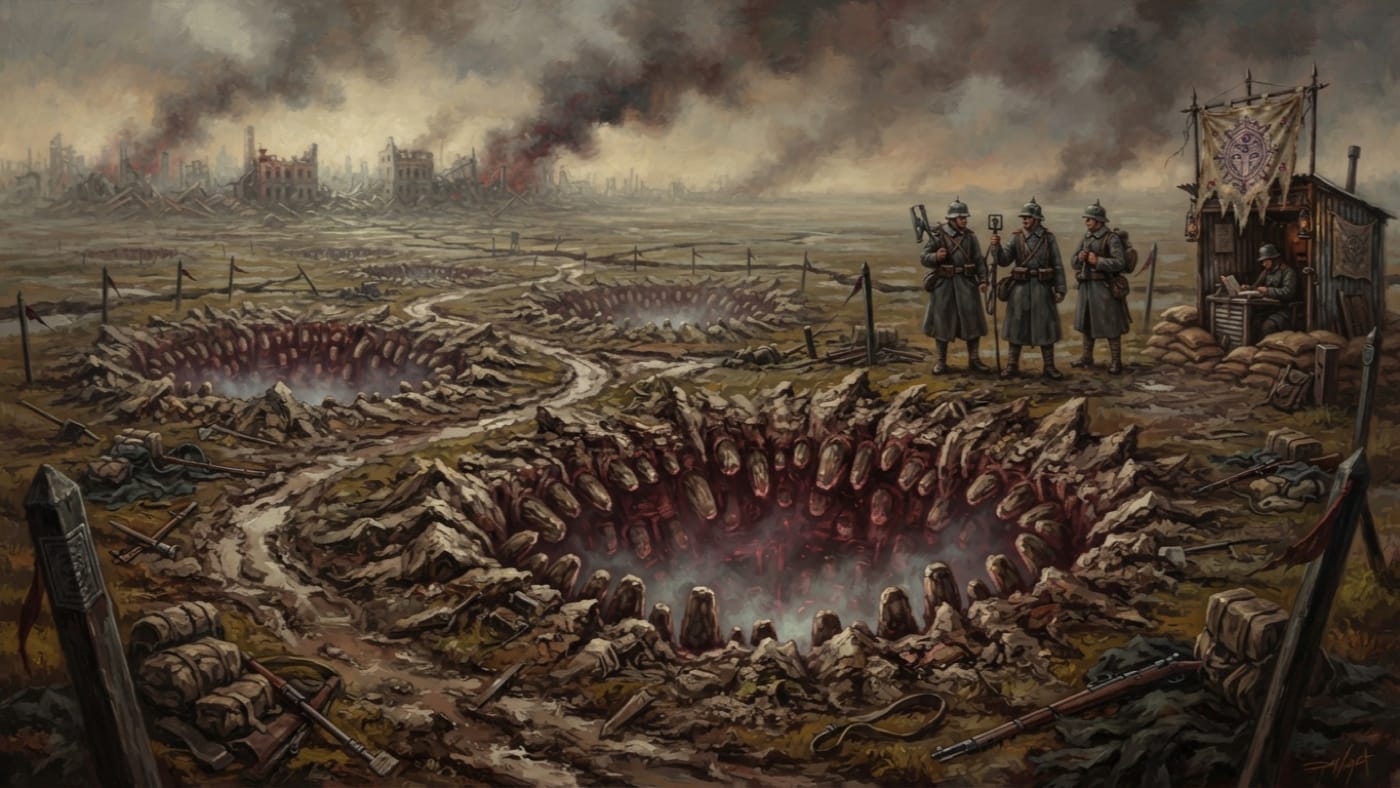
Everything known of their shape comes from depositions taken from the few men recovered alive at the perimeter. The Bureau measures their testimony in hours of coherence, not in oaths. They agreed on very little. The mouths opened vertically and gaped at the sky the way a well gapes. Some were reported to be the size of wells. Others were the size of gun-carriages. No witness described a body beneath them. No witness was in a position to look.
Three men reported one mouth whose teeth were set like cobblestones, and then their deposition coherence failed. The Bureau entered the detail as disputed testimony. I enter it here the same way. I would add that when three men fail together, it is either collusion or corroboration, and the dying make poor conspirators.
The older registers describe the general Maw-Born of Kargath's dominion as demons that are mostly mouth. They range from human-sized to building-sized and turn toward food more than they move toward it. Some have been rooted for centuries in ground eaten down to bedrock. The Bureau has provisionally accepted the comparison, and the family resemblance is plain. Resemblance is not ancestry. Every clerk in the Church resembles every other clerk, and only some of us are related to bishops.
The geography is Kargath's, and so is the appetite. The Blightmarsh is his country, and Debrecen was his first meal. The register does not show whether he was present at the opening, whether he sent the Mouths up, or whether any one of them thinks for itself. I have watched three theologians argue it to a standstill. None of them had smelled the bread.
#On the Streets Beneath
Debrecen was eaten on the night of the Sundering, 1 November A.S. 45. The city went into the Blightmarsh and out of the world, and for one hundred and twenty-seven years the mud said nothing about it.
In A.S. 172 the surface split along lines that matched the pre-Sundering civic plans. The first fissure ran north to south along the course of Piac Street. The second followed the angle of the old market approach. The lanes came next, then the courtyards, then the wells. The Mouths opened inside that pattern, like a summons served at a list of old addresses.
I am a careful man whenever care is free, so I will be careful here. The Bureau has established that the fissures follow the old streets. It has not established that an intact Debrecen lies under the Marsh with its roofs on and its bells hung. Nobody has gone down to look and come back with a report. My own entry on the collapse says the Blightmarsh remembered the city. I wrote that line, and I stand by it as an interpretation. The ground opened where streets had been, and the Mouths rose where the ground opened. What it means belongs to the Bureau of Doctrine, which will say so once it has decided what it would prefer it to mean.
#On the Debrecen Evidence
Everything the Bureau knows about the Mouths at work comes from the loss of one forward observation regiment. That regiment had not gone east to fight. Its duties were observation, boundary measurement and support for the Litany-Engineers attached to it. It was watching the ground. The ground was the enemy, and it was watching back.
The regiment's last complete report records four signs: sub-surface strain, vertical bubbling, faint choral return, and bread-smell from the eastern fissures. Field officers now recite the four like a catechism. The Bureau records them as associated with the opening. It does not hold that they precede every opening or that they always come in that order. Any catechism promising a warning was written by someone who has not been eaten.
The bread-smell should have triggered withdrawal under the advisories attached to Standing Order 119-F, which the Bureau of War had issued in A.S. 163. The advisory never reached the regiment's field packet. The fourth revision, which classifies smell as contact, came in A.S. 199. That was twenty-seven years too late for anyone under Piac Street. I have heard junior officers say the regiment broke the order. It broke nothing. In A.S. 172 the order did not yet name the thing that killed them.
Memorial pamphlets issued after the collapse stated that the regiment advanced under direct assault by Maw-Born entities.
Corrected in my entry on the collapse, and corrected again here, because the error turns up in any account that mentions teeth. Nobody saw a Mouth before the ground opened. If the regiment advanced at all, it advanced over terrain. The Mouths came afterward, from below, on their own schedule.
Eight hundred nominal effectives were consumed in six hours. That is the figure for the regiment's roll, and it counts only names on the roll. Camp followers are missing from it, and so are the penal diggers. The Bureau has never divided the loss among the Mouths, because nobody counted the Mouths. A sergeant who quotes a rate of consumption per jaw per hour is inventing arithmetic, and I have reprimanded two of them for it.
The recovered men are the only witnesses. Their survival was brief and their depositions short. As far as I know they appear in no total, which is how the Bureau honours an awkward number.
#On the Interrupted Emergence
The Litany-Engineers did what the Bureau of Engineering denies its men are for. Under collapse conditions they consecrated one mile of trench. The mud would not hold ink, so they cut their palms and wrote the psalms in blood. They laid the fuses end to end along the line. The charge went at Vespers, and the mire collapsed inward.
The official result, entered under seal, reads "enemy emergence interrupted." I have read that phrase a hundred times, and each time I admire how much it declines to claim. Interrupted. It does not say the Mouths were destroyed or the fissures closed. It does not say blood, psalm or blasting powder is a weakness that will work a second time, although I have heard that claim in three mess halls. The engineers bought an interval. None of them came back from it.
Fire burned under the muck for three nights afterward. Then came the singing, muffled and off-tempo through packed mud: the Choir Beneath. The Bureau files it as acoustic after-effect. In the confessional and outside it, I have been asked whether the Choir is the engineers, the regiment, Debrecen's own dead, or the Mouths rehearsing. The Bureau has no answer. Neither do I, and I am paid to have one.
I preached the memorial at Bastion-Constantinople. I did not see the Mouths. Unlike those who did, I am alive to write about them, and I use that advantage freely.
#On the Exclusion
The fissures do not stay shut. They fill with mud, flatten, and come back after rain. Survey teams sent close enough to confirm closure have reported bread-smell, street-noise and market bells from below. They have also reported familiar voices: a child calling prices in pre-Sundering Hungarian, and a sergeant of the lost regiment asking whether the line had advanced. The register does not say whether these are the living, the dead, or the Mouths imitating both. It also does not say whether the Mouths that come back with the fissures are the same ones that rose in A.S. 172. Nothing in the record lets me write that a demon broken at Vespers came back up with the rain, and I will not write it to round off a paragraph.
The site is a permanent exclusion zone, marked with black stakes and triple seals. Patrols keep beyond listening distance. The Bureau of War has never fixed that distance in yards, because the Marsh will not hold still for a surveyor. Men who hear the Choir are rotated west. Men who hum along with it are quarantined. Men who answer it are struck from the duty sheets.