
#On the Blank
Broken glass is a maintenance matter. A wrapped hammer meets a lower skull, the casting falls in pieces, the socket gapes, and every citizen who passes knows what he is looking at: a crime, a nuisance, a ladder in the morning. The Stack has been damaged. The lesson is interrupted and will resume once the Ladderhand has swept.
The blank is a different creature. It is a whole casting, seated in its socket and sound in the wire, lit amber by the crown lantern like its neighbours, and it carries no ink at all. The row above it reads. The row below it reads. The rib holds, the alignment toward maximum pedestrian flow is correct, and at fifteen paces the passer-by sees clear glass where a condemned name belongs. Nothing looks broken, and that is the offence.
Civic Doctrine teaches that a recorded sentence becomes a public lesson through compulsory witness. The citizen need not consent. He need only pass beneath. A smashed skull halts that witness for an hour, while a blank keeps it going and alters the text. The display goes on working, faithfully lighting an omission, and every bridgehead, ration court and school entrance becomes a congregation reading something it was never licensed to read.
The Mercy Cults understand this perfectly. Their hammers are grief. Their blanks are argument.
Keepers use the phrase more loosely. On a Pillar-Keeper route, an unsealed skull installed during audit season is also an "open mouth," and an auditor who finds one can end a career before breakfast. That is a fault of paper and wire. The protocol surveyed here answers the narrower and graver case: an uninscribed casting substituted, without office, for a Bureau-inked unit. A temporarily unsealed repair is not automatically a Mercy Cult incident, whatever the junior Purity clerk hoped when he filed it.
#On the Notice Permitted to Be Read
The document is headed OPEN MOUTH RESPONSE PROTOCOL — CLEARANCE TERTIUS. The Codex holds only the extract already reproduced in my tract on the Mercy Cults. Nothing further has been released, and I have asked. Clearance Tertius is the level at which a document may be quoted to persons entitled to be frightened by it and withheld from persons entitled to be reassured. The reader therefore receives the skeleton of the procedure with the organs removed.
OPEN MOUTH RESPONSE PROTOCOL — CLEARANCE TERTIUS Upon discovery of blank replacement unit: cordon radius █████ paces; route Keeper detained; glass fragments retained; witnesses separated by household; children under catechetical age ████████████████; responsible Stack extinguished for █████ minutes only; explanation issued as maintenance fault. Unauthorised utterance of phrase “God took the name back” triggers ████████████████.
Read the provisions in order. The trigger is exact: a blank replacement unit, meaning an installed casting, not an empty socket. A cordon follows, and its radius is withheld. The route Keeper is detained. Glass fragments are retained. This shows that the Bureau wants every shard on the scene. It does not show that the blank was smashed. A blank may be seated whole, and the fragments may come from the inked skull it displaced or from anything else the vandal dropped in the dark. Witnesses are separated by household. A clause concerns children under catechetical age, and every word after the age is black. The Stack is extinguished for a limited number of minutes. Then comes the public account, and finally a phrase spoken in the street that sets off a response the notice declines to describe.
That is the whole extract. It gives no chain of command, no timetable for the investigation, no conditions of release and no schedule of punishment. Readers who want the conditions of release may apply to Purity in person and learn them by experience.
#On the Keeper and the Household
The Route Keeper is detained first because the circuit is his. His numbered keys hang on a cord at his belt, and his log records each keyed pin and each twist of seal-wire. Nobody seats a casting in a Stack without opening a socket. Nobody opens a socket without a key, or without a counterfeit good enough to fool wire that is meant to be re-checked after every wind. That makes the Keeper the nearest custodian of the question. For the benefit of any advocate reading this, I record that detention under the notice is custody of the question and establishes no guilt.
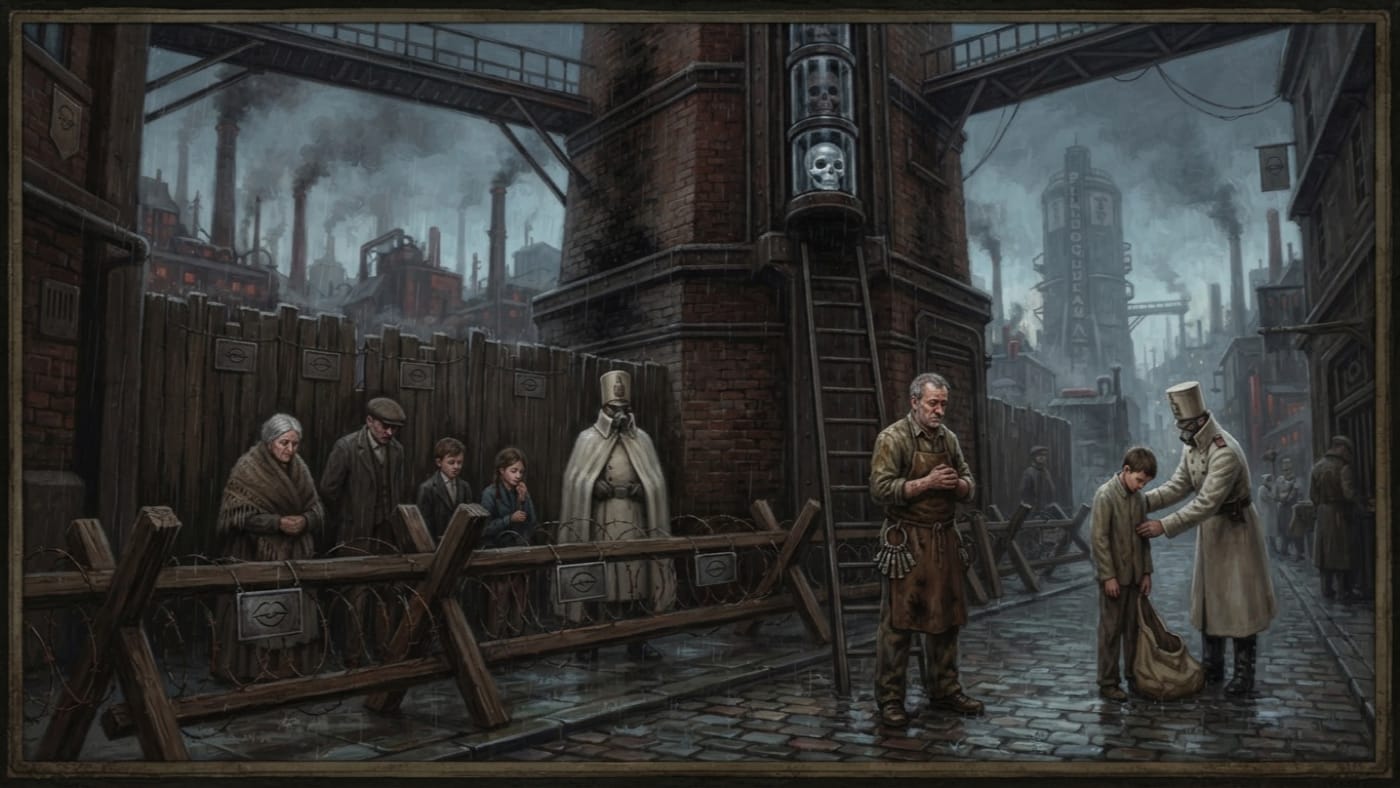
Keepers vary. Some sell delay: a late report, a repair put off until the market has had its look, a prayer-strip filed as weather damage. Others hand cultists to Purity before Matins in exchange for a fistful of oil-vouchers. Most are simply cold. So the Keeper stands at the foot of his own ladder in oil-stained gloves while a white-mantled officer counts his keys against the register, and his newest Ladderhand is searched with the thoroughness reserved for people who will be blamed regardless.
The households come next. The notice gives no reason, so I will supply the obvious one. A family that saw the blank together will agree on what it saw, and agreement is how a liturgy begins. So the mother is placed on one side of the cordon, the son on another and the lodger on a third. The grandmother who came out only for turnips stands among strangers while a clerk asks each of them, separately, what was written on a skull that had no writing on it. They wait in the wet. The notice does not say for how long.
Of the children under catechetical age I can report only what survives: the notice names them in the same breath as the separation of households, and the rest is redacted. The Catechism Schools keep their own procedures for older pupils who repeat Cult phrases at the gate. Those belong to another file and must not be used to fill in this one. The bar stays black.
#On Restoring the Name
The name belongs to the Bureau of Records. Only Records authorises the removal or correction of a displayed name, and a Stackwarden signs for the ordinary removal. The display belongs to the Bureau of Civic Doctrine, which sponsors the custodians and certifies the glass. Restoration is the Keeper's ordinary sequence carried out under unusual eyes. He inspects, logs and isolates the unit, removes it by keyed pin and cut wire, installs the inked replacement, verifies the inscription, aligns the row, relights the lantern and certifies the work. The Ladderhand climbs the cold rungs with oil and chalk. The cut wire is bagged. The blank comes out whole and goes into evidence, a piece of glass that said nothing and is now the most thoroughly interrogated object in the district.
The Synod alters its displays constantly. A mis-inked name is re-inked. Records may order a unit removed or corrected, and that removal grants no pardon and leaves the sentence untouched. The difference between a Records correction and a Cult blank lies in the signature, not the glass. Putting the name back does nothing for the condemned either. Display never established that the person had been executed, and restoration establishes nothing more. The sentence stands exactly as it stood before the vandal climbed.
The lantern goes out for the protocol's withheld number of minutes. I may say why darkness is allowed at all. The public understands a dark Stack as a fault. A lit blank is a lesson the public must not be allowed to finish reading.
#On the Maintenance Explanation
The last readable provision deserves admiration: explanation issued as maintenance fault. It is true in every detail that can be checked. A socket was opened. A unit was replaced. A lantern was put out. A Keeper was taken off his circuit. All of that is maintenance. The explanation leaves out only the theological emergency, which is the one thing that actually happened.
The Cults have their own explanation, and it is shorter. They hold that man may punish and the Synod may record, but only the Creator may keep a name forever before the eyes of the living. To them a blank is a work of mercy and the absence is a reclamation. The Bureau of Doctrine classifies this as indigenous theological error, Category: Compassion (Unsanctioned), and does not intend to let the street finish the thought. That is why the notice provides for an utterance. Glass can be carried away in a sack. A phrase repeated at a ration court travels with the queue, and by its third repetition it has become a creed. The Bureau of Purity answers the spoken phrase for the same reason it retains the glass: both are evidence that has not yet stopped moving.
Some cultists invoke Saint Velek over the blank, as Keepers invoke him over their wire. His patronage is ratified. The rest of what is said about him is hagiography and trade gossip, and Doctrine holds that a blank releases nothing and no one.
Earlier notices attributed blank-skull substitution to imported Rationalist agitation from the Netherlands.
Withdrawn. The Bureau recognises the Mercy Cults as native to Synod parishes. The blanks are installed by our own people with our own keys.
Links between the Cults and the Silent Godless remain disputed. Both movements use dead drops, countersigns and the habit of speaking sideways in queues. Similar methods do not prove a shared theology, shared leadership or any formal alliance, and the Godless can hardly defend the Creator's monopoly on judgement while denying that the Creator exists. Purity files the resemblance under contamination. Doctrine files it under unresolved.
#On Present Application
As of A.S. 201 the Mercy Cults are active and suppressed, and the protocol is attested in force in the account reproduced above. Its year of issue, its author, its signatory and any revisions are not in the Codex, and this survey supplies none of them. The A.S. 143 codification of the visibility standards dates the standards, not this notice. What the Codex can certify is the practice: cordons at bridgeheads, Keepers at the foot of their ladders, households standing apart in the wet, and a notice nailed up by morning announcing a lantern fault.
The Synod can replace glass within the hour. It has written a procedure for everything else.