
I've checked the continuity reference: the generation hold was lifted on 29 September, so the draft is below.
#On the Public Warning
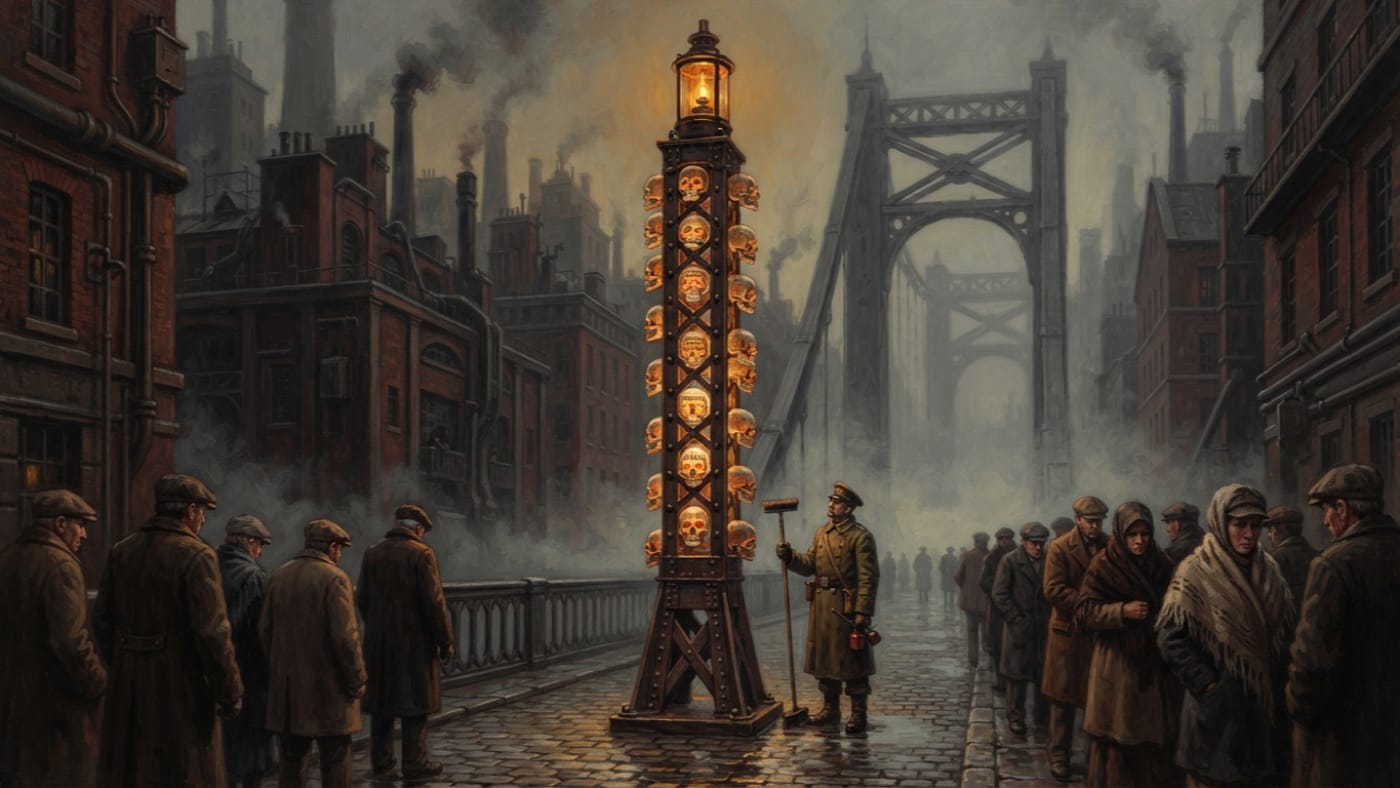
A condemnation begins on paper. It takes a clerk's hand, a seal and a shelf in the Bureau of Records, and on paper it stays where only clerks will read it. The Glass Skull Stack moves it out to the street. The name goes up on an iron pylon at a bridgehead and is lit after dark. It stands where a widow queues for bread, where a schoolboy walks to catechism and where a debtor crosses to his tribunal. Nobody has to visit it. It is already on their way.
Each Stack is one unit in a distributed installation. They are cheap and they are everywhere, which is the purpose. The Synod doesn't build a monument for these citizens. It builds a fixture, the way a city installs a drain or a milestone.
They have nothing in common with the Pillars of Glass at Zaragoza, and I insist on this every time the Stacks are mentioned. The Zaragoza columns hold bodies. The Stacks hold ink. A pilgrim travels to Zaragoza to look at the dead. A citizen walks past a Stack on his way to buy lamp oil, and he looks at it because the Bureau has made sure he can't avoid it.
#On Glass, Iron, and the Name
A Stack stands twelve to twenty feet high. Its frame is iron, ribbed and bolted, and it carries rows of hollow glass crania that climb toward a lantern housing at the top. The castings are poured at the Bureau-licensed foundries of Strasbourg and Bastion-Irongate, down in the Danube gorge. The glasswrights call the material sermon-clear. Soot doesn't stick to it, ink holds on its inner surface, and in a high wind it gives off a sound. What else goes into the melt is the foundries' business, and their ledgers have been kept from me.
The name is written on the inside. A Keeper puts a long-handled brush through the casting's opening and inks the letters onto the inner curve, so they are read through the glass, in reverse of the writing and right-way-round to the street. The condemned on display include heretics, debtors past their seventh notice, apostates, and oath-breakers whose breach was ruled civic. In certain districts there are also persons whose recorded offences were judged instructive. Display proves that a name was entered. It does not prove the person was executed. Some of the named have been burned, some are in labour gangs, and some are three streets away paying instalments. The glass doesn't distinguish between them.
At dusk the crown lantern is lit, an oil reservoir and a trimmed wick, and its light runs down through the rows until every cranium glows amber. One flame does it, refilled by a man with a can. No casting gives off any light of its own.
This is how a Stack stays permanent: every part of it can be replaced. A cracked cranium comes off its pin and a new one goes on. A Records amendment strip can strike a name, correct one or swap it for another, and the street sees nothing but the same glow. The warning lasts because its contents can be edited.
#On the Standard and the Street
The Stacks are older than their rulebook. The Bureau of Civic Doctrine's own preamble ties its municipal reforms to the aftermath of the Broth Riots of A.S. 112, and Stacks were evidently already standing to be smashed during those riots. Who raised the first one is a question the Ledger leaves unanswered. The rules for building them were codified in A.S. 143 (1853 CE). That is the year the installation got a standard, and nothing more.
Visibility Standard 7c requires every inscription to be legible at fifteen paces. The companion Standards set the height of the topmost row of crania at no less than twelve feet. They require that no citizen walk more than four hundred paces without meeting a Stack, and they make placement compulsory at every bridge, gate, ration court, school entrance and tribunal approach. Each Stack's front row must face the "axis of maximum pedestrian flow."
Read the placement clause again with a map. Bridges, gates and ration courts are where a crowd is forced into single file, and single file is where a crowd can be counted. The Stack is put at the narrow point, where a man is already waiting and already watched. Stacks also mark curfew boundaries and the edges between districts, they tell people where gathering is approved, and in bastion cities they show the evacuation routes. A citizen learns his city by its Stacks long before he can read the names in them.
The Mainz Gate route at Mainz serves as the textbook case. Its Standard was reconfirmed in A.S. 198, and its route log records every Stack lit by Vespers on a September evening of A.S. 200.
#On Custody and Failure
The Bureau of Civic Doctrine sponsors the custodians and regulates what the public can see. Records decides what the glass says. The Stackwarden authorizes removals and receives petitions. The Keeper does the climbing. The Bureau of Purity arrives once the damage has become a matter of theology. The occupational ranks, wages and working day belong to On the Pillar-Keepers, and I leave them there.
The repair sequence runs like a liturgy. Inspect, log, and isolate the crack. Draw the keyed pin, cut the seal-wire and record the cut. Seat the replacement and re-ink the name from inside. Walk fifteen paces and read it. Set the alignment, light the lantern, sign the certificate.
Every step in that sequence can fail. A clerk can copy the wrong name, and a family three doors from the guilty one learns about it from the glow. A counterfeit casting can arrive with seals no clerk remembers issuing. Keepers carry spare seal-wire of the right gauge, so intact wire proves less than an auditor would like. Then there is alignment. A Stack can be turned a few degrees away from a doorway for oil-vouchers in a poor quarter, or for seal-wire bundles where the trade is better. It still glows, but it is no longer looking at that door. The Standard insists on impartial placement, and the alignment can be bought.
#On Blanks and Mercy
The whole programme rests on one claim: the name is there, the name is certain, and the light makes sure you see it. A cracked casting is a repair job. A blank one is an argument against the Synod, and it is lit up for everyone to read.
The Mercy Cults know this. They hold that putting the condemned on public display takes over a judgment that belongs to the Creator alone. They come at night with hammers wrapped in cloth to muffle the blow. They paste prayer-strips over the names. Worst of all, they swap an inked cranium for a blank one. Keepers call that empty casting an open mouth, and an open mouth on a bridgehead says the Bureau's sentence can be taken off a street with a pane of glass. Purity's response to these blanks is fast and quiet, and it is not published.
The Mercy Cults have been attributed to imported rationalist sympathies.
The Bureau of Doctrine has revised the classification to indigenous theological error, Category: Compassion (Unsanctioned). A foreign error can be stopped at the border. A native one has to be corrected parish by parish, without end, by salaried staff.
Whether the Cults have any connection to the Silent Godless is disputed in some filings and blacked out in others. I record that the question exists and decline to answer it.
#On What the Glass Returns
In a strong wind the Stacks make a sound. The Bureau of Bells calls it architecturally incidental. The Keepers call it glass-speech: ringing ears, condemned names heard in wind and running water, ruined sleep, jaws that ache from clenching. Civic Doctrine files these complaints as occupational folklore. The Ward-Sisters of the Bureau of Mercy record them as bell-sickness variant, environmental. The two bureaus disagree about the cause and agree that nobody is discharged for it.
The Keepers fill the gap with Saint Velek the Clear-Eyed, their ratified patron, who is shown holding a glass orb and a branding iron. Hagiography credits him with listening glass, castings that catch sound and return it. The Bureau of Engineering denies that the technique exists. Neither the vita nor the denial counts as an inspection report.
Provincial pamphlets credit Saint Velek with inventing the Glass Skull Stack programme.
Corrected. Visibility Standard 7c is a Civic Doctrine instrument of A.S. 143. The saint gave the Stacks their devotion. He did not design them.
The Mainz Gate Stack will need oil again tonight. Someone has to trim the wick before Vespers and walk fifteen paces to check the names. If he can't read them, he climbs back up.