
#On the Public Name
Civic Doctrine is the Synod's teaching that a sentence, once recorded, must also be met in the street. Nobody founded it as a school, and it has no scripture of its own. It needs none. Its text is a list of names, and its pulpit is an iron pole at the corner of the ration court. The Bureau of Civic Doctrine administers it. Readers who want that office's auditors and petition windows can read its own entry. This one concerns what the citizen is made to learn.
The Synod carves up a condemned person as carefully as a butcher. The name and every amendment to it belong to Records. Interpretation belongs to the Bureau of Doctrine, my own house, and so does the ruling on which confessions instruct. Enforcement belongs to Purity. The display belongs to Civic Doctrine, which pronounces no sentence and interprets no creed. It takes a portion of ink out of a closed book and hangs it, lit, over the street.
In the book, a name is a fact. On the glass it becomes a lesson that nobody passing below can skip.
#On Compulsory Witness
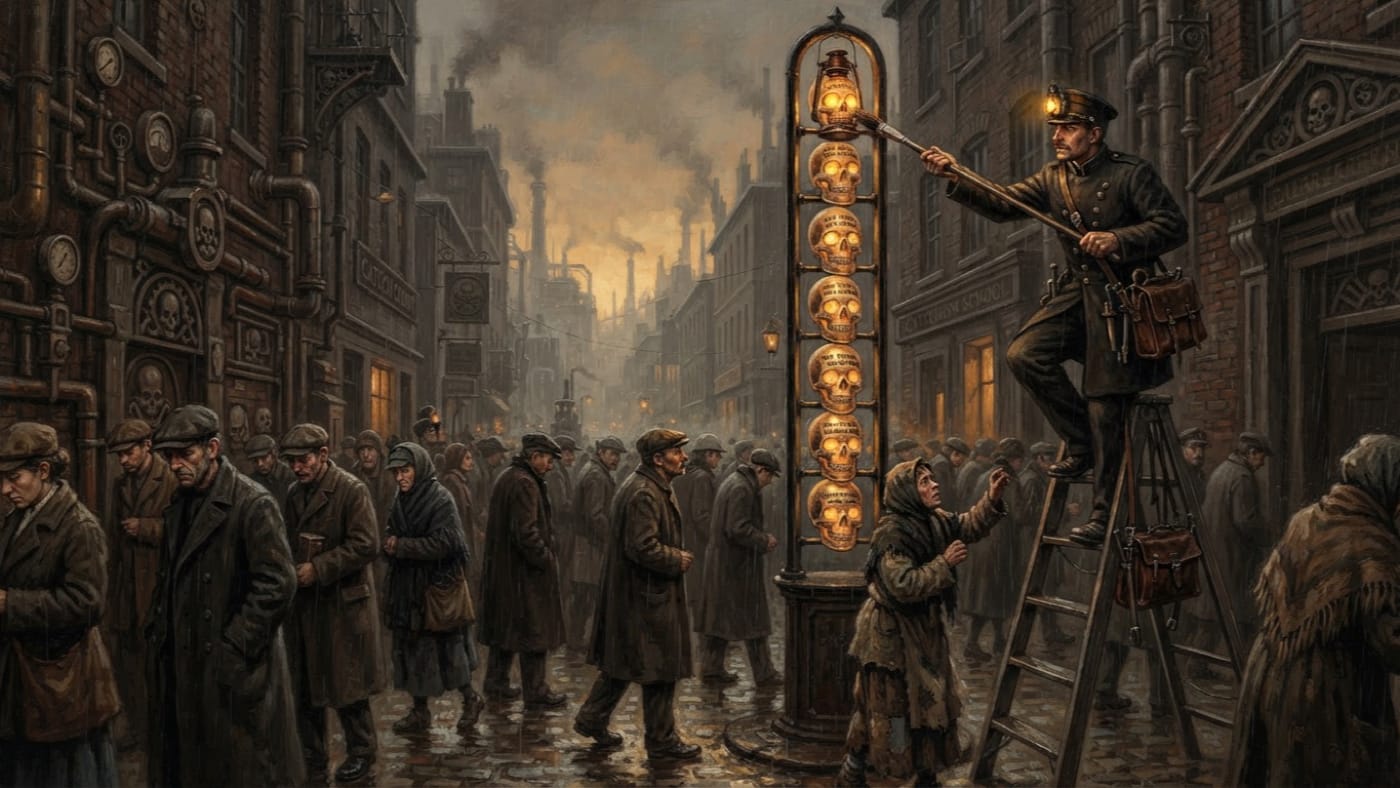
Visibility Standard 7c, codified in A.S. 143 / 1853 CE, supplies the grammar. A name inked on the inner surface of a hollow glass skull shall be legible at fifteen paces. The skull-crown shall stand at least twelve feet up. A citizen should meet a Glass Skull Stack within four hundred paces of wherever that citizen stands. Bridges, gates, ration courts, school entrances and tribunal approaches are mandatory sites. The forward row of crania faces the axis of maximum pedestrian flow, so the queue looks at the names while it waits for bread.
The year 143 dates a codification. It gives no date for the first Stack or for the Bureau's birth, and my vaults supply neither. Reformers who trace the Standard to the Broth Riots of A.S. 112 / 1822 CE are welcome to the thirty-one years in between.
The skulls hold no remains, whatever pilgrims fresh from the entombment pillars at Zaragoza may tell their cousins. A Stack is glass, ink, iron rib and an oil lantern at the crown that turns the rows amber after dusk. Its horror is clerical.
The Standard is a mandate. Compliance is an audit finding, and audits are announced in advance. Some districts meet the four hundred paces. Others meet them on paper.
The doctrine is purest at the school entrance. A child bound for the Catechism Schools passes under the names before the catechist has opened the primer. The glass gives the first lesson of the day, and it tests the child every morning after that without a word from any teacher.
#On Custody and Correction
Follow one name. Records issues it. A Stackwarden receives the order and authorizes the work. A Route Keeper carries it to the Stack and a Ladderhand carries the oil. The old skull is unpinned by key and its seal-wire cut and logged. The new casting goes onto the pin, and the name is brushed onto the inner surface with a long-handled brush. The Keeper walks off fifteen paces, reads, checks alignment, lights the crown and signs. Before the signature the Synod has a record. After it, the Synod has a witness.
Eligibility is local, and Civic Doctrine does not pretend otherwise. Heretics and apostates appear on most lists. So do debtors long past notice and oath-breakers whose breach a tribunal judged civic. Some districts add confessions that Doctrine has classified as instructive. No two district lists agree, and the debt threshold enforced in one quarter is gossip in the next.
Records may order a name amended or removed. The Keeper climbs, the skull comes down and the wire is logged. Removal is a clerical act and grants no pardon. It cannot recover what the neighbours learned while the name was lit. The fishwife who memorized it keeps it, because she was taught well. A mis-inscribed name is worse. The lesson lands on an innocent lintel and stays there while the petition runs, which takes weeks, and the lantern is lit every evening of them.
Maintenance is therefore the doctrine's theology. A dark Stack teaches nothing, and a cracked skull teaches that the lesson can be broken. Every rag, wick and coil of wire in a Keeper's kit is a small article of faith, logged in triplicate.
#On the Blank
The Mercy Cults are the doctrine's only serious critics, which says little for its critics. Here is their argument, fairly put. Human authority may punish and may record, but final judgement belongs to the Creator. A condemned name should therefore return to divine privacy. Hanging it in glass above a school gate anticipates a verdict that has not yet been given.
The Synod's answer, which I hold and Doctrine has sealed, is that the Creator permits His Church to teach by example. A name in glass passes no judgement on the soul. It shows the public a tribunal's sentence, and the tribunal sat in the public's name. Witness is a duty the faithful owe one another. Neither party can produce the Creator's signature on its reading. The Bureau has the lanterns.
Doctrine classifies the movement as indigenous theological error, Category: Compassion (Unsanctioned). The category marks the boundary. Licensed mercy passes through the Bureau of Mercy, where it is dispensed in wards, logged and audited. Mercy that climbs a Stack at night has no office, and compassion without an office acts against one by definition.
Earlier Bureau notices attributed Mercy Cult vandalism to Rationalist agitation imported from the Netherlands.
Corrected. The Bureau of Doctrine classifies the movement as native to Synod parishes. The Netherlands are acquitted of this one.
The Cults use three methods, and the less violent the method, the greater the danger.
The wrapped hammer breaks the carrier. The glass falls, the Keeper files a damage report, the foundry ships a replacement in straw, and the name is back within days. Smashing a skull only proves the Stack held something worth smashing.
The prayer-strip covers the inscription with paper and flour glue. Rain takes most of them. For an hour, the queue reads a prayer where the name should be.
The blank replacement skull leaves the apparatus whole. The iron holds, the lantern burns, and the row faces the axis of flow exactly as 7c requires. At one place on the row, the public finds clean glass where the Bureau promised a name. Keepers call this an open mouth. In trade slang the phrase also covers an unsealed installation, but in this entry it means the blank. A broken Stack shows plainly that it was attacked. A Stack with a blank in it appears to go on teaching, and it teaches that a name can be withdrawn without anyone's permission. Purity treats the open mouth as a theological offence. Its procedures for one are restricted beyond my reading.
Some accuse the Cults of dealings with the Silent Godless, and others dispute it. Nobody has proved it. One movement defends the Creator's sole right to judge, and the other denies He exists. At most they share some cellar habits. I record no alliance because nobody has shown me one.
#On the Hands That Maintain Witness
Civic Doctrine certifies visibility. The people who provide it climb in the dark for custodial wages.
Their cooperation with the Cults is individual and much disputed. One Keeper leaves a repair until the market has seen the blank. Another dims a lantern, defers a report, or files a prayer-strip as weather damage. A third takes the Cults' oil-vouchers and sells their names to Purity before Matins. The corps is a workforce, and a workforce has no single conscience for Purity to arrest.
The alignment clause sells relief in smaller portions. A merchant pays in seal-wire bundles, and the forward row turns a few degrees off his doorway. The names stay just as bright. They now fall on the widow across the lane, who paid nothing.
Then there is glass-speech. Keepers report ringing ears, condemned names heard in wind, water and ordinary talk, sleepless nights, aching jaws and teeth ground flat by morning. Civic Doctrine files it as occupational folklore. Mercy files it as a bell-sickness variant, environmental. Neither filing settles the cause, and the Keepers go on hearing it.
Their patron is Saint Velek the Clear-Eyed, ratified for Keepers and licensed glasswrights. His miracles and his invention of listening glass belong to hagiography and trade report, and I certify neither. His motto hangs in the depots and is muttered on the ladders: LOOK UP. REMEMBER DOWN. The first half is addressed to the citizen. The second describes what the Keeper's jaw does at night.
#On Present Application
This entry is a survey of current practice, dated A.S. 201 / 1911 CE. Civic Doctrine operates wherever a Stack is lit. That includes every district that passed its last audit and a good many that failed it. Names are inked, removed on Records authority and broken by hammers. Blanks appear, Purity takes them down, and the Keepers re-ink what replaces them. The Mercy Cults remain active, and so does their suppression. The Standard of A.S. 143 stands unamended, and the Bureau audits against it.
The Synod does not ask the citizen to agree with the lesson. The citizen is only required to pass beneath it, on the way to bread, to school or to trial.