
#On the Banquet
The Oaths of Regensburg is the name the chroniclers give to a banquet held in Regensburg in A.S. 29, 1739 by the common reckoning, in the last years of the Atheist Wars. The year is secure. The day and month are lost, and I will not fill them in from the calendar of my own convenience.
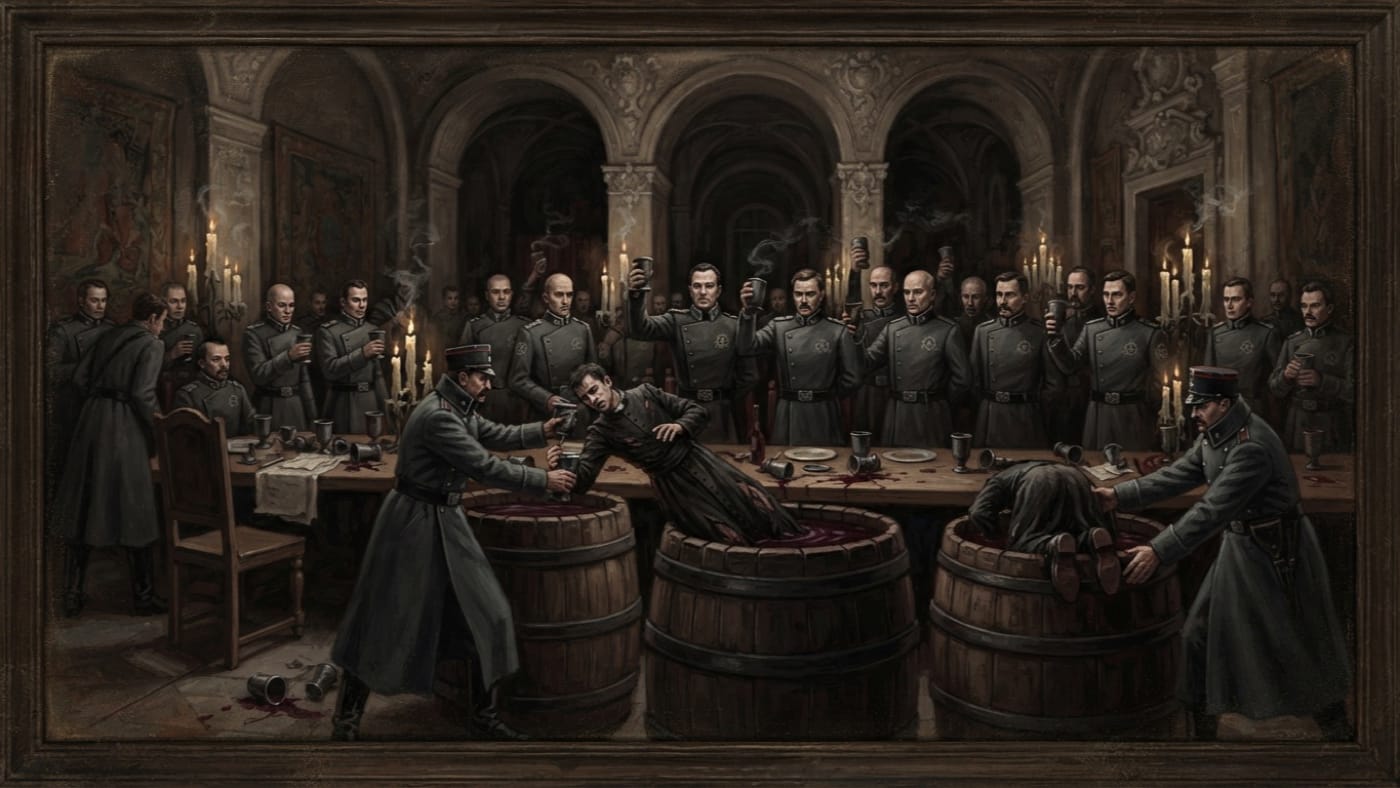
The name misleads. A clerk who hears "Oaths" goes looking for a formula, a roll of subscribers, a sealed instrument with witnesses crowded into the lower margin. No such document survives, and the oldest notice of the event mentions none. The chronicle records three things: that the Rationalist elite raised their cups to the "death of superstition"; that priests were drowned in the wine-vats from which their persecutors drank; and that the Bishop of Worms vanished, after which the Rationalists declared he had never existed. Whatever was sworn that night was sworn into cups, and cups keep no minutes.
The fuller reconstruction, which I set down in my account of the Treaty of Regensburg, places the banquet in the grand hall of the city's former episcopal palace. The Council of Nine attended with their senior officers. Candles taken from the cathedral altar lit the hall. The death of superstition was proclaimed in seventeen languages. These particulars come from that single reconstruction. The reader should not picture a choir of eyewitnesses behind them, however pleasing the detail.
The men at that table were not yet a Republic. Their prefectures, guards and prisons were already working, and working well. The formal settlement that would make them lawful masters of the continent was still a year away. They toasted an extinction they had not finished arranging. Vanity has always arrived early to its own feast.
#On the Three Priests
Between the seventh and eighth toasts, according to the reconstruction, three priests were brought into the hall.
They had been taken at Rouen during the Cauterization in A.S. 24, when the cathedral burned with a fire the later annals of the Church say walked by itself. They were held for five years in a prefectural prison. Five years is long enough for a guard to learn a prisoner's cough, and long enough for a prisoner to learn which guard enjoys his work. The account does not give their names. It does not give their ages, dioceses or orders either, or what five years had done to their bodies, and I will not forge any of it. The Church has suffered enough forgeries for one millennium.
They were offered a choice. They could recant publicly and join the celebration, taking a cup among the men who had gaoled them, or they could refuse.
Weigh the offer. The Rationalists had no need of three more corpses, since Rouen and the prisons could supply corpses by the cartload. What they wanted was three raised cups. A recantation in that hall, before the Council and between toasts to the death of superstition, was worth more to them than a province. The priests would have been the evening's exhibit: here is the old faith, washed and shaved and drinking with us. After five years, the persecution wanted to be thanked.
They refused.
The account records the refusal and nothing of its wording. No speech survives. Pamphleteers have since supplied defiant Latin, prophecies and curses hurled down the table, in assorted grammar, and the Bureau of Doctrine has had to scrape every one of these orations off devotional broadsheets like pigeon dirt off a reliquary. A refusal needs no oration. It only has to be kept to the end, and they kept it.
They were drowned in three great casks of Rhenish red. The chronicle adds the detail that has kept this event in preachers' mouths for a century and a half: the vats they died in were the vats the banquet drank from. The guests poured from the same wood. The record does not say whether they poured before the drowning or after, and I have never been able to decide which is worse.
The Bureau classifies the three as martyrs. That filing was made long after their deaths, by a Church that in A.S. 29 had no Synod to file anything. There was no Bureau then, no tribunal and no inquiry, only cellars, rumour and the occasional priest still alive enough to repeat a story. The classification came later, as all honours to the dead do. It changes nothing about the casks.
Common speech has since gathered them into the larger memory of clergy hunted through the Rationalist years, both those who prayed underground and those who died above it. I record that kinship of suffering, and I will not invent a congregation for them. They were priests of Rouen and prisoners of the prefecture, and they would not drink.
#On the Missing Bishop
The Bishop of Worms is a separate case. The Codex has to keep him separate, because the Rationalists' whole aim was to make him impossible to keep at all.
He did not die in a cask. Nothing in the record says he died anywhere. The Bishop of Worms disappeared during the banquet, between the ninth and tenth toasts according to the only surviving account, and his captors then announced that he had never existed. No body is recorded and no executioner named, and no one saw him escape. I have read the pious versions in which he walked through a wall and the impious ones in which he was in the river by midnight. Both carry the evidentiary weight of a tavern ballad.
His personal name has not come down to the Codex. That loss is the Rationalist method in small. They could not prove he was nowhere, so they decreed he had never been anywhere. In a decade when parish registers were burned by the wagonload, the decree very nearly worked.
The Bureau of Records files him under Existence: Disputed (Administratively). I have defended that classification in public and despised it in private. It is honest, in that it admits the Bureau does not know his fate, which is more than the Bureau admits about most things. In its own ink, though, it also accepts the Rationalist premise that a man's existence is something an administration can dispute.
The old chronicle calls him a martyr. That is the Church speaking about a shepherd who vanished, and as a theologian I agree with it. As Warden of the Ledger I may not record a death I cannot document. Both offices sit in the same chair and do not speak at meals.
#On the Settlement That Followed
The Oaths came before the Treaty. The Treaty was signed in A.S. 30 in the Reichssaal, the old Imperial Diet chamber, which is a different room under a different roof from the palace where the casks stood. Its articles have their own entry. Anyone who wants forty-seven articles of theft may read them there.
What the banquet supplied was instruction. The bishops and remnants who faced the Council across the Reichssaal table knew what had become of three priests who refused a cup, and of a bishop nobody could account for. No clause mentions the casks, and none needed to. A signature taken from men who have lately learned the alternative is written in another man's hand. Canon law has a term for that, and the Rationalists never bothered to learn it.
The banquet did not found the Rationalist Republic. The Treaty gave that Republic its continental form, and the Oaths set the mood for the Treaty. When the Bureau of Doctrine annulled the instrument in A.S. 92, retroactive to the moment of signing, it passed judgment on the ink. It did not bring anyone back out of the wine. The Bureau's annulments reach a long way back, but they do not reach into a cask.
The Oaths of Regensburg were "a ceremonial event staged the previous evening" before the signing of the Treaty.
Withdrawn as to the interval. The Oaths belong to A.S. 29 and the Treaty to A.S. 30, as the same entry stated. "The previous evening" cannot stand beside two different years, and the Codex holds no measurement of the days between them. The order stands: banquet first, signature after.
#On the Refectory
The wine-vats are gone. No inventory records whether they were removed, burned or sold, and I have looked, at some cost to my eyes and my temper.
The grand hall of the former episcopal palace is now the refectory of the local seminary. Students eat at long tables in the room where the Council drank. This is either a triumph of reclamation or a failure of imagination in the diocesan property office, and I am satisfied it is both. The Codex does not establish when the seminary was founded or when it took the hall.
The Gates of Regensburg carry the city's larger verdict, blessing above and curse below. The lower plaque curses those who buy peace with altar-blood, and its wording was adapted from a graffito scratched in the cellar beneath this palace. Tradition gives it to a captive priest. The Bureau cannot say which priest, or that it was a priest at all, since any prisoner of those years might have cut it. Sentiment prefers the three of Rouen, and the evidence does not support the preference. The record does not fix when the stone was set at the gate either.
On the annual feast-day the students raise a toast in water. Nobody speaks. The custom's beginning is unrecorded, and no archive I have entered holds a written rubric for it. The seminary has sensibly refused to let anyone improve it. Seventeen languages were spent on the first toast in that hall. The answer is given in none.