
#On the Burning of Rouen
"The fire walked itself." — Synodal annal, retrospective entry for A.S. 24
The year was 1734 by the reckoning then in use. It became A.S. 24 only when the constitutional settlement of A.S. 90 numbered the years backward, sixty-six years after the fact. By then the cathedral of Rouen had long been a gutted shell, and the Church had finally gained the right to date its own wounds. Fourteen years had passed since Saint-Malo opened the Atheist Wars, and six remained before the Treaty closed them. Rouen falls in the long middle, where the desecrations grew less hurried and more deliberate.
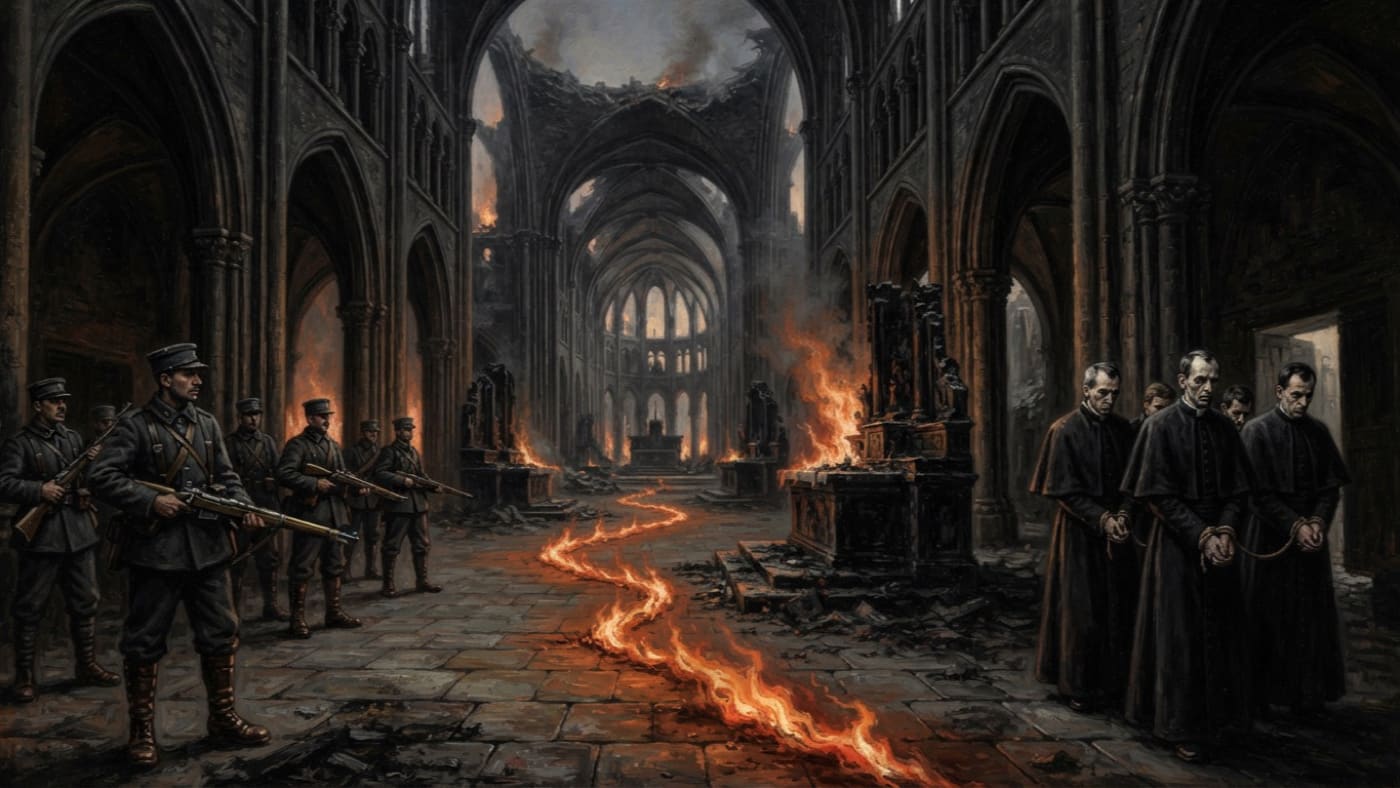
The Rationalists orchestrated the Cauterization. On that point the record speaks with one voice, and I will hear no pamphleteer who wants to make it a matter of taste. They gutted the cathedral with fire. Everything else in this file is about how the fire behaved, what was said of it afterward, and who was carried out of Rouen alive to die somewhere better lit.
This article exists because of three men. The Treaty of Regensburg records that three priests captured during the Cauterization were brought before a Rationalist banquet five years later and drowned in wine. The Treaty's file names where they came from and moves on to its forty-seven articles. The Bureau has gone back to look.
#On the Fire in the Nave
Ordinary fire is a glutton with no manners. It eats whatever is nearest, climbs whatever is driest and goes wherever the draught invites it, and it does not stop to look at anything. Any sexton who has trimmed a wick knows this. Any Rationalist who has lit a pyre knows it better.
The witnesses at Rouen described another kind of fire. They swore it crawled up the nave like a serpent and paused before each altar as though to sneer. Each altar: the witnesses were particular about the plural. A fire that had merely caught would have taken the altars in whatever order the timbers allowed. This one, by their sworn account, held to the line of the nave and stopped at every station, the way a visitation stops at every chapel in a diocese to inspect it and find it wanting.
Later retellings will tell you a serpent climbed the nave. Strike them. The witnesses said like. A simile under oath is evidence of what the witnesses saw and how they could bear to describe it. It does not license a beast, a face in the flame or a voice in the smoke, and the Bureau has burned enough forged testimony to recognise a simile that has been encouraged to grow scales.
The record says gutted. It does not give the number of the dead, the names of the lost relics, the condition of the roof or the hour the flames were set. I will not supply a casualty list to make the page heavier. A gutted cathedral is heavy enough, and the stones it left behind give testimony of their own, which I will come to.
#On the Accounts
The Rationalist explanation was that arsonists ran rampant.
Consider the source. This was an administration that recorded its own atrocities in triplicate and toasted them in seventeen languages, a movement that never let a burning go unclaimed if a claim would serve. At Rouen it discovered a sudden modesty and handed the credit to persons unnamed, uncaught and unpunished. The Bureau has read a great many Rationalist confessions. This one is written as a denial.
The Synodal annals, compiled long after the cathedral had cooled, put it in four words: the fire walked itself. That is institutional wording, written in a later century by clerks with the advantage of distance and the disadvantage of never having smelled the smoke. The Bureau of Doctrine has debated ever since what kind of walking it was, and the debate has two positions.
The first is sorcery. In this reading the fire was driven, and a driven fire implies a driver. Doctrine has not said whose hand that was, and I am not paid to guess in print.
The second is the Creator's own grim refusal to let sacred things be stolen intact. In this reading the fire was a verdict on the thieves. The altars were burned so that they could not be looted, catalogued and sold at auction alongside the relics of Amsterdam. The Bureau's filing clerks prefer this reading, for reasons that do them little credit. A cathedral lost is a defeat. A cathedral withheld is doctrine.
Neither position has prevailed, and neither touches the prior question. Whether the flame walked or was walked, the Rationalists arranged the occasion. The theologians may argue about the fire's agency for as long as their stipends last. The orchestration is not in dispute.
The Atheist Wars (101–200 A.S.)
An older chronology, still circulating under its own heading, set the Atheist Wars in the second century of the Synodal reckoning. That would have the Rationalists burning Rouen some decades after the Rationalist Republic had ceased to exist, which is ambitious even for them. The governing chronology runs the wars from Saint-Malo in A.S. 10 to the Treaty in A.S. 30. The Cauterization stands at A.S. 24, where it has always stood.
#On the Three Taken to Regensburg
Three priests were captured during the Cauterization. That is the whole of what the record says about their taking. It does not place them inside the burning nave, and it does not make them the only living souls carried out of Rouen. Their names are not preserved. I will not invent any. The Bureau has a department for that, and it is overworked.
They were held for five years in a prefectural prison. The record does not name the prison, its warders or its location, or the road by which the three men were later moved east. Five years is the whole of the account, and it is long enough. Each of those years held some number of mornings on which a man in a cell might have bought his release with a sentence. The record shows no such sentence.
In A.S. 29 the Rationalists held the Oaths of Regensburg in the grand hall of the city's former episcopal palace. It was a banquet, with toasts raised to the death of superstition. The three priests from Rouen were brought into the hall and offered public recantation. They refused. The Rationalists drowned them in vats of Rhenish wine.
One year later, in A.S. 30, the Treaty was signed in a different room, the Reichssaal. Keep the two halls apart: the parent record has blurred them before, and the Bureau will not have its martyrs moved to a more convenient chamber for the sake of a tidy narrative. The Treaty gave the Rationalist Republic its formal continental settlement. The men who made it had dined the year before on the refusal of three priests from Rouen.
The Bishop of Worms disappeared at the same Oaths. His case is separate, and nothing connects him to Rouen. He has his own file and his own unresolved existence.
#On the Stones That Remain
Rouen is a Norman city on the Seine road and sits today under ordinary Synodal custody in the western heartland. No such custody existed in A.S. 24. In that year the Church in Rouen meant a gutted cathedral and three priests in chains, and the Synod that now holds the city was sixty-six years from its constitution. The Rationalists who lit the fire held their Republic for fifteen years after the Treaty, until the Sundering broke it in A.S. 45. The stones have outlasted them by a century and a half.
When it rains in Rouen, the cathedral stones still release soot.
It has been one hundred and seventy-seven years. No scrubbing schedule, sermon or decree has been recorded that dates the end of it, because none is needed: the stones go on giving up their black in every rain, as if the fire were still in them. Each school of interpretation claims the soot. To the sorcery faction it is residue. To the faction of refusal it is a standing protest from masonry that would not hand over what it guarded. To the Rationalist account, if anyone still kept one, it would be the fault of arsonists.
Doctrine has not ruled. The stones do not wait for a ruling.