
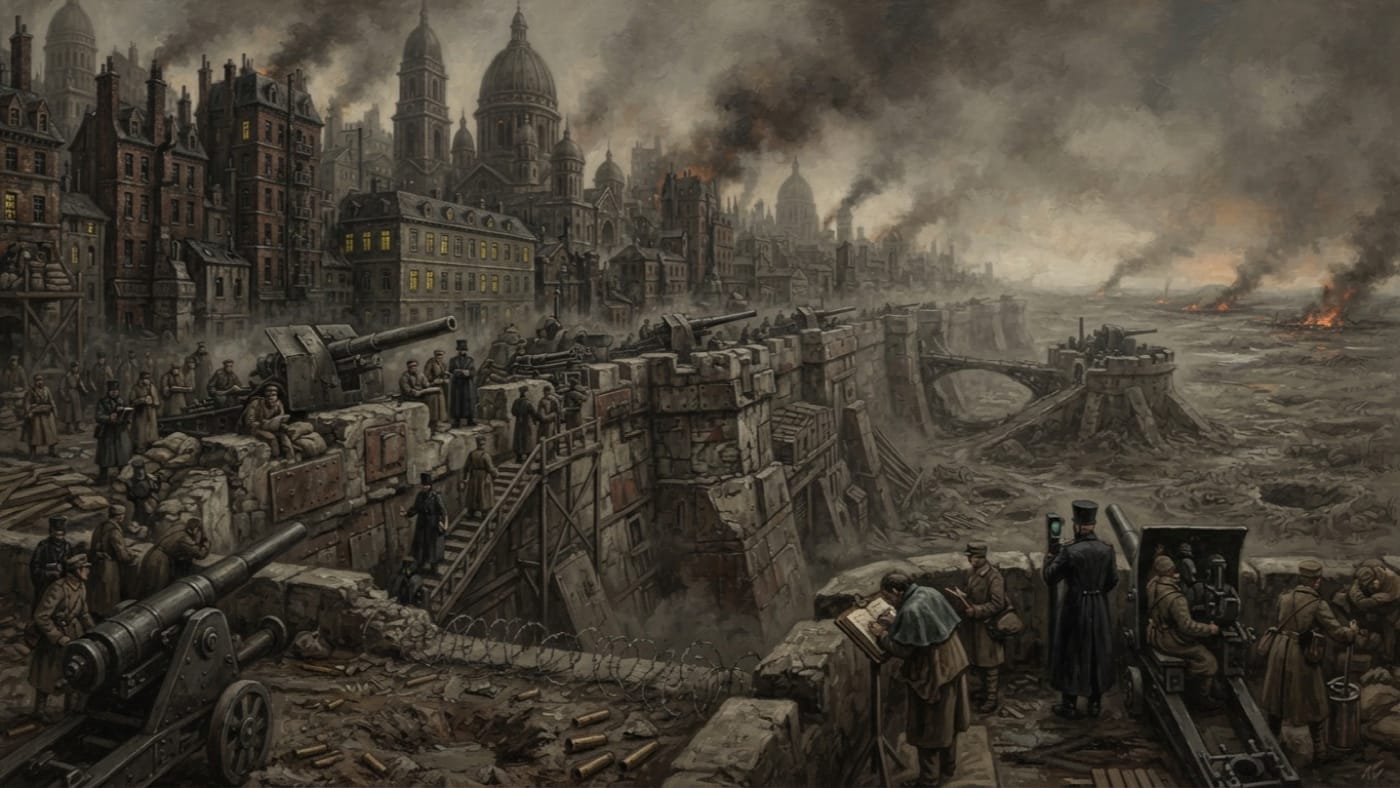
#The Northern Aspect
The northern wall of Bastion-Constantinople is a direction before it is a structure. Ask a gunner where it begins and the answer is a finger pointed at the smoke. Ask the Bureau of Records and it will produce four folios. None of them agree on a terminus. All of them agree that the frontage faces Thrace, and all of them are stamped.
That much is beyond dispute. The fortress holds the Bosphorus as the southern anchor of the Sagittal Line, and its north-facing defenses look out across the Thracian Plain. That plain is some sixty miles of contested approach, filed by the Bureau of War as Operational Zone Ferrum-North and called the Plate by the men who hold it. Behind the wall stand the cathedral domes, the ration halls, the clerks' lit windows and three hundred thousand registered souls. In front of it stands Maldrake the Wrathforged, whenever he chooses to attend.
The reader expecting a single named rampart with a founder, a foundation stone and a dedicatory sermon will be disappointed. The northern wall is the face the city turns toward its worst neighbor, and it is defended accordingly.
#On the Inherited Ground
No charter founds the northern wall. I have looked. The Ledger of Years fixes the ratification of the Bastion in A.S. 68 (1778 CE), when the southern hinge of the Line was sealed and its bell-schedule standardized. That writ covers the fortress. It does not list the courses of every curtain, and the engineers who laid them did not pause to date their mortar for my convenience.
What came before the ratification was improvisation under fire. The retreating Continental Levy reached the Bosphorus in A.S. 47 (1757 CE), two years after the Sundering, and stood there because standing was the only maneuver left in its legs. The ditches came first, and they faced north, because the furnace-legions came from the north. Earthworks hardened into revetments, and the revetments acquired guns. By about A.S. 65 a defensible Line had emerged across the continent from the Baltic to the Bosphorus. It was incomplete in places and holding in most. The long siege of the city had slackened by then into the colder siege that continues today.
Somewhere in that sequence the northern frontage became a wall. The records establish the growth of the fortress far more securely than they establish the stages of this one face. I report the difference because the Bureau pays me to know it.
An inherited compendium of the fortress, compiled under a name since retired from the Codex, gave the Bastion's rising as A.S. 331.
The Bastion was ratified in A.S. 68. The compendium's year lies well beyond the present, in a century the Ledger has not yet been permitted to administer. No construction year is recorded for the northern wall itself, and none is supplied here.
#On the Wall and Its Outer Works
The wall does not meet Thrace alone. In front of it, sunwise from the north, lie the six outer ravelins of the Bastion. The first of them is the Ravelin of Vigilance, set out against the Knife-Mile and the northern approach. Vigilance is a named work, with its own parapet and its own ordinances. Whatever the pilgrims' guides print, it is not another name for the northern wall. Think of it as an outstretched hand with the shoulder behind it. The ravelin takes the first look and the first shell, and the wall behind it mounts the guns that answer.
From the parapet the gunners look over the ravelin's crest into the Plate. On a clear dawn they see shell craters, trench lines, wire, and the dull sheen of a slag-river that has cooled across what was once a road. The Bureau of Rites certifies perhaps nine clear dawns a year. On the other dawns they see ash. The sixty miles belong to the theater as a whole. Nobody on the wall sees all of them, and the Bureau of Engineering has asked me to stop implying otherwise.
Artillery speaks along the frontage at every hour the bells permit. The great published plate of the fortress shows it at Vespers, with flashes along the northern wall, Wardens in procession on the parapet, and the cathedral spires crowding behind as if they wished to watch. The engraving flatters the masonry and the Wardens alike. It is accurate about the closeness. No hinterland separates the guns from the city, and the shell-casings cool within earshot of the choir.
I decline to give dimensions. The Bureau of Engineering holds them, and it has a habit of revising them after each campaign.
#On Duty Under the Bells
The Wardens on the northern parapet keep time by the carillon, as does everything in Constantinople that eats. The Bureau of Bells codifies each peal. The Bureau of Doctrine supplies what the peal means, the Bureau of Records writes down that it rang, and the Bureau of Tithes attaches an invoice. Watches change on the bell and gun crews stand down on the bell. The ration kitchens behind the wall lock on the bell too, whether or not the gun crew was relieved in time to reach them. The litany of the queues, sing or starve, is kept with particular rigor by men who have spent four hours watching smoke.
The gunners serve the pieces while the Wardens walk the parapet and count. Clerks come up in the afternoons with their ledgers wrapped in oilcloth against the ash. They take down what was fired, what was seen, and who did not come down.
The wall's most persistent doctrine lives in that last column. The parish clergy teach that any soldier who dies within carillon range is entered in the Book of Departures without a clerical hand. Doctrine affirms this. Records has demurred, in a note that is neither sealed nor unsealed: its ink never runs dry at Constantinople, but that is a separate matter from the ink moving on its own. The clerks on the northern parapet bring their own pens.
On the third Friday of each month, the femur attributed to Saint Iselda is carried along the parapet of the Ravelin of Vigilance, out in front of the wall, where the men on the northern guns can watch it pass. The Bureau of Relics holds that every femur is authentic once notarized. The gunners uncover their heads as it goes by, if the enemy allows.
#On Fire and Repair
Maldrake arrives in campaigns. His pyre-smiths and his Hellbow Legion cross the Plate like a survey party marking out a foundation, with measured advance, registered fire and patience. When the matter warrants it, the Flameheart Colossus comes too. In Thrace, Wrath keeps excellent field notes. The fortress's published account holds that every campaign costs Constantinople a wall, and that every wall comes back taller, because escalation is the only answer to Maldrake that Doctrine will ratify. The Ledger does not say how often that account applies to the northern frontage in particular, or by how many courses.
Two pressures stand apart in its pages.
The first is the Burning of the North Gate in A.S. 140 (1850 CE), attributed to Maldrake. In the surviving account, a cohort of Hollowed staggered into the palisade and collapsed there. When Paladins cut them apart, their chests burst open and released a sorcery-flame that ate stone like fat. The fortress commemorates the burning on the 9th of Corvus. That is the day of the observance. The records do not establish whether it was also the day of the fire, and I have stopped asking the Bureau of Rites to pretend otherwise.
The second is the Year of Ash Rain, A.S. 143 (1853 CE). Maldrake set the northern forests alight, and ash fell on the city for nine months. The crops failed and the Ninth Bell Famine followed. The northern wall faced directly into the fall for all of it. A wall, it turned out, is only as strong as the men fed to repair it. Masons work on bread, and gunners load on bread. Hauling stone up a ramp through falling ash on half-ration calls for a kind of devotion the Bureau of Doctrine likes to describe and has never performed.
That is where Kargath the Devourer enters the northern account, by the kitchen door. His dominion lies in the marshes before the Ravelin of Purity and along the Black Sea approaches, well away from the Thracian guns. He has no need of the guns. A convoy that fails, water that turns, grain that arrives as rot: each of these reaches the northern parapet as a shorter ration and a slower repair.
#Present Condition
As of A.S. 201 the northern wall is in service. That sentence is the whole of its triumph, and I will not decorate it. The guns answer the Plate on the bell, and the Wardens walk. The ash comes down in Maldrake's seasons and is swept and bagged. Under a Tithes ordinance I did not write, it is also counted. Marshal Vaubret directs the Thracian theater from his bunker beneath the Ravelin of Fortitude. The northern guns answer to the theater, and the theater answers to wire.
Kargath's convoys fail at their usual rate, and Maldrake's campaigns come when they come. The city behind the wall goes to its kitchens at noon and expects the wall to still be standing when it comes out.
It generally is.