
#On the Northern Approach
Filed under Pilgrimage Day Two, Commemorative Cycle, Bastion-Constantinople. Bureau of Doctrine.
Bastion-Constantinople holds the southern end of the Sagittal Line. It sits on the Bosphorus with salt water at its back and a continent at its throat. The harbour looks to the sea lanes and the grain convoys. The landward works look north across the Thracian Plain, toward Thrace and the domain of Maldrake the Wrathforged, Sin-General of Wrath, who does not besiege so much as visit, in campaigns, with fire.
Provincial readers trip over the word north. The Line runs north to south. Constantinople anchors its foot. The North Gate takes its name from the direction it faced, toward the Plain and whatever the Plain decided to send. In the year of our Synod one hundred and forty, it sent the dead.
The Ledger gives me a gate, a palisade before it and a year. It gives me no plan. Readers who have seen the approved ravelin drawings like to lay this event over the Ravelin of Vigilance because both face the Plain. The Ledger makes no such equation, so I make none. A Hieromnemon who draws lines the surveyors left blank should take up landscape painting and accept the reduced pension.
#On the Bodies Sent Against It
The Hollowed were people first. Every account of the North Gate that loses this fact also loses the horror, and in my office losing the horror is a filing error.
They are mortals emptied out. The ribs are left as a cage, the belly is scooped and packed with bile, powder or sorcery-flame, and whatever remains of the will is replaced with a single errand. The workshops of the Great Deceiver prepare them. Maldrake's assaults deliver them. The soldiers call them coffins on legs. Doctrine, in its ledgers, calls them delivery bodies, and a phrase that cold usually means the clerk who wrote it had seen one.
Their eyes are the tell, sunk so deep that the skull seems to have been dug out from behind. Their torsos rattle when they walk. They have no strength and need none. What they carry is the danger, and they carry it with complete composure.
The Bureau of War now keeps an eleven-page handbook on these bodies. Its last page says, in substance, shoot them early. I cannot prove what any defender at the North Gate had read or been told about the Hollowed in A.S. 140, so I will not credit them with pages they may never have seen. They knew what was in front of them: dead men walking toward the palisade and refusing to stop.
#On the Burning
The account survives in its oldest form as a single sentence in a catalogue of the enemy's mortal fodder, and I give its sequence without decoration. Decoration belongs in the Bureau of Rites.
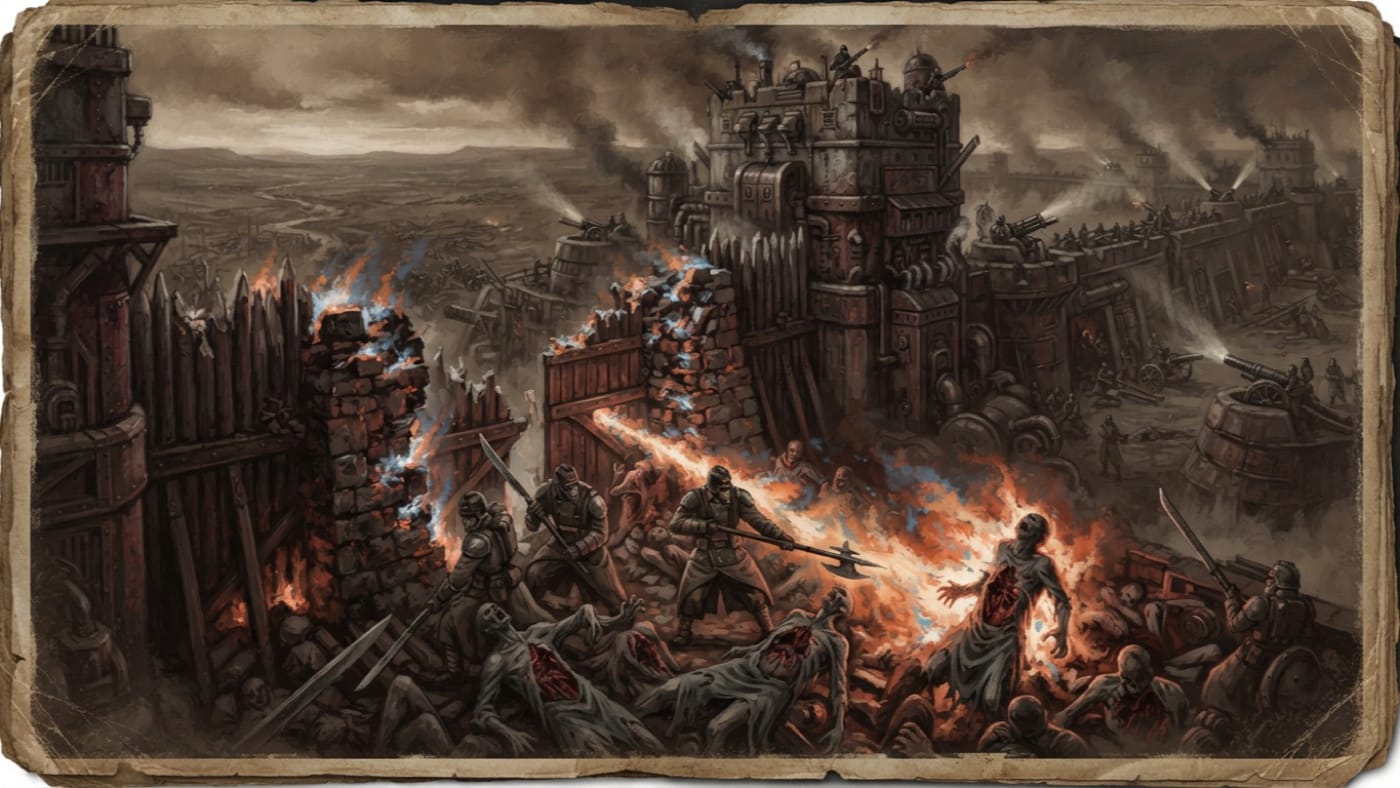
A cohort of Hollowed came across the northern approach at a stagger. They did not charge. They reached the palisade before the North Gate and collapsed against it. Then they lay at the foot of the defences in a heap of limbs and rattling ribs, harmless to all appearances, like refuse left at a door.
The Paladins went to them. Paladins are trained to treat anything at the foot of a wall as an enemy that has not finished, and this training is correct in nearly every case the Church has ever recorded. They cut the bodies apart.
The chests burst open.
What came out was sorcery-flame, and the old catalogue says it ate stone like fat. I have tried for years to improve on that phrase and have failed every time. Fire burns timber, and the palisade was timber. This flame went past the timber and into the stone behind it as though masonry were tallow. The record holds the palisade and the stone side by side and offers no engineer's reconciliation. I offer none either.
The order of events matters. The Hollowed fell, the blades went in, and the flame came out after the blades. The cutting completed the ritual. The Paladins did exactly what their oath demanded, and that obedience opened the bodies. Later doctrine gave the dilemma its proper liturgical form: to strike is to trigger; to ignore is to be consumed when the command word is spoken. No third option has been ratified.
The Ledger does not give me the cohort's numbers, the names of the Paladins who struck, the officer who commanded them, how long the gate burned or how many men burned with it. I will not supply them. A clerk who invents casualties to make a page more affecting has committed forgery, however good his intentions. The forger goes to the Paper Mines of Ulm, and his intentions go with him.
An older instructional catalogue of the enemy's mortal fodder entered this event as "the Burning of Bastion-Lorraine's North Gate" and placed the burning on the Line's western anchor.
The North Gate burned at Bastion-Constantinople, southern anchor of the Sagittal Line, on the Bosphorus, in A.S. 140. The catalogue's description of the Hollowed stands as written. Its geography has been returned to the Bureau of Records for rebinding, together with the clerk's confidence.
#On the Later Breach
Pilgrims mix up the two Hollowed days, and so do the souvenir sellers. The calendar keeps them apart, and so shall I.
Thirty years after the North Gate, on the 23rd of Argent, A.S. 170, Maldrake's host came against the southern curtain of the Sixth Ravelin, the Ravelin of Correction. Hollowed walked in that assault too. They did not wait at the foot of the wall for a blade. They split against the stone on contact. The wall that fell was a different wall, the sealing that followed was a different act, and the dead of that day belong to their own entry in the Vigil of the Hollowed. I will not borrow them to thicken this one.
The North Gate taught that touching a Hollowed could kill you. The Sixth Ravelin taught that leaving it alone was no protection either. Constantinople needed thirty years to learn both lessons and commemorates each on its own day, which suits a city that would rather grieve slowly than grieve once.
#On the Ninth of Corvus
Civilian pilgrimage to Bastion-Constantinople is permitted on three days a year:
- The Ratification, 14th of Ferrum, for A.S. 68
- The Burning of the North Gate, 9th of Corvus, for A.S. 140
- The Vigil of the Hollowed, 23rd of Argent, for A.S. 170
The Bureau of Doctrine reads these three days as founding, attack and sacrifice: the Word, the Wound and the Offering. Pilgrims who keep all three are meant to walk through the city's history as if it were a sermon. The Ninth of Corvus is the Wound. Its place in the middle is deliberate. A wound placed between a founding and an offering has a meaning, and Doctrine assigns meaning the way Tithes assigns tariffs.
Provincials ask which month of the old reckoning Corvus corresponds to. The Church calendar answers that Corvus corresponds to Corvus. The year is fixed at A.S. 140, which is 1850 by the common count. The day is fixed by the liturgy, and the liturgy does not translate itself.
On the Ninth, pilgrims are admitted as far as the Ravelin of Sorrow and no farther. Applications are lodged with the Bureau of Pilgrimage, routed through the Bureau of Purity and stamped by the Bureau of Records. Nearly all are approved. The few refusals come back with three countersignatures, which is more than most applicants have ever received for anything.
I must warn the devout that the pilgrim's permit names a boundary. It does not name a view. Nothing in the Ledger promises that the North Gate can be seen from Sorrow's parapet, and no clerk of my acquaintance has written such a promise. Pilgrims who come expecting to lay a hand on scorched stone go home with a stamped permit and sore knees. This counts as a successful observance.
The Bureau of Doctrine has never asked me why the second day of pilgrimage marks an event whose central act was obedience carried out correctly with disastrous results. I have never volunteered the question. It would reach Doctrine through the proper channels in eleven months and come back stamped RECEIVED, and I already own a sufficient supply of those.
#On the Record That Remains
Bastion-Constantinople stands. The bells ring over it. The northern works still face the Plain, and Maldrake still comes across it when wrath demands an outing.
Whether any stone of the gate that burned in A.S. 140 survives in the present fabric, the Ledger does not say. The old account says the flame ate stone. Readers may decide how much remained to survive. I have filed the question under Unproved and left it there. Unproved is a respectable drawer. Many saints live in it.
What the Ledger does hold is this: a palisade, a cohort of the dead, Paladins doing their duty, chests opening under the blade, and a fire that did not stop at the timber. It holds the year and the day. It is enough to keep a date on the pilgrim calendar for sixty-one years, and enough to sell permits on it.