
#On the Night, and the Character of the Witness
"They did not fall; they simply sat." — Shipka tradition of the Sleeping Crown
A kingdom ended at its own table during the Sundering of A.S. 45 / 1755 CE, and nobody drew a sword. The Church calls the occasion the Night of a Thousand Lamps. The kingdom was Phocis, a valley realm east of the Balkan passes. The Church's histories reckon its fall as the first touch of Syrion, the Languid Dreamer, upon the waking world.
I was not present. Nobody now living was. What follows is received history: the tradition kept along the marsh corridor at Bastion-Shipka, the master account held by Doctrine, and the published survey of the Vales of Stagnance. They agree on the shape of the thing and quarrel over its particulars. Where they quarrel, I report the quarrel. A Hieromnemon who smooths a disputed account into a pleasing one has committed forgery with better penmanship.
No source gives the day, the king's name, the palace's name or a count of the guests. The title promises a thousand lamps. No clerk counted them.
#On Phocis Before the Silence
Phocis was competent. Say that first, because its competence is the indictment.
Its vineyards climbed ordered slopes. Its river garrisons kept their stations. Mills turned, orchard terraces were pruned on schedule, and tax-collectors travelled the white court roads and arrived when expected, which in the eighteenth century was a species of miracle in itself. Phocian scribes boasted they could foretell a harvest to the bushel. The court prided itself on punctual feasts, and its tax-rolls were kept with a care that later Records clerks have studied with something close to envy.
A kingdom so ordered believes that order is a possession. It is a practice, and practices end when the hands performing them stop.
The toast at the centre of the tradition was raised to the "Dawn of Reasoned Peace." The account gives the words and nothing more. No surviving source ties them to a treaty, an anniversary, a minister or an embassy, and I decline to supply one. The phrase belongs to the age that produced it: the Rationalist decades, when educated courts assured one another that calculation had retired the need for vigilance. Phocis raised its cup to that confidence. The Vales account adds, sourly, that the peace being toasted had already begun to rot in Europe's mouth. In the year of the Sundering, every peace had.
#On the Banquet
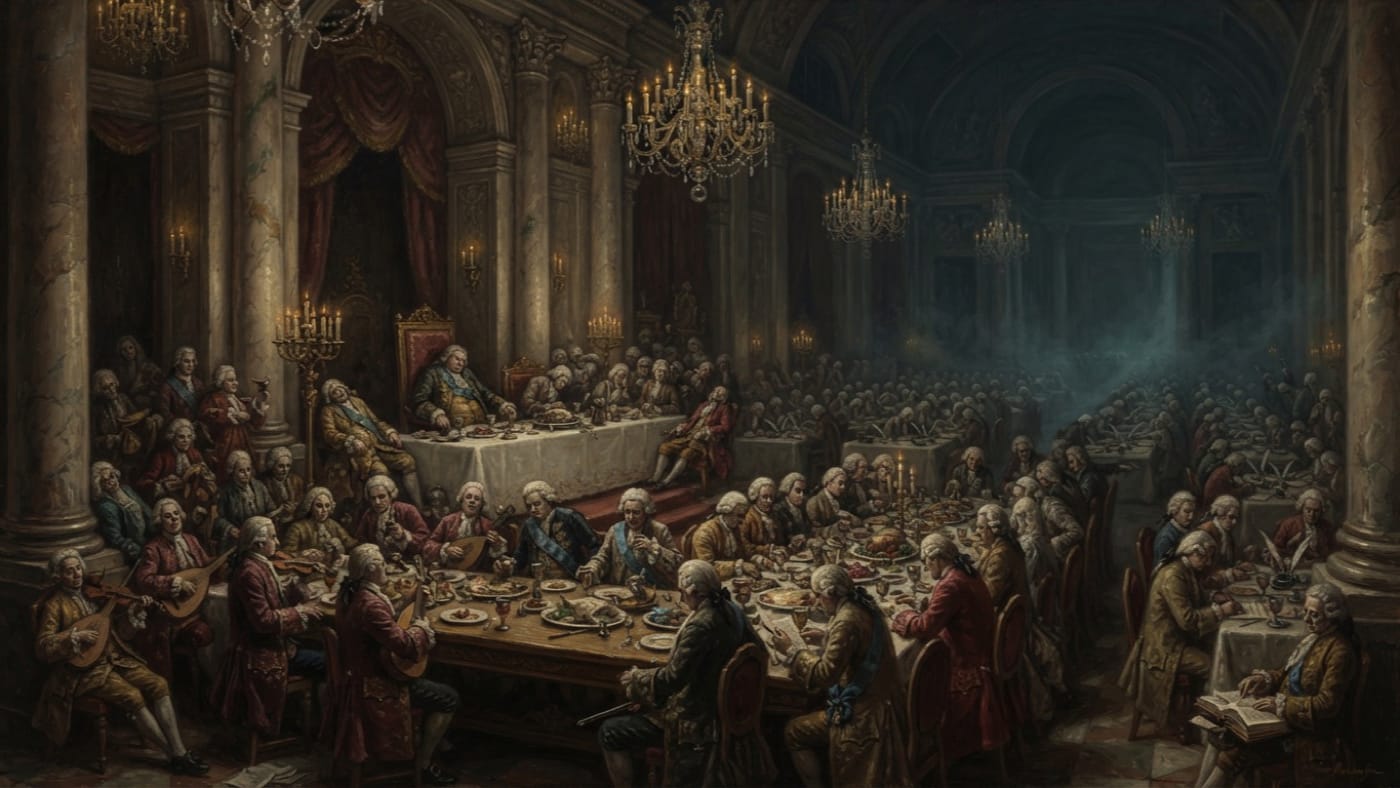
Glass chandeliers lit the hall, along with the smaller lamps of service. Wine had been poured. The court was seated.
The king rose, or half-rose, and lifted his cup. The courtiers laughed, as courtiers do when a king speaks of dawn. Music followed, or was about to. The Shipka tradition says the musicians struck their first chord; the Vales account says they were still preparing it. I leave the beat uncertified. The interval that matters lies somewhere between the first sip and the second.
In that interval the court settled.
Every version insists on that word or a cousin of it. Nobody is said to have fallen, clutched a throat or overturned a bench. The bodies lowered themselves into their chairs as men do at the end of a long day's audit, and stayed there. Hands came to rest beside cups. Heads inclined. Eyes stayed open and saw nothing anyone could afterwards demonstrate. Breathing continued, so shallow that the tradition claims the candle-flames scarcely moved before the sleepers' mouths.
The Vales tableau extends the settling beyond the high table, with servants leaning against pillars and guards lowering their halberds as if a superior officer had granted permission. The Shipka account confines the first sleep to the court and leaves servants on their feet to attempt what came next. I will not certify that every steward in the palace slept with his master, or that every steward was spared. Both accounts need somebody awake afterwards to remember.
Dishes stood half-carried. Instruments lay in laps. The lamps burned on, unattended, until their oil was spent. That is the only clock the hall left us, and it is an honest one.
No demon is recorded at that table, and no guest unmasked himself. The Dreamer rarely troubles to appear when a chair will do his work.
Royalist fragments inherited into earlier compilations record that the Phocian court was massacred by invisible blades during the first eastern collapses.
Rejected. The fragments are unattributed, and the explanation contradicts every account of the bodies, which describe no wound and no bleeding sleeper. The blade was a courtier's invention, preferable to admitting that a crown can be lost sitting down.
#On the Attempts to Wake a Government
The received account divides the aftermath into three durations. I give them as the tradition gives them. They are remembered intervals, not timed observations, and they do not mark three separate events.
Three days. For three days, the account says, servants whispered to the sleepers and shook them. The escalation can be imagined without inventing it: a name spoken, then repeated, then shouted; a hand on a shoulder, then both hands; water, perhaps, or smelling-salts, or the brutal intimacy of slapping a prince. Nothing answered. The sleepers breathed and did not rise.
Three weeks. For three weeks the valley bells rang. These were parish and civic bells, the ordinary bronze of a valley kingdom, rung decades before any Bureau of Bells existed to claim them. They rang, the tradition says, until they were hoarse. Nobody recorded whether they rang to summon help, to wake the court, or simply because ringing was what the ringers knew how to do. Then they stopped.
One year. For a year the scribes went on filing.
A government is a machine for turning a ruler's will into other men's labour. In Phocis the will had stopped and the machine had not. Petitions came in for decrees that would never be sealed. Magistrates wrote for instructions, received silence, and wrote again. The scribes, ever industrious, noted the absence of royal decrees with exemplary precision, entered it, dated it and filed the empty ledgers in their proper presses. For a year the kingdom's clerks recorded, punctually and in a fair hand, that nothing was being commanded.
Then the scribes, too, forgot to ring for dawn, and the account goes quiet.
Distinguish the deaths. The kingdom died: its decrees, its courts, its tax-roads and its harvests failed within a generation. The sleepers are another matter. No record I have handled describes their burial, their waking or their present condition. I do not know whether that court still sits at its table, and I will not write as though I do. The Church inherited a dead state and a sealed room, and only the first can be certified.
#From Royal Heartland to Syrionic Territory
The banquet is remembered as a single night. The country that followed it took decades.
From the vineyards of Phocis the haze moved downriver and over the ridges, one valley at a time. It travelled by water first, along mill-races and drainage canals, then under chapel doors and into the ledgers of men still writing up last season's accounts. Villages stopped ringing their bells. Mills turned once a month, then not at all. Crops stood in the fields unharvested, which is a different thing from a failed harvest and a worse one. The Lore Book puts it plainly: decades passed uncounted while the mists thickened and whole generations sank into stillness.
The royal heartland now lies within the Vales. The lower basin of the old kingdom became the drowned flats of the Phocis Marsh Corridor, the reed country between the fog and the western passes. Later its rivers forgot their beds and its clocks their duty, and survey parties learned to come home with fewer years than they had taken in. Those disorders belong to the regional record and to the slow growth of Syrion's domain. They did not arrive at the feast.
#On the Later Use of the Night, and Shipka's Answer
Catechists use the Night as a warning against complacency. They are right to, though they often blame the wrong people. Syrion does not recruit the idle. He recruits the tired, and a court that has toasted its own reason for a generation is tired in the particular way of men who have stopped checking. That is Doctrine's judgment of an institution. It passes no sentence on the cupbearer, the fiddler, or the scribe who kept filing because nobody told him to stop. Those people were left without orders, and from inside an office the absence of orders is what Sloth looks like.
When the Church drove the Sagittal Line south through the Balkan passes, it set a bastion on the western approaches to that drowned country and, by long tradition, charged it with the old kingdom's memory. The charter styles it PHOCIS-MARSH NODE. Its siting-ledger reads: That which once slept shall guard against sleep. The royal seat lay deeper east, and Shipka was built on mud the king never saw. Its business is clocks. Its pumps are tested on the bell, its relays are checked against the Hourglass standard, and its garrison rotates out before the men forget how to count days. Each of those routines is a ledger that has to be filled with something done.