
#On the Canal Mouth
"Registered name. Destination. Weight of ink." — Toll Warden Goss, A.S. 197; repeated without amendment, A.S. 201
The Archivolt Causeyworks keeps three throats. The Triple Lock lifts barges between pools. The Stitchbridge carries the junction overhead. The Mouth-Sluice lets in the water and whatever floats on it. The city's surveyors list the Mouth-Sluice as a canal exit. I have twice entered the city through it by barge, in A.S. 197 and A.S. 201. A threshold can be used in whichever direction one's papers permit, so the surveyors and I are both correct. In the Causeyworks that is rarer than a dry sock.
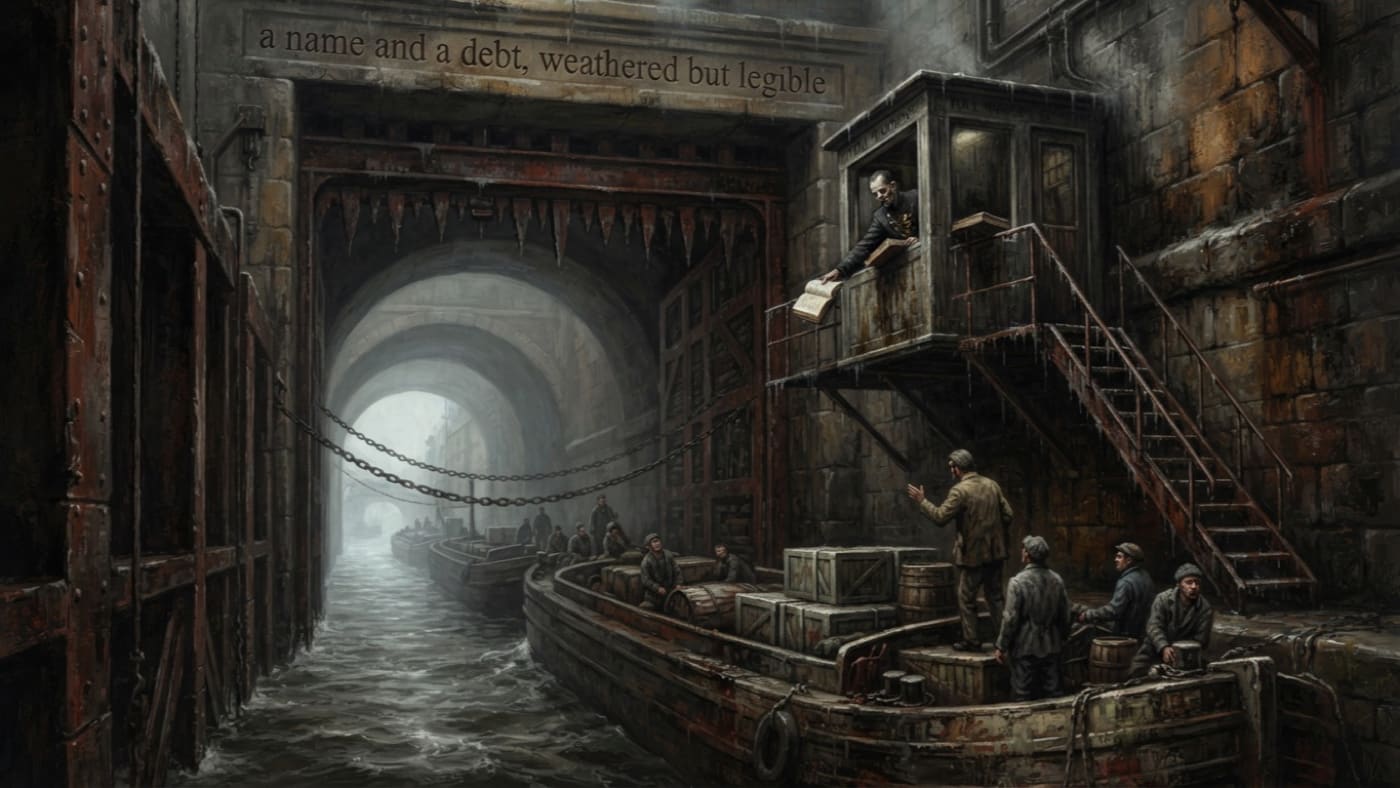
Here the canal narrows between the sluice teeth and runs faster than any passenger would choose. Wet masonry rises on either side, and fog keeps to the undersides of the arches beyond. Above the narrows sits the toll warden's station, and above the station sits its lintel. I shall come to the lintel, because everyone does. The air smells of brine and tar. I record both smells without explaining either. No survey has explained them to me, and the Bureau does not take dictation from its nose.
The city lies in the River-belt, where three canal spines meet, two to four days inland from Saffron Bastion. That reckoning covers the whole road. No record says how long the last stretch through the sluice will take. It depends on what is moored ahead of you and on the state of its papers.
The Causeyworks was chartered in A.S. 82. Its first stone bridge followed in A.S. 84 and its Bridge-Scribe Collegium in A.S. 92. None of these dates is the date of the Mouth-Sluice. I have found no builder, no year of cutting and no dedicatory stone, and I decline to carve one in prose.
The Archivolt Causeyworks was chartered in A.S. 82, following the Synod's determination that the River-belt's toll revenues were being lost to "informal waterway administrations."
Correction: the charter of A.S. 82 stands. The Synod does not stand in A.S. 82, because it was constituted at Strasbourg in A.S. 90. The action of A.S. 82 belongs to the emerging Church administration and the toll authorities of that period. The Synod later inherited their work and, in the customary manner, signed it.
#On Examination
At my first crossing, a warden wearing the chain badge of his office asked me three things: my registered name, my destination and the weight of my ink. At my second crossing, four years later, the same warden asked me the same three things in the same order. His name is Goss. I can certify what he asked me. I did not observe whether he puts the same catechism to a fishwife, a grain factor or a provost, and the Ledger records what it observes.
The questions are brief, but a good deal of machinery stands behind them. A toll warden inspects what is handed up to him: crossing passes, toll chits, cargo declarations and crossing receipts. He writes down the name a traveller offers. He does not rule on it. That task belongs to the bridge-scribes of Archivolt Row, who test the name against the registry under Chief Scribe Mael Arct, the man who decides which names the city recognizes. Permission to cross rests with Canon-Toller Edris Vane. Whatever is to be made permanent goes to the chisels of Master Mason Lysa Korr. The warden at the Mouth-Sluice comes first in that sequence and ranks lowest in it. Everything else the city does to a traveller begins with what he writes down.
Destination matters because it decides which locks a barge will need and which bells it must wait for. Ink matters because unsealed ink is forbidden cargo in a city that writes its law on bridges, and a man who arrives able to write has arrived able to amend. I declared mine: consecrated, sealed and accounted for to the dram. Goss wrote the figure down without lifting his eyes from the page.
#On the Lintel
An approaching barge reads the warden before the warden reads the barge. Above his station the city has carved his name, Goss, and beside it a debt incurred in A.S. 189 for an overweight shipment of devotional candles. The sum is in the stone. I will not copy it out. The granite has published it once and does not need a second edition from me.
Nothing is carved beside the debt. In the Causeyworks a settled stone entry is never erased, because the Bureau of Doctrine has decreed the erasure of stone a theological impossibility. A settlement is cut beside the original, and the two remain together forever, the debt and its discharge contradicting each other for the instruction of passing bargemen. At Goss's station the debt stands alone.
I cannot say what binds this debt to this post. The file gives no contract, no sentence of service and no term. I note the absence and leave it empty. A clerk who fills absences with likely matter is a forger with a pension.
The warden who examines the city's travellers is himself an entry in the city's ledger, and he does his examining directly beneath that entry. Ledger-drizzle crusts his inscription as it crusts every other. That much equality, at least, the city grants him.
#On the Teeth and the Water
Smugglers hide beneath the sluice teeth. The city's own surveys say so, and in the same line they name the danger peculiar to this place: the drown-sweep. The surveys offer no commentary beyond putting the two side by side, and I add little.
I have no document on what drives a drown-sweep, who orders one, how often one comes, or whether it comes by design or by weather. I record two adjacent facts. Among its defences, the Causeyworks counts sluice floods used to deny travel through the under-vaults. And a man who lies beneath the teeth of the Mouth-Sluice has chosen the one hiding place in the city that the water itself can search.
At night, curfew chains are dropped across the canal mouths to seal the waterways against unlicensed passage. Traffic that refuses to stop goes below, into the Undervaults, where the runners called Mudkeys deal in hidden routes, divers, bribes and silence. The Mudkeys work the city's underside. I have no evidence that they hold the hollow beneath this particular sluice. In a city of eight districts and a great many desperate people, a hiding place needs no owner to be full.
#On Waiting
A flagged name does not travel. When the warden's record raises a question, someone from the barge goes up to the Row to have the identity verified, and the crew waits at the Mouth-Sluice. Mooring is charged by the hour. I could not obtain the rate. I obtained instead the faces of the men paying it, and they told me enough.
Waiting is a hazard to paper. The damp gets into everything, and a curled or bled permit is refused on sight. The city has a word, dry-safe, for papers that are still legible, and it treats such papers as a kind of wealth. A merchant at the sluice keeps his documents the way a priest keeps the sacrament: against his body, out of the weather, and checked with frequent anxiety. A flat, dry pass announces that its bearer is solvent. A damp one announces that he has been waiting.
Every hour at the sluice is charged against the cargo, and the city takes its tolls in coin, in a share of the cargo and in labour. A grain barge held at the Mouth-Sluice for want of a stamped paper is a granary under arrest.
Past the sluice, the next appointment is the Triple Lock, which belongs to the Lock Authority and runs to its own bell schedule. Lock-priority slips buy a place in that schedule. They buy nothing at the Mouth-Sluice, where the warden has his three questions and no bells to keep. A barge can clear one throat promptly and choke in the next.
#On the Present Condition
The Mortar Saints carve back into public stone names that the Index Damnatus has struck out. In A.S. 199 a banned name was found inside a keystone of the Stitchbridge, and the city has been tightening its grip ever since. Crossing inspections grew longer. Tolls rose. Safety closures multiplied. At the Mouth-Sluice the result is the plainest one: longer queues, damper papers, and more hours of mooring paid by people who have never held a chisel.
In A.S. 201 I found the queue longer and the questions unchanged: three questions, in the same order, from the same warden, beneath the same unanswered debt.
Canon-Inquisitor Silex Marrow holds a Bureau of Purity warrant to unseal keystones in the Saintspan Quarter. The Toll Chapter petitioned against it, and the Bureau of Records objected on grounds of jurisdiction. Purity overrode both. The audit has produced no outcome I can file. Whatever it finds will be argued over at the Saintspan, far from Goss's station. Its delays will reach the Mouth-Sluice all the same, in the usual form, charged by the hour.