
#On the Canal Edge
"A clean name is a paid name." — Causeyworks proverb, repeated on the platforms with a straight face.
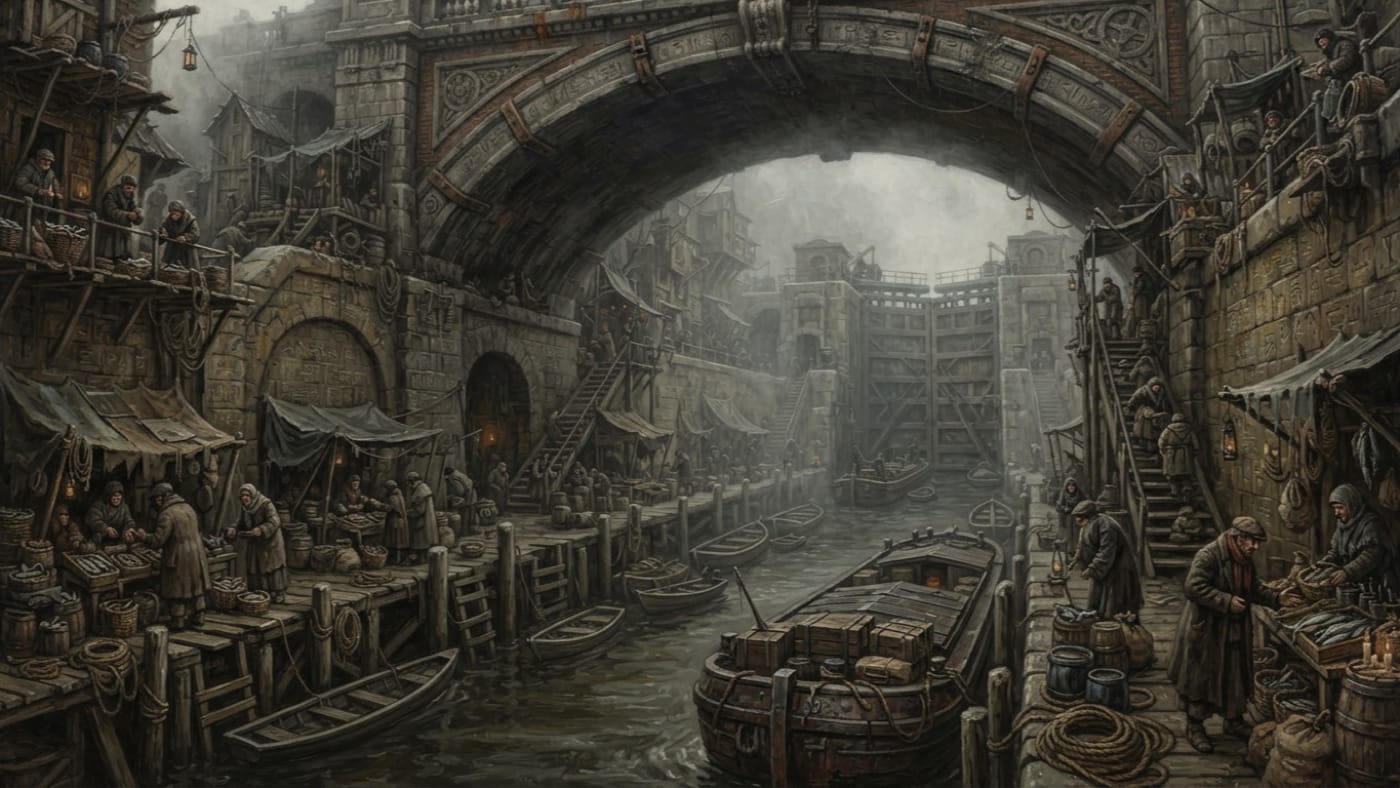
Barge-Lip Market is the district of the Archivolt Causeyworks that hangs off the canal edges on wooden platforms. The platforms sway with the current, the traders sway with the platforms, and after an hour among them a visiting officer of the Bureau of Doctrine begins to sway as well. That is undignified, and I record it only because the Bureau requires completeness.
The smell reaches you first: fish, then tar, then cheap spice, in descending order of volume. Below the planks the canal slaps at the pilings. Above them the stone city keeps its accounts, with inscribed spans, rust-iron clamps and bone-lime mortar crusted white by ledger-drizzle, and fog lodged under the arches as though waiting to be called. The lock bells carry across the water on a schedule that the Lock Authority publishes and the market knows by heart.
The rest of the Causeyworks writes itself in granite. Barge-Lip is made of timber, rope and pitch, and it keeps its accounts in the older and cheaper medium of who owes whom. A stall here is worth exactly as much as the lock window of the barge tied beneath it. When the Triple Lock keeps to its bells, the platforms feed the city. When it closes, they feed on each other.
#On Goods and Passage
The ordinary trade is food and repair. Fish goes into the stew, onions into the mash, and the canal bread goes stale before it is sold, so the question never comes up. Tar for hulls is ladled from blackened pots. Candle stubs, lengths of rope and iron hardware change hands at the rail. Cheap spice travels in twists of paper small enough to hide in a palm, and so do other things. Citrus peel is a luxury. Real coffee is spoken of the way country priests speak of relics they have never seen.
The platforms get their stock from the river traffic. Candlewick wax comes upriver through the city, and Wexel's grain comes down. The coastal road to Saffron Bastion adds a second set of permits, which disagree with the Causeyworks' permits on nearly every point of form. Most of this cargo passes the Barge-Lip without stopping. The market lives on what falls off it, gets traded off it, or is sold before a toll warden can weigh it.
Payment takes every form the River-belt has devised. The Crown of Grace, the Synod's stamped iron, sits beside toll chits, stamped paper, stone tokens and the oath-notes of the dock unions. A man with none of these pays in labour hours, and the Lock Authority is glad to collect them.
The goods that sell best cannot be put on a scale. Lock priority is one. A barge that clears the Triple Lock at dawn sells its fish fresh. A barge that clears it at dusk sells its fish to the poor. The difference is bought on these platforms, in wax, in tokens, or in the arrangement the dedicated city surveys politely call "no-questions cargo."
The market holds no charter of its own. It trades under the city's.
The Causeyworks was chartered in A.S. 82 by determination of the Synod.
The Synod as a formal body dates from the Concordat of Strasbourg, A.S. 90. The A.S. 82 charter was issued by the Church's emerging administration and the toll authorities that preceded the Synod. Calling it Synodal is a later filing convention and describes the archive, not the event. The Bureau regrets that the archive was more confident than the calendar.
#On the Cost of a Name
In the Causeyworks, respectability is measured in dryness. Papers that come out of a coat flat and legible mark a person who can afford oilcloth, a dry bed and a scribe who knows him on sight. The platforms call such papers dry-safe. Damp papers mark a person who will be asked more questions.
No stallholder asks your registered name before selling you a herring. The bridge on your way home will ask. At the crossings the wardens want the registered name spoken aloud, and a man who would rather not speak it can answer with his registry number. That privilege costs money, like every other privilege in this city. The market sets its prices knowing the customer still has to walk home over stone.
Three officers stand between a trader and his route. Canon-Toller Edris Vane holds crossing access, and a toll denial from his Chapterhouse can starve a stall in a week. Chief Scribe Mael Arct holds recognition: whether a name is known, whether it is flagged, and whether it may be "corrected" on paper. Master Mason Lysa Korr holds the chisel. Under Doctrine, lawful reconciliation of a stone entry leaves the original carving in place and cuts the correction beside it. Nothing in the stone is removed. The citizen simply acquires a second inscription.
None of the three owns the Barge-Lip, and none sits on its planks. They don't have to.
Debt in this city takes a physical form. Toll arrears become a name flag, and a name flag becomes a stone entry, carved as DEBT MARKED on a parapet along the debtor's own route. A merchant can buy a better paper self from the scribes' windows. The carving stays where it is, on the bridge he crosses to reach the platforms.
#On the People Who Trade
Merchants and dispatchers rank third among the city's classes. Only the Toll Crown's officers and the licensed scribes and masons rank above them, and they know it. Beneath them work the barge crews, the candle sellers, the lock labourers drafted in the barge seasons, and the salvage divers who come up out of the black water with iron, rope and anything else the canal has not yet digested.
All of them eat the same fish stew. The prosperous take theirs from a dry bowl.
Etiquette on the platforms follows the city's rule that dryness means dignity. A towel offered to a customer is hospitality, and a towel refused is an insult. Papers are handled by their edges. Names are kept low, because although the planks are only planks, the spans overhead are stone, and fog carries a voice farther than its owner meant.
The Bureau holds no report of a listening arch within the Barge-Lip itself. The traders keep their voices down anyway, and I commend them. Caution is cheaper than a hearing.
The sicknesses here are the canal's. Damp gets into the lungs, canal fever comes in the warm months, and a man who slips between a hull and a piling at the wrong bell is recorded as transit attrition. Cargo theft is constant. Identity fraud is steadier than the weather.
#On Curfew and Contraband
At curfew the chains drop across the canal mouths, and the part of Barge-Lip's trade that cannot bear lanterns moves in under the arches. Not every stall moves, and not every seller is a smuggler. Some are only tired. But the market is quieter after dark, and it gets its prices from a different ledger.
The black market is shared between the Barge-Lip and the Undervaults. The two remain distinct. The Undervault Bazaar lies below, and its runners are the Mudkeys, who move people and cargo by hidden route, bribe and silence. What is bought on the platforms at dusk often travels by their routes before dawn. The provosts have not established, and I will not certify, any Mudkey command on the planks themselves.
The inventory is consistent across every report. It runs to forged passes, lock-route maps showing which gates keep which hours, and miracle trinkets. It also runs to banned-name fragments and keystone slivers, which are shards of bridge cavity worked into portable hiding places for letters, identities and forbidden syllables. The Bureau of Purity regards the fragments as traffic in names struck by the Index Damnatus. Buyers regard them as insurance, as heirlooms, or as something they would rather not describe to a cleric. What such a fragment does under the wrong arch is a matter reserved to the Bureau's assessment and is not traded here.
One product cannot be had at any price. Sellers who offer "true uncarving" are lying, and the dedicated city surveys say the trade is too loud to deliver even when a seller means it. A forged paper can change what the scribes' windows believe about you. It changes nothing on the parapet.
#On the Present Condition
The city's account dates the tightening to A.S. 199, when a banned name was found carved inside a keystone cavity of the Stitchbridge. Since then crossing inspections have grown longer and tolls higher. The Lock Authority now orders "lock safety closures" often enough that the dock unions call them blockades. The Barge-Lip feels each closure within a day. Fish spoils, tar thickens, and stallholders who cannot pay in coin pay in labour hours or take their trade under the arches. The squeeze sends customers from the lawful platforms to the unlawful ones.
Canon-Inquisitor Silex Marrow holds authority to unseal keystones in the Saintspan Quarter. The Toll Chapter has petitioned against the assignment, and the Bureau of Records has raised jurisdictional objections. The audit has no outcome that I am in a position to file. The market has adjusted its prices anyway.
The platforms will sway tomorrow as they swayed today. The stone above them will keep every entry, the wood will keep none, and the traders will go on selling fish, tar, spice and the occasional forbidden syllable to anyone who can pay in a currency the city recognizes.