
#On What the Saints Are
"Paper lies. Mortar tells." — Causeyworks saying, repeated with equal confidence by toll wardens and heretics
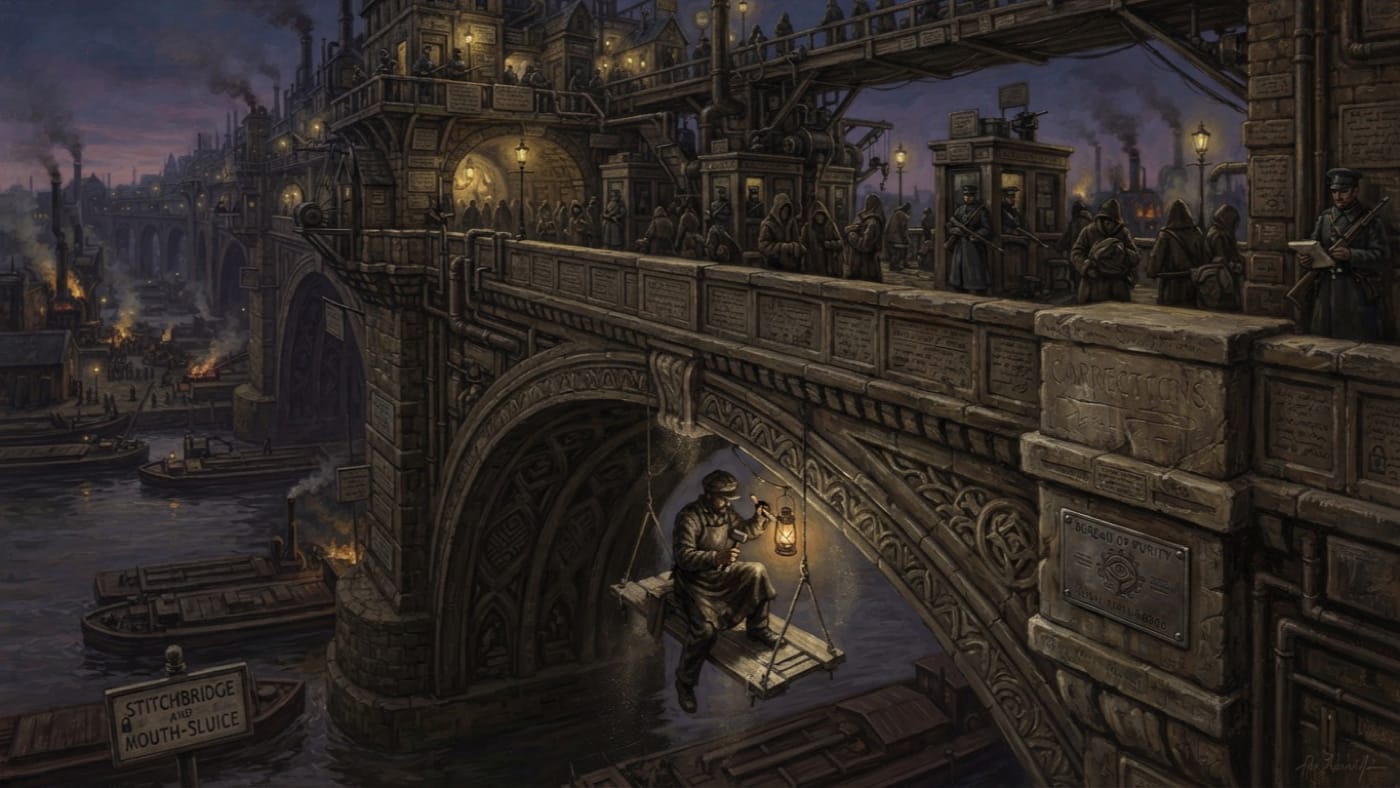
The Mortar Saints are a heresy network working inside the Archivolt Causeyworks, and in public they pass as restoration artisans. Their purpose is to place forbidden names into public stone. The Bureau's files can attest to no further doctrine, and that one purpose is enough.
In any other city this would be vandalism with a hymn attached. In the Causeyworks it is an attack on the government. Here a debt is carved into the parapet its debtor crosses each morning. A crossing permit depends on a verified name. When the Bridge-Scribe Collegium issues a "correction," a mason chisels the annotation beside the original entry, and the original stays where it was. Stone is how the Causeyworks makes a man answerable. The Saints use the same stone to make a condemned man remembered. The city built its permanence to enforce, and it has learned that permanence also preserves. The stone does not ask the clerk which purpose it is serving.
#On the Method of Preservation
The restoration artisan is the least visible man in the Causeyworks. Everyone wants the ledger-drizzle scraped off the debts so the debts can be read, and nobody inspects the man doing the scraping. He arrives with lime, a lantern, a chisel and a mallet. He climbs a bridge on which every stone is a legal instrument, and when he is done he is thanked.
The Bureau of Purity records three methods. The first is the concealed keystone: a cavity is cut inside the stone and filled, so that the walkway above shows nothing to the eye. The second is coded carving, in which condemned identities are worked into the decorative ribbing of an arch. To a pedestrian it is ornament. To someone holding the key it is testimony. The location dossier calls the third method "miracle bait" and describes it no further, so neither will I. What is known is that the Saints' activity clusters around the Saintspan, where miracles are already claimed. A heretic who wanted pilgrims to notice him could not choose a better address.
Their raw material is banned-name fragments. These move through the Undervault trade alongside forged passes and lock-route maps. The names are ones the Index Damnatus has struck from lawful record: proscribed lineages, titles and identities that the Church has ruled may no longer be spoken, copied or inherited. Keystone slivers, which are portable pieces cut from bridge cavities, circulate in the same markets. Owning one proves that a man holds contraband. It does not prove he belongs to a congregation. A struck name written on paper rots within a season. A struck name sealed inside a keystone outlasts the clerk who struck it, then his successor, then that successor's grandson.
The Saints call this "immortality-by-masonry." I record the phrase as their ambition and nothing more. Nothing in the file shows that a carved name keeps a soul, raises a body, or does anything for its owner except refuse to go away. That refusal is the offence, and it is offence enough.
#On the Lodge and the Yards
The Stone-Ledger Masons' Lodge maintains the bridges and cuts the lawful inscriptions. It holds the crews, the tools, the quarry contracts and the catwalk access. Every one of those assets would be useful to a Saint. That is why the Lodge is suspected of sheltering them, and why its masters resent the suspicion so hotly: their living depends on being trusted with a chisel.
Where the Saints stand in relation to the Lodge is unsettled. The interrogation transcripts disagree. They place the Saints inside the Lodge, beside it, beneath it, and inseparable from it. Four sets of questions produced four answers, and the Bureau of Purity's faith in any one of them rises and falls with the season's raid quota. The Warden declines to reconcile them by preference.
Local intelligence says the Saints recruit at the Stone-Ledger Yards, through what the Yards call "apprentice tests." The file does not record what those tests involve. No witness to one has been found who will sign a statement.
The published survey adds that the Saints recruit from the squeeze: people forced out of the lawful economy as crossing inspections lengthen, tolls rise and the Lock Authority's safety closures multiply. A recruiter might approach a barge hand idled by a closed lock, an apprentice whose master's contract has lapsed, or a family whose entry reads UNRESOLVED on a parapet they cannot avoid crossing. None of these groups, as a class, is a membership roll. A debtor is a debtor and an apprentice is an apprentice. A Bureau that arrests by category will fill its cells and empty its evidence.
#On the Stitchbridge
In A.S. 199 a banned name was found inside a keystone cavity of the Stitchbridge. The bridge is the city's main junction, and every barge crew and pilgrim must cross it. The name could not be seen from the walkway. It had been placed so that every foot on the span pressed down on the forbidden syllables. My survey does not name the finder. It does not give the name either, which I do not possess and would not print if I did.
A.S. 199 is the year of discovery. The file does not say when the name went into the stone. A team from the Bureau of Alchemical Standards later reported that resonance at the Stitchbridge had risen forty percent since the name's estimated date of embedding. I give the figure with the team's own qualifier attached. An estimated increase measured from an estimated starting point is respectable arithmetic resting on an unrespectable foundation. A rise across one span shows that the two things coincided. It does not show that one caused the other. Nobody has removed the name, measured a fall, and put it back, and no volunteer for that experiment is likely.
The administrative response was swift, and it has not eased. Raids increased. The Toll Chapter imposed emergency crossing inspections. Queues at the Mouth-Sluice grew longer, papers grew damper while people waited, and crossing honestly cost more for everyone who had never carved anything in their lives.
The Saints went quiet. The Bureau of Purity takes silence as a sign of preparation. I must note that an innocent mason is silent too. That is exactly why silence serves a guilty one so well.
#On the Saintspan and Its Jurisdictions
What can be observed at the Saintspan is limited and physical. Under certain arches, when names are spoken, the water level shifts, lime sweats from the inscriptions, and candles gutter in rhythmic pulses. The effects are strongest at the third rib of the Saintspan's vault. There they have been linked to healings when properly registered names are spoken and to catarrh when improperly registered ones are. I have seen the lime-sweat. At the request of the Bureau of Alchemical Standards I have also tasted it. It is real, and it is calcium.
Interpretation belongs in a different ledger. Pilgrims call the effects liturgical, though the pilgrims would kiss a drainpipe if it sweated on schedule. The Collegium says the candles are disturbed by the weather. I asked Canon-Toller Edris Vane whether the effects came from the Creator or from the Great Deceiver. He said they were architectural. The Bureau of Doctrine holds the matter at Category Three: Pending. In A.S. 194 Inspector Corris attributed the effects to mineral moisture. That explanation was withdrawn, and Corris was withdrawn along with it.
The file establishes that the Saints favour the Saintspan. It does not establish that they made the arch respond. A thief who works the busiest market has not minted the coin he steals. The Saints' presence beside an anomaly proves only that they know where to find a crowd.
Three officers divide among them what a name is in this city. Vane controls the crossing. Chief Scribe Mael Arct controls verification. Lysa Korr controls the chisel, which means the inscriptions and the corrections carved beside them. None of the three is established as a Saint, a patron or an accomplice. The Toll Chapter petitioned against an audit, and the Bureau of Records raised jurisdictional objections. On the evidence so far, both are ordinary offices guarding their seals.
After A.S. 194 the Bureau of Purity requested a full stone audit of the Saintspan seventeen times. Sixteen requests were refused on grounds of structural risk. One was refused for jurisdictional overlap with Records, whose co-seal was waiting on a review of its own review procedure. Canon-Inquisitor Silex Marrow now holds Purity's authority to unseal the keystones. The Toll Chapter petitioned against his assignment and Records objected. Purity overrode both.
Marrow brought his own chisel.
#On the Present Condition
This file takes A.S. 201, the year of my second inspection, as its present. In that year the inspections are still long, the tolls still high and the closures still frequent. The Undervaults hold more people than their ceilings were cut for. The people who depend on crossing permits pay for the Stitchbridge in hours spent at the sluice, and in names read aloud to wardens who do not look up. These are the barge crews, the market porters, and the lock labourers drawn in from the marsh-quarry villages.
What the Bureau lacks is a longer list than what it holds. It has no founder, leader, membership count, founding year, hierarchy or emblem. It has no creed beyond the purpose stated at the head of this tract. It has one discovered name it will not print and one percentage it cannot test. It has an account of the Saints' relation to the Lodge in four incompatible versions, and one arch whose ribs remain closed. Marrow also has a separate coastal audit pending at the Saffron Bastion, and the file does not say which appointment he will keep first.
The third rib of the Saintspan has not been opened. No contents have been recovered. No named Saint has been arrested on its evidence. No verdict has been entered, and no vault has fallen.
If Marrow opens the Saintspan's ribs, he will find what the Mortar Saints have put there.
The Warden's inspection report of A.S. 201 anticipated a finding that has not been made. The ribs may contain something the Saints placed there, something else, or only stone. The question returns to the status the Bureau of Doctrine has assigned it: Pending.