
#On the Fragment
"Architecture broken into portable secrets." — From my own report on the Causeyworks. I quote it because it was correct the first time.
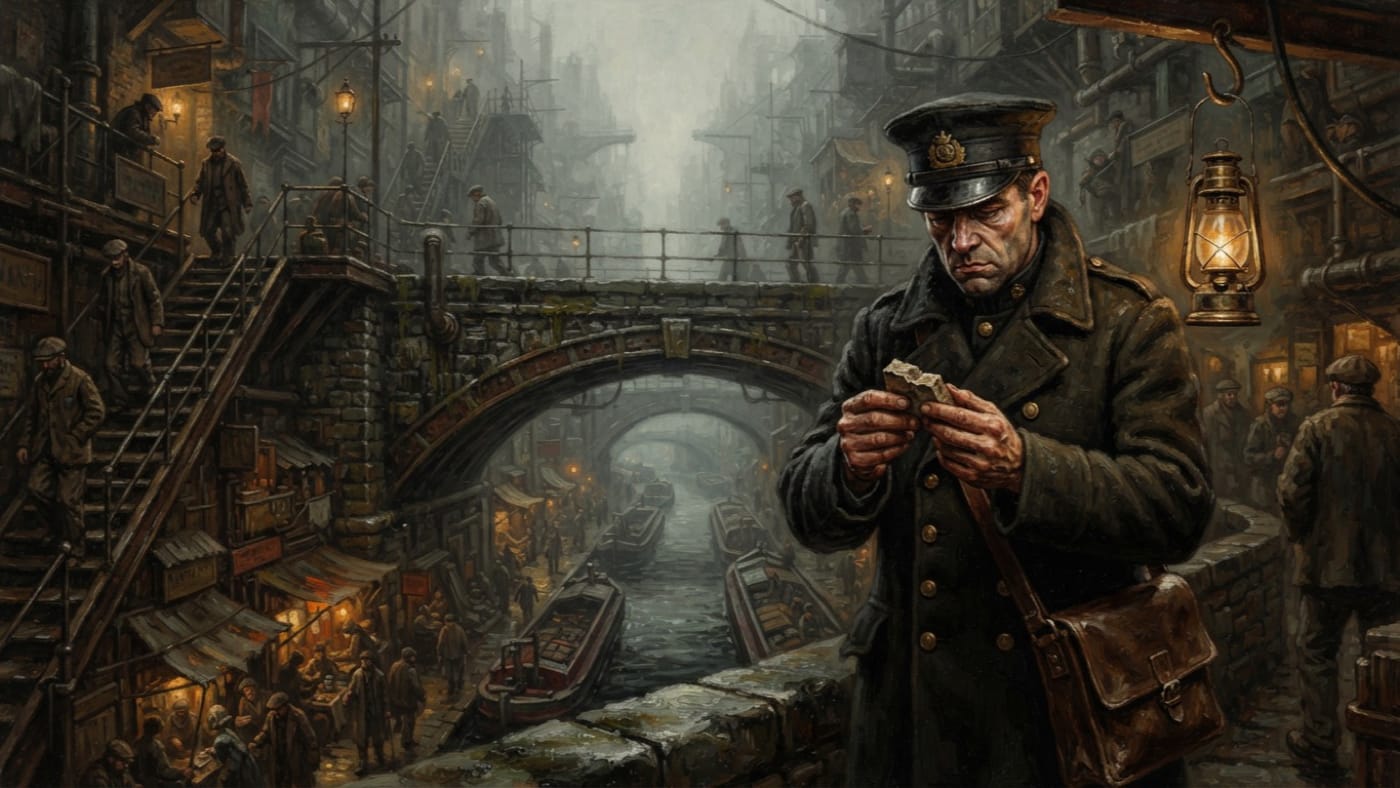
A keystone sliver is a piece of bridge that has learned to travel. The contraband inventory of the Archivolt Causeyworks defines it as a portable hiding place carved from bridge cavities, used to smuggle letters, identities and forbidden syllables. It lists the sliver among the goods sold in the Undervaults and on the swaying planks of Barge-Lip Market. It is small. It goes into a palm, a boot seam or a loaf of canal bread. The record does not measure it any further, and neither will I.
The class is defined by what it does. Its shape is not fixed. No standard pattern governs the cut, the cavity or the size. The Causeyworks is built of river-stone, bone-lime mortar, salvaged brick, rust-iron clamps, tallow-wax sealant and slate, and a sliver is made of whatever the city offered at the point where the chisel went in. What every example shares is an offence against the city's founding premise. In the Causeyworks a lawful name is fixed in public stone, where a toll warden can read it, a neighbour can read it and a provost can read it in the fog. A sliver is stone that moves, and it carries what the city wants kept still.
#On the Carved and the Concealed
The word "letters" in the municipal definition has two meanings, and the trade uses both.
In the first meaning, a letter is a message. Folded paper, wet at the edges and smelling of lamp-tallow, is stowed in the cavity of a fragment and carried where an open page would be read, confiscated or simply ruined by the ledger-drizzle. The second meaning is the older one. A letter is a carved character, and some slivers carry their message on the stone itself: syllables cut by a mason's hand and sold in the Undervaults the way relic-mongers elsewhere sell knucklebones. The city's own lore calls these name fragments, letters carved on slivers, and describes them as traded like relics. I record that comparison as a description of the market's manners. The Church has made no pronouncement on the stone's sanctity.
How the cavity is closed, how the characters are arranged and what cipher, if any, governs them are matters the record leaves blank. I have seen street diagrams of thumbnail grids and wax-stopped hollows. None of them carries a seal I recognise, and I decline to give them one.
"Identities" means names: a lineage, a registry particular, a name the Bureau of Records would prefer to have struck. It does not mean what the Barge-Lip hawkers suggest when trade is slow. Carrying a name is not the same as changing one. When a stone entry in the Causeyworks is reconciled, the correction is carved beside the original, and both remain. The black market will sell a forged pass, a lock-route map or a fragment bearing half a forbidden syllable. By the city's own account it cannot reliably sell a true uncarving. Break a sliver from a span that bears your debt, and you will own a stone with part of a sum on it. The city will still own the debt.
#On the Trade Beneath the Spans
The occupation has a name before it has a guild. The Keystone Courier, as the city calls him, smuggles small carved slivers and treats letters as contraband. No source gives him a charter, a lodge, a patron or a fixed route, and I will not invent one for the convenience of a later inquisitor. He is a function with legs.
What he carries must pass through a city designed to stop him. Canon-Toller Edris Vane holds the crossings. Chief Scribe Mael Arct holds verification, the act by which a name presented at a scribe's window is recognised or refused. Master Mason Lysa Korr holds the chisel that makes recognition permanent. Every span has a warden, and every warden asks for a registered name. At curfew the iron chains drop across the canal mouths, and the lawful city shuts like a missal. Nothing in the record shows that any of these three officers handles slivers. The sliver trade exists because of them, and that is a different charge.
Below the chains are the Undervaults. The Undervault Runners, whom the locals call Mudkeys, move people and cargo unseen by routes, bribes and silence. Their resources are tunnel maps, divers and stolen chits. They move the sliver as they move anything else that pays, and nothing in the record makes them its makers or its sole carriers. A courier needs a route, and the Mudkeys sell routes. There the documented relationship ends.
Concealment is the point of the object. On a toll span a written page is examined. In a city whose stone is constantly chipping, sweating and being repaired, a chip of masonry passes for debris. The sliver gives a forbidden text that disguise and keeps it dry.
A word for the provost who has skimmed this far. The goods in that stamp are separate offences. A sliver in a man's boot is evidence of smuggling. It does not prove that a banned name lies inside it, and the Index Damnatus is not served by pretending otherwise. Open it first, then charge him.
#On Names Kept in Stone
The Bureau of Purity takes an interest in slivers for the same reason it takes an interest in the whole city: the Mortar Saints.
Publicly they are restoration artisans. Purity describes them as a heretical network that seeds forbidden names into public stone through hidden keystones and coded carvings, so that a lineage struck from the Index is restored in a bridge and stays there for centuries. They call this immortality-by-masonry. That is what they hope for. Nobody has proved it works. Their relationship to the Stone-Ledger Masons' Lodge depends on which interrogation transcript one reads. They may be embedded in it, adjacent to it, beneath it or inseparable from it. The Lodge, for its part, supplies the city with crews, chisels, mortar and access to every span. The Bridge-Scribe Collegium decides whose name is recognised. Neither body is the contraband network, and a Purity clerk who writes otherwise will be corrected in this margin.
A name carved in a keystone stays where it was put. A name carried on a sliver can go anywhere. The record does not say which of the Mortar Saints' purposes the trade serves, if it serves any. I leave that question with the inquisitors, who are paid to ask it.
Then there is the architecture. Name-Resonance Architecture, as the Bureau of Alchemical Standards has classified it, is the documented tendency of certain arches to respond to spoken names. Water levels shift, inscriptions sweat lime, and candles gutter in a rhythm the Collegium calls atmospheric and the pilgrims call liturgical. The Saintspan is the principal site. I have tasted its lime-sweat. It tasted of calcium, iron and close attention.
Inspector Corris of the Bureau of Alchemical Standards (A.S. 194) attributed the Name-Resonance phenomenon to "mineral moisture interacting with vocal vibrations in enclosed stone environments."
Inspector Corris has been reassigned. The phenomenon stands at Category Three: Pending.
All of these responses belong to arches in place. No observation in the record shows a detached sliver speaking, healing, summoning, locating a bloodline or keeping anything of the span it was cut from. The miracle brokers of the Barge-Lip will tell you otherwise for the price of a candle stub. Their claim is a sales pitch.
#On the Present Scrutiny
The city's published account puts the turn in A.S. 199. That year a banned name was found carved inside a keystone cavity of the Stitchbridge, the primary junction through which every barge and pilgrim passes. It was invisible from the walkway, and every foot that crossed above it pressed down on the forbidden syllables. The account says nothing of a sliver at the Stitchbridge. The name was in the bridge, where heresy of that school prefers to sit. What followed concerns the sliver all the same. Raids increased. The Toll Chapter imposed emergency crossing inspections, and they have not relaxed. Crossings are slower, tolls are higher and the Lock Authority closes the gates more often. The Undervaults have swelled with those squeezed out of the legal economy. A city that searches every span pushes its secrets into whatever can be carried.
That is the condition I recorded on my second inspection in A.S. 201, and it is the condition from which this dossier is drawn.
The pressure has a name: Canon-Inquisitor Silex Marrow, assigned to the Causeyworks with authority to unseal keystones in the Saintspan Quarter. The Toll Chapter petitioned against the assignment. The Bureau of Records raised jurisdictional objections. The Bureau of Purity overrode both. Marrow brings his own chisel. The audit has not reported, and this office will not anticipate it. Whatever is or is not in the Saintspan's ribs, the record holds no recovered sliver from that work and no finding about one.
The Bureau of Doctrine has the final say on what a thing means. Pending the inquisitor's chisel, I record the keystone sliver as what the inventory says it is: a piece of the city's ledger cut loose and carried off in the dark, owned by no faction the record can prove and worth exactly what a frightened man will pay for a name the city cannot read.